Opposing University of Washington students debate affirmative action
May 9, 2019, 9:14 AM | Updated: Oct 10, 2024, 2:25 pm
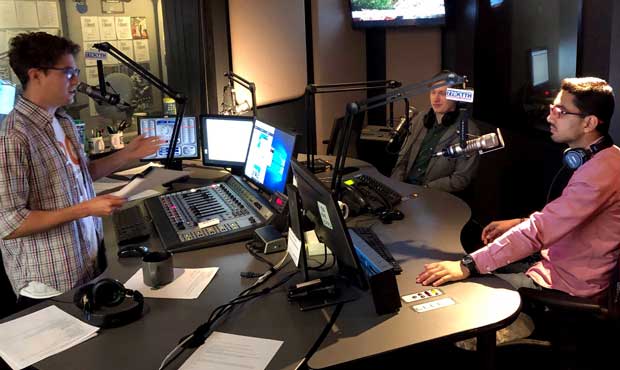
Chevy Swanson, president of the UW College Republicans, and fellow student Parsa debate the issue of affirmative action on The Saul Spady Show on KTTH. (Daron Casey, KTTH)
(Daron Casey, KTTH)

In one corner — Chevy Swanson, president of the University of Washington College Republicans. In the other corner — Parsa, a civil engineering and Urban Studies student at UW. The issue between them — affirmative action in Washington state.
The Saul Spady Show on KTTH hosted the two UW students for an on-air debate about affirmative action. A tense conversation has risen around the issue since the recent passage of I-1000, ending affirmative action in Washington.
In response, UW College Republicans hosted a bake sale on May 3, though it was really more of a demonstration. The sale featured different prices for different races and groups. The event prompted a crowd to gather, many heated exchanges, and even a call for the university to fire one professor.
RELATED: Referendum 88 would send I-1000 to voters in November
RELATED: I-1000 is an example of politicians refusing to listen
Hear the full debate between Swanson and Parsa below. It is largely focused on the educational side of the issue. The two discuss affirmative action and why it is important, or not needed.
Against affirmative action
Swanson, 21, is studying data science and information security. He, and his group of college Republicans, are against affirmative action. They argue that the system already accommodates issues of race and other factors, and that there is no need to add group identity into the mix.
“I think that we’ve seen a lot of evidence in the last 20 or so years, that we haven’t have affirmative action, that the things we have been putting in place to replace it have been far superior,” Swanson said. “We have this holistic application process that has a lot of factors … essays, a lot of different things you can say about yourself more than just your grades. And I think that tells the individual story far better. We certainly have the resources at these schools in order to go through everyone’s application, treat everyone as individuals. And I think that is going to catch the problems that arise when you have people, certain races starting at a lower spot, that’s being caught in the essays. That’s being caught in these holistic applications. But it’s not forgetting about people who might be in situations that aren’t racial.”
“You might be able to say that one person was born into a bad economic situation, into a bad neighborhood, going to a bad school because of the cycle that has to do with race … (and) because of racial issues,” he said. “But at the same time, there could also be many people who are in those areas, who started in those areas, born in those bad neighborhoods and economic situations without that. I think we should be … helping both those people. We should be looking at both their stories … and I think we should continue working on that instead of referring to group identity which I firmly believe the important parts of these group identities are caught in the applications as they stand.”
For affirmative action
Parsa, a senior, studies urban development, hosing policy, transportation, and economic development, but among that is an emphasis on diversity, interfaith and intercultural dialogue. He has helped organize Jewish-Muslim and Christian-Muslim events in the past. He favors affirmative action and I-1000.
“The idea behind affirmative action, and what it stands for in the United States, is a driver of bridging the gap that exists in educational resources for certain groups,” Parsa said. “…we do have disparities in education as a result of segregated communities, segregated housing, segregated schools. A lot of this is actually happening in the north. Schools that are predominantly Hispanic, predominantly black are being underfunded. There are systemic issues associated with this … these systemic issues are very, very interconnected.”
“People think, for example, that black people are poor therefore they live in poor communities,” he said. “But if you look at the issue of redlining and FHA policies, this is a cycle where communities that have black people are deemed less valuable. That drives down their property values, that drives down their property taxes.”
There are other metrics, too. Parsa notes percentage of callbacks for resumes with black-sounding names versus white-sounding names. There is also the lengths of prison sentences for the same crime compared between groups. These add up to steeper challenges entering schools and the workforce.
“If we look at the broader context of our society, if we have these systemic issues, then diversity in and of itself becomes a value for universities to promote and to cultivate in an effort to foster social integration,” Parsa said. “And we need to be able to look at race in order to be able to do that.”