
Oil prices climb 4% as Russian refinery attacks and Middle East tensions rattle energy markets
Jul 13, 2026, 2:00 PM | Updated: 4:09 pm

Oil prices rose 4% to start the week, climbing to around $74 a barrel as escalating conflicts in the Middle East and Ukrainian attacks on Russian refineries inject fresh uncertainty into global energy markets.
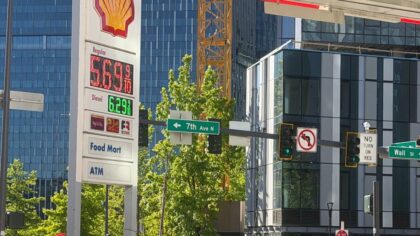
But for drivers in Washington, there’s a temporary reprieve. Gas prices remain on the decline, with the statewide average dropping about 9 cents a gallon over the past week. Seattle’s average sits at $5.20 a gallon.
That relief may not last, Patrick De Haan, head of petroleum analysis at GasBuddy, said on “Seattle’s Morning News” on KIRO Newsradio.
“A majority of states have now started to see gas prices going up,” De Haan said.
He said that could eventually hit Washington as well.
Rising oil prices emerge as Ukraine steps up attacks on Russian oil refineries
The dual pressures driving crude prices higher extend well beyond the Strait of Hormuz, which has been a flashpoint for months. Ukraine has stepped up attacks on nearly a dozen Russian oil refineries, disrupting a country that produces roughly one out of every nine barrels of diesel worldwide.
In response, Moscow has taken the rare step of blocking fuel exports to preserve domestic supply — a move with ripple effects across the globe.
“Russia tends to be an exporter of those products,” De Haan said. “But now, in very rare form, Russia has blocked the export of those products to keep the fuel that they’re producing within their own borders, and that’s having an impact globally.”
Despite the turbulence, De Haan described the market’s reaction as surprisingly restrained. Iran launched attacks on neighboring countries over the weekend, yet crude prices moved only modestly.
“You would expect a little bit more of a market response from what’s happened over the last week, and we really haven’t seen that yet,” he said. “I think that’s the market growing a little bit weary with all these developments.”
De Haan said traders appear to be holding out hope that diplomatic efforts will produce a resolution, though the shape of any agreement remains unclear.
RELATED STORIES

Strategic Petroleum Reserve hits lowest level since 1983
Meanwhile, the nation’s Strategic Petroleum Reserve continues to dwindle. The Strategic Petroleum Reserve dropped by about 5.5 million barrels last week and now sits at its lowest level since mid-1983. De Haan said the pace of releases has slowed as oil prices have fallen in recent weeks, but the reserve will remain “quite low and very uncomfortable” through the end of summer given the latest escalations.
On the political front, Washington Senate Republicans are pushing for a special legislative session to temporarily pause the state’s gas tax. De Haan said similar proposals have surfaced in other states but none on a permanent basis.
“We’ve seen states talking about pausing taxes temporarily,” he said.
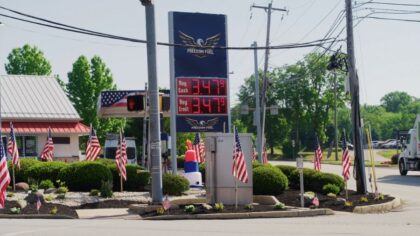
De Haan also weighed in on the emergence of so-called Freedom Fuel Network stations in Pennsylvania and New Jersey, which have drawn attention for prices well below local averages. He said GasBuddy is tracking the stations but cautioned that the pricing model may not be sustainable.
“Stations have to make a living,” De Haan said. “They have to pay their employees. They have to pay their bills.”
Manda Factor is the host of “Seattle’s Morning News” on KIRO Newsradio. Follow Manda on X and email her here.