SEATTLE NEWS ARCHIVES & FEATURES
DuPont Amtrak crash: Questions for 3 unaccountable agencies
Dec 19, 2017, 12:26 PM | Updated: 2:11 pm
(AP Photo/Elaine Thompson)
(AP Photo/Elaine Thompson)
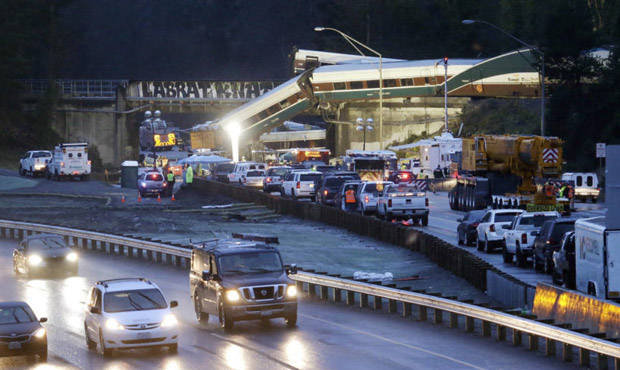
The DuPont Amtrak crash seems eerily predictable to me. No, I don’t claim to have ESP. Community groups opposed it. Local elected leaders said it would kill people in town because it lacked new safety measures. It was sadly predictable to me because it was run by three completely unaccountable and rogue agencies: Amtrak, WSDOT and Sound Transit.
None of these three organizations show any form of responsibility to the voter, and two have a history of ignoring safety concerns and warnings.
We don’t know exactly why, but all accounts — the NTSB, Amtrak, and local media — indicate the train that derailed was going 80.1 mph in a 30 mph zone. Three people were killed and their families are no doubt devastated. I can only imagine the horror felt by the engineers.
What we do know, or at least should know, is that these three agencies have cultures that make tragedies like this likely to occur. They know they are racing against new technologies that will make their fiefdoms even more obviously obsolete — software-driven cars, software-driven drones and telecommuting. What makes this even more predictable: they are in a race to capture territory so they are as big as possible and therefore have more inertia, making them harder to stop.
These agencies need to answer some questions.
Questions about the DuPont Amtrak crash
As I pointed out early yesterday, which made some people angry with me — valid criticism — Amtrak is a zero accountability agency. From silly things, like it costs Amtrak $16 to sell $9 microwaved hamburgers akin to the ones 7/11 sells for a buck. Or the more serious concerns: AMTRAK’s costs are a bloated budget; Amtrak employees spying on customers; the deadly delay to launch new safety measures. Amtrak ignored safety concerns by local officials because Amtrak is not held to account; they are just handed even more money. And now, the DuPont AMTRAK Crash.
Why was a ten minute gain in travel time to Portland important? Who did that help? Why was that worth $188 million? Did the engineer who apparently took a 30 mph turn at 80.1 mph have any practice with that train on that inaugural run on that route? Since it was the first run, did you bring a supervisor who had been involved in the testing WSDOT claims it did on the line? Since it was the first use of that train on that line carrying passengers, did the engineers receive a safety reminder they there was a new, 30 mph turn where there had previously been straight track? Why did your agency — which has never been forced to turn a profit or even be sustained by fare revenue — choose to delay the safety function of the new software? Why, since there are multiple airplane trips to Portland that are often only $39, was it important for taxpayers to build this new line?
Questions for Sound Transit
Sound Transit didn’t cause the DuPont Amtrak crash. They simply provided the rail … but: Why was this important to Sound Transit’s tax base which doesn’t extend that far South? Who in Sound Transit’s tax-base was it helping? If it was freight travel to be opened up, why did taxpayers get charged and not the railroads? How on earth was this good for people? What, if any, pay-off did Sound Transit get from Amtrak for use of that rail? What, if any, lessons did Sound Transit learn from ignoring communities who warned them of safety issues (only for them to be proven horribly right)? Why did they not heed the warning of the mayor of Lakewood or at least urge Amtrak and WSDOT to do that?
I think I know why: Sound Transit doesn’t care because they are an unaccountable agency. Sound Transit gets away with lying and breaking the law on a regular basis. They don’t need to care because no one makes them. Sound Transit blithely ignored community concerns to build what is, by any objective measure, a waste of a train line — which is now much worse: a deadly one. A total of $188 million was spent for a train line that moved 77 people on a Seattle-Portland trip that was 10 minutes shorter than the previous one — 10 minutes. A historical case in point (one of many): Sound Transit officials lied the citizens or Rainier Valley who said they didn’t want a choo-choo train cutting down the middle of the street, endangering people and dividing the community. Sound Transit lied and said they would elevate it. They didn’t and the train has hit cars with some regularity.
Questions for WSDOT
WSDOT helped facilitate this deal. That makes perfect sense once one understands that WSDOT is not in the business of moving people. They are in the opposite business: making it hard for people to move. This deal certainly did nothing to move people. This is part of the theme: the majority of people who pay the bills want roads, not choo-choos and not bike lanes and WSDOT doesn’t care. They, like their partners above, are unaccountable. They should also answer questions about the DuPont Amtrak crash.
WSDOT was presumably responsible for assuring the safety of this route, since it went over I-5 of was a transportation project. They say they tested this for safety. You will forgive me for being skeptical of an agency that pretends we cannot build our way out of congestion, which then paints their way out of congestion when federal moneys were on the line. You will also forgive my skepticism when this same agency pretends the I-405 tolls are legal, when they were supposed to have been shut-down after they didn’t meet their speed commitment. So, I am sure WSDOT did some testing: I do not believe WSDOT demanded enough training or safety measures.
In addition to many of the questions, above, I have these for WSDOT: How as this a good deal for passengers? Why did WSDOT trust two agencies with a history of ignoring safety warnings to deadly results? Why didn’t WSDOT demand more training? Did WSDOT erect, and demand erected, new warning signs on the new route?