SEATTLE NEWS ARCHIVES & FEATURES
How segregation was planned, and continues in Seattle
Apr 12, 2019, 5:26 AM | Updated: 10:12 am
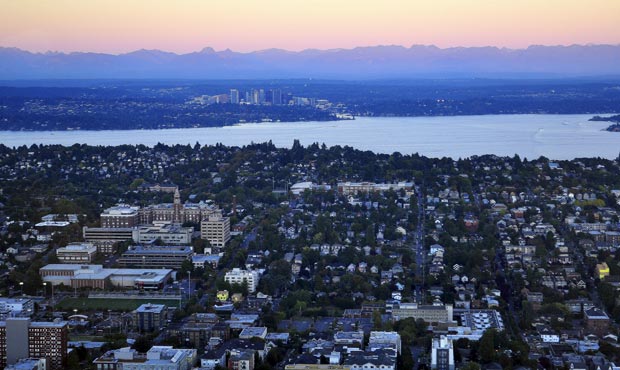
Seattle's Central District overlooking Lake Washington and the Eastside. (Joe Wolf, Flickr)
(Joe Wolf, Flickr)
Segregation is not a practice that was isolated to pre-civil rights era of America. It’s a problem that has persisted in every major metropolitan region ever since. This includes Seattle where the disparity between African Americans and white residents continues to this day. It wasn’t by accident. It was designed at the local and federal level through policy, according to Richard Rothstein.
“The consequences of this policy endure,” Rothstein told the Candy, Mike, and Todd Show on KIRO Radio. “We never remedied it, because we ignore, forget, rationalize the fact that this was a government-created policy. The residential segregation we have in every metropolitan area in this country is a civil rights violation. We never remedied it because we delude ourselves into believing the government wasn’t involved and it all happened by accident. We call it ‘de facto segregation.’”
Rothstein is a fellow at the Economic Policy Institute. He is also the author of Color of Law, a book that has been turned into the short film Segregation by Design.
RELATED: Racial covenants linger in Seattle housing deeds
Rothstein’s work points to on-the-record policies that evolved into modern segregation and privilege in American society. For example, red lining in cities like Seattle that separated racial groups. And racial covenants that were included in housing deeds that prohibited non-white families from living in certain, desirable areas.
“It’s not just the Seattle area, it’s all across the country,” Rothstein said. “The covenants were actually required by the federal government, which subsidized the creation of the suburbs all across the country, in Seattle as well as every other metropolitan area, on an exclusively white basis. The Federal Housing Administration would guarantee bank loans for builders only if they promised to never sell a home to an African American. The Federal Housing Administration even required builders to include those kinds of clauses in the deeds of every home prohibiting resale to African Americans, then rental to African Americans. That policy created the white noose around every metropolitan area as the suburbs were created.”
There has been a recent movement in Washington state to remove these racial covenants in housing deeds that still exist in local communities.
Seattle segregation by design
The consequences of such policies were enormous, Rothstein argues. White families in the ’40s and ’50s, many including veterans from the war, were able to buy new homes for fairly cheap — for about $100,000 in today’s money. The homes were slated for white-only families by federal policy. These communities were built by locals, including developments by William and Bertha Boeing.
Those same homes now sell for between $300,000 and $500,000, perhaps more depending on the area. This adds up to appreciated wealth which increased over a couple generations. It means that in that time, white families were able to better handle emergencies, send kids to college, finance retirements, and bequeath wealth to their children. The result is a modern day disparity between black and white communities that has compounded over time.
A local example can bee seen in the fact that Seattle’s schools are six times as segregated as they were in 1990. Nationwide, African American incomes are about 60 percent of white incomes. And African American wealth is only 10 percent of white wealth.
“And that enormous disparity between a 60 percent income ratio and a 10 percent wealth ratio determines so much of our inequality today,” Rothstein said. “It’s almost entirely attributable to unconstitutional federal housing policies practiced in the mid-twentieth century.”
He further argues those policies evolved into health gaps, school achievement gaps, and predicts violence seen in cities around the country and mass incarceration.
RELATED: Sugarcoating white supremacy in Western Washington
RELATED: Washington’s history of white supremacist groups
“We would not have that problem if we were not concentrating the most disadvantaged young men in single neighborhoods without access to good jobs or transportation to good jobs,” he said.
“This was not the action of rogue federal bureaucrats who were imposing their own prejudices,” Rothstein added. “This was written federal policy that the suburbs were only to be open to white families. The federal government … had manual, a published manual, which said that appraisers could not recommend for federal guarantees bank loans and developers who would sell to African Americans in white neighborhoods. The federal manual even said that appraisers couldn’t recommend for federal bank guarantees all white developments if they were located near where African Americans were living, because, in the words of the federal policy manual, ‘that would risk the infiltration by inharmonious racial groups.’ This was explicit racial policy on the part of the federal government. It began in the 1930s, it continued until 1962 … and its remnants continued until the Fair Housing Act of 1968.”
That act was not well enforced, he adds.
Rothstein said that there are solutions, but he has little faith they will be embraced. They involve providing subsidies to groups of people to allow them quick entry into wealthier communities with better education and access to better economic advantages.
Follow @http://twitter.com/Mynorthwest