SEATTLE NEWS ARCHIVES & FEATURES
Ideologically diverse ‘Seattle is Dying’ panel agrees city’s actions not working
May 25, 2019, 9:54 PM
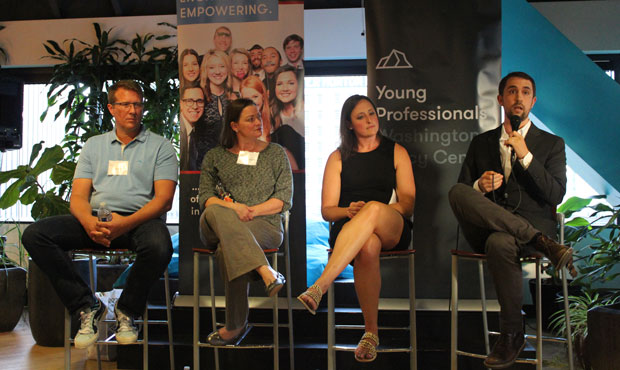
Business owner Chad Mackay, Seattle University Professor and Homeless Rights Advocacy Project Director Sara Rankin, concerned citizen Amber Matthai, and film director Chris Rufo all discussed different approaches to solving the drug and homelessness crisis. (Nicole Jennings/KIRO Radio)
(Nicole Jennings/KIRO Radio)
A Washington Policy Center Young Professionals panel discussion on KOMO 4’s “Seattle is Dying” documentary did not solve the city’s drug and homelessness crisis in one evening, but it did provide something rare in today’s politics — civil discourse between people of different ideologies.
Despite a last-minute cancellation by former venue Peddler Brewing in Ballard — after the brewery said it received a harmful amount of negative feedback from the community — the “Seattle is Dying” discussion still went off without a hitch Thursday evening at its new location, downtown tech startup SURF Incubator.
And while the panelists each brought different approaches to fixing Seattle’s problems, all four agreed on one set of points — the suffering on the streets needs to end, and city leadership has thus far failed to find viable long-term solutions.
“I work downtown, I catch the bus on Third and Pine, and so I see people who have a lot of substance abuse issues and a lot of mental health issues on my way to work,” said panelist Amber Matthai, a concerned citizen from Licton Springs. “And so it’s reached a tipping point where we need to start doing something, because … our leaders’ means to an end is not working. The problem is getting worse.”
Matthai has firsthand experience with the disease of opioid addiction — her father was a heroin addict who “lived under 405 in Renton.” On her way to her high school graduation, Matthai passed him in the street. Now he lives in an adult family home suffering substance-induced schizophrenia and dementia.
For Chad Mackay, CEO of restaurant and hotel group Fire and Vine Hospitality, the extent of the crisis set in when he found his sons, who ride their bikes to school past tents every day, playing a make-believe game called “homeless camp.”
Mackay, who along with panelist Sara Rankin helped found the Third Door Coalition to end chronic homelessness, especially wants to see a conversation in which city leadership is “not attacking business as the source of the problem.”
During last year’s head tax debate, Seattle City Councilmember Kshama Sawant referred to Amazon CEOs Jeff Bezos as “our enemy.”
“I want effective solutions and I’m tired of fighting … How do we have a conversation that’s not a ‘for’ conversation — you’re either for or against something?” he said. “Let’s have an ‘and’ conversation.”
“The only way we’re going to work through this is if we can figure out a way to stop making this as polarizing as possible,” agreed Rankin, a law professor at Seattle University and director of the university’s Homeless Rights Advocacy Project.
Doing the research
Matthai, who made a brief appearance in “Seattle is Dying,” suggested that the problem is not a lack of funding, but a lack of honesty on the part of city leaders and housing groups about what is being done with the millions spent on homelessness every year.
“Look at where the money is going, and are those organizations being held accountable?” she said. “There are certain organizations that have held onto property given to them freely by the city for the past 20 years to develop low-income housing, and they have not [developed it].”
She added that some of these properties have been hidden in shell companies.
Filmmaker and City Journal contributing editor Chris Rufo, who briefly ran for the Seattle City Council, agreed that Seattle politicians have not been truthful about the crisis, in particular in terms of its extent. He called the #SeattleForAll hashtag used by the city “straight out of a science fiction book from the Cold War.”
“Be skeptical, trust yourself, and demand that we go with a different set of different controlling ideas and principles,” he said. “If we want change, I think that’s the direction [in which] we have to go.”
Rufo said that the city’s tolerance of street camping and refusal to prosecute prolific offenders simply attracts more lawbreakers to the area from around the country. He compared it to “bucketing water out of a boat at the same time you’re punching holes out of the bottom.”
Rankin, however, cautioned against relying too much on the knee-jerk emotional reactions that come to mind when seeing tents and RVs on the side of the street.
“It takes a lot of work to become educated about what those cost-effective solutions are and to remain educated about what those cost-effective solutions are,” Rankin said. “It’s so much easier to just lean on the crutch of emotional responses or ideological responses.”
Matthai noticed a sharp uptick in crime in her neighborhood after the city put in the Licton Springs low-barrier encampment in 2017, an encampment for people who may not be eligible for other shelters. The encampment closed at the end of March.
“When I wear open-toed shoes, I need to make sure I’m not going to step on needles, because two of my neighbors stepped on needles in their own yards,” Matthai said. “That’s a problem.”
However, Matthai wanted to rely on real numbers rather than her own perceptions. A business intelligence analyst by profession, she worked with the Seattle Police Department to research the data and found that crime in a two-block radius increased over 100 percent in just a little over a year.
The reason, she guesses, was the geography of the tiny house village. Putting a low-barrier encampment on the notorious Aurora Avenue just surrounds people who may already be struggling with addiction with more drugs, sex trafficking, and other crimes, she said.
“You’re putting a very vulnerable population literally in probably one of the worst areas in the city and you’re trying to help them,” Matthai said. “Instead, what you create is a hotbed for crime.”
Potential solutions
For Rankin, long-term supportive housing is the number-one priority. Where there is housing stability, she said, sobriety will follow.
She advocates for supportive housing, which gives a homeless person a low-cost apartment with caseworkers and services on-site.
“When they get supportive housing, the services and treatment are available, and they start availing themselves of services and treatment at a much higher rate,” she said. “And then the impact of that service and treatment is far more robust and enduring because they have the stability of housing.”
Tenants pay 30 percent of their income — whether this is from a job, social security, or disability benefits — toward rent, which, Rankin said, gives them more of a stake in the game than if they were to receive an apartment for free.
Mackay said that for the cost of putting a person in jail for three months or in Harborview for three days, a homeless person can be housed in supportive housing for a year.
Rufo, however, believes that more emergency shelters will make a greater, faster impact than supportive housing. He pointed out that the supportive housing model “will take a decade or more, even under the rosiest assumptions.”
“You have to first create enough emergency shelters so that you can give people an option, you have a place to go … you could do it with a very small amount of money, private donations, philanthropic business donations,” he said.
Matthai, who said that she knew a person who died while on a wait-list for drug rehabilitation, stressed that more rehabilitation centers are needed. She suggested that the city take the funds presumably being set aside for a safe injection site and put them toward establishing more rehab facilities.
Rufo said that according to his research, two-thirds of the homeless people who are contacted by the city’s Navigation Team refuse services.
“People who need help, who want help and need help, we should be throwing every dollar, every resource, every service to them,” he said. “But people who don’t want help — people who want to live on the streets — we have to have some sort of humane, compassionate law enforcement response.”
Rankin said that it is a misconception that most of the chronically homeless — those who are homeless more often than housed, and who suffer from addiction and/or a debilitating medical condition — do not want services. They refuse services, she said, because they know they are ineligible for many places of treatment for reasons such as having a criminal history, using drugs, wanting to keep a pet with them, or wanting to stay with a partner.
“The vast majority of unsheltered, chronically homeless people do want help … they’ve sort of learned that [shelter] is not going to pan out, that it hasn’t been feasible,” she said. “So we need to make more options that would be more accessible to people so that they can learn to identify an actual meaningful offer of service.”
The ‘Seattle is Dying’ impact
As controversial as it has been, “Seattle is Dying” made a difference in the way that residents talk about their city, panelists said.
“It cut through some deeply problematic taboos that we have in Seattle,” Rufo said. “It opened up a real conversation for the first time in many years.”
The documentary, he explained, demonstrated that being upset by Seattle’s crisis is not a partisan issue. People from across the political spectrum are demanding safer streets and an end to the human suffering that can be witnessed in neighborhoods all around the city.
“The [‘Seattle is Dying’] reporter, Eric Johnson, is not a Republican,” Rufo said. “He’s just a citizen who was fed up, who wanted to make a difference, who wanted to speak the truth. He paid a personal cost for that.”
“‘Seattle is Dying’ is polarizing because you have your ideology, and when your ideology doesn’t match what you see, you have a crisis of sorts,” Matthai said. “You can believe your ideology, or you can believe what you see on the streets.”