Climate change made deadly Nepal glacier and rock collapse more likely, according to analysis
Sep 16, 2026, 5:08 PM
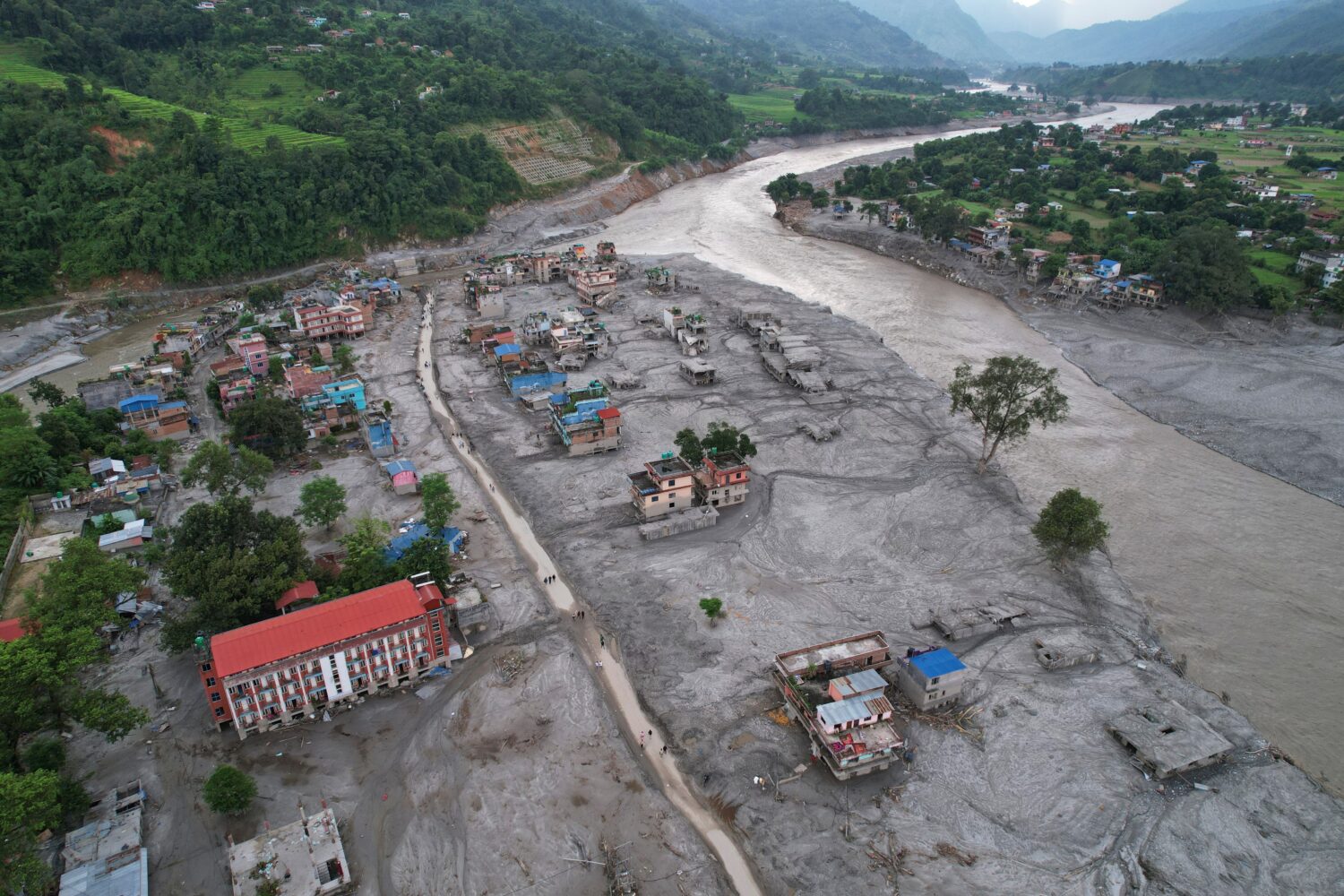
FILE - Homes are engulfed in mud in the aftermath of flash flooding along the Trishuli River in the Devighat area of Nuwakot district, Nepal, Aug. 29, 2026. (AP Photo/Rajesh Kumar Singh, File)
Credit: AP Photo/Rajesh Kumar Singh
(AP Photo/Rajesh Kumar Singh, File)

BENGALURU, India (AP) — Human-caused global warming thinned glaciers and thawed mountain permafrost, likely helping to destabilize the Himalayan slope that collapsed last month and unleashed catastrophic flooding across Nepal, according to a report released Thursday.
The report by the World Weather Attribution cautioned that climate change was not the sole cause of the Aug. 26 disaster. A large 2015 Nepal earthquake may have weakened the rock years before the collapse, their analysis found.
“This disaster was not an extreme weather event, but the fingerprints of climate change are still clear to see in long-term changes,” said Ben Clarke, a climate researcher at Imperial College London who worked on the analysis, in a press statement.
More than 1,300 people were killed and over 5,000 remain missing after a massive section of rock and overlying glacier collapsed near Nepal’s border with China. The resulting torrent of water, ice, boulders and sediment swept through communities along the Trishuli River corridor and caused billions of dollars in damage.
Climate scientists said that across the Himalayas rising temperatures are causing glaciers to retreat and thawing permanently frozen ground that helps bind fractured mountain rock together. That means climate change can alter not only weather hazards such as heat and heavy rain, but the stability of the mountains themselves — threatening communities concentrated in narrow river valleys below.
The analysis did not determine whether the collapse would have happened without climate change, caused mainly by the release of greenhouse gases when fuels like oil, gas and coal are burned. However, researchers concluded that warming intensified several processes that made the slope less stable over decades.
The report found that one of the clearest changes directly linked to climate change was the rising elevation of the freezing threshold.
The report found that warming had pushed the altitude at which ground remains consistently frozen upward by roughly 100 meters (328 feet) per decade. This exposes rock at increasingly high elevations to longer periods above freezing, thawing permafrost and causing cracks within the ice, ultimately weakening the rock face under the ice.
Jakob Steiner, a geoscientist at the University of Graz who has worked in the Himalayan region since 2006 but is not an author of Thursday’s report, said monitoring instruments around 5,000 meters (16,404 feet) now show that some rock and ground no longer remain frozen throughout the year.
“This means that the ground that was sitting below ice for hundreds and thousands of years is now becoming exposed,” said Steiner.
The report found that glacier retreat was another destabilizing force.
Glaciers in the region have been losing mass for decades at a rate equivalent to more than half a meter (about 1.6 feet) of thinning each year, the report found. The Langtang Lirung glacier, located in the region where the disaster occurred last month, has retreated about half a kilometer (0.3 miles) since the 1990s, exposing rock once covered by ice.
The Himalayan region contains the largest volume of snow and ice outside the polar regions. More than 63,000 glaciers in the area feed at least 10 major Asian river systems and support the food, water, energy and livelihood security of billions of people. However, various studies have found that around 78% of the glacier area, located between 4,500 and 6,000 meters (14,763 to 19,685 feet) above sea level, is highly exposed to warming. United Nations reports have found that between 2000 and 2019, glaciers lost 267 billion tons of ice per year, roughly equivalent to the mass of 46,500 Great Pyramids of Giza.
As glaciers shrink, they can remove pressure that helped support adjoining rock walls, while producing additional meltwater.
The weeks before the Aug. 26 collapse were also unusually warm. July and August 2026 were the warmest such months recorded locally, according to the analysis.
“Other than the potential geological factors like earthquakes that are weakening the bedrock, all these other factors are made worse by human-induced climate change,” said Friederike Otto, climate scientist at Imperial College London and one of the report’s authors.
The report said the catastrophe also demonstrates how some climate-related risks in the world’s highest mountains may exceed the protection that early warning systems and other adaptation measures can provide.
Nepal has developed disaster risk reduction plans and warning systems, but researchers said the size and speed of the collapse overwhelmed those defenses. Unlike a flood caused by rainfall, which can sometimes be forecast hours or days ahead, catastrophic slope failures in remote high mountains can occur suddenly and remain extremely difficult to predict.
Otto, the climate scientist, said that the mountain ecosystem and societies are more vulnerable to climate impacts than those living in the plains. “Small changes in temperatures affect the stability of the land itself,” she said.
Better high-altitude monitoring, earth observation and warning systems could reduce some risks, the report said. But researchers warned there are limits to adaptation in Himalayan valleys where settlements, roads, hydropower projects and other infrastructure are concentrated along rivers.
Since glaciers and permafrost respond to temperature changes over decades, some mountain destabilization caused by warming has already been set in motion, said the report.
“The most important thing to minimize the risk in this region is to rapidly stop using fossil fuels that lead to increasing global temperatures,” said Otto. “All these drivers that we’ve talked about, permafrost melting, glacial melting, etc., will just become worse. And that means that events like this become more frequent.”
___
Sibi Arasu can be followed on X at @sibi123. Reach him at sarasu@ap.org.
___
The Associated Press’ climate and environmental coverage receives financial support from multiple private foundations. AP is solely responsible for all content. Find AP’s standards for working with philanthropies, a list of supporters and funded coverage areas at AP.org.