Takeaways from AP’s investigation into how US tech companies enabled China’s digital police state
Sep 8, 2025, 9:31 PM

Petitioner Yang Guoliang, whose family has been trapped in an increasingly tight noose of surveillance for the past 16 years, rests in his bedroom at his home in Changzhou, in eastern China's Jiangsu Province, Friday, Dec. 13, 2024. (AP Photo/Ng Han Guan)
Credit: ASSOCIATED PRESS
(AP Photo/Ng Han Guan)

BEIJING (AP) — Across China, tens of thousands of people tagged as troublemakers are trapped in a digital cage, barred from leaving their province and sometimes even their homes by the world’s largest digital surveillance apparatus. Most of this technology came from companies in a country that has long claimed to support freedoms worldwide: the United States.
Over the past quarter century, American tech companies to a large degree designed and built China’s surveillance state, playing a far greater role in enabling human rights abuses than previously known, an Associated Press investigation found. They sold billions of dollars of technology to the Chinese police, government and surveillance companies, despite quash dissent, persecute religious sects and target minorities.
Most of the companies that responded said they fully complied with all laws, sanctions and U.S. export controls governing business in China, past and present. Here are key findings:
U.S. companies introduced systems that mine a vast array of information — texts, calls, payments, flights, video, DNA swabs, mail deliveries, the internet, even water and power use — to unearth individuals deemed suspicious and predict their movements. But this technology also allows Chinese police to threaten friends and family and preemptively detain people for crimes they have not even committed. The AP found a Chinese defense contractor, Huadi, worked with IBM in 2009 to design the main policing system for Beijing to censor the internet and crack down on alleged terrorists, the Falun Gong religious sect, and even villagers deemed troublesome. IBM referred to any possible relationship it may have had with Chinese government agencies as “old, stale interactions”: “ … If older systems are being abused today — and IBM has no knowledge that they are — the misuse is entirely outside of IBM’s control, was not contemplated by IBM decades ago, and in no way reflects on IBM today.” Huadi did not respond.
American surveillance technologies allowed a brutal mass detention campaign in the far west region of Xinjiang — targeting, tracking and grading virtually the entire native Uyghur population to forcibly assimilate and subdue them. IBM agents in China sold its i2 software to the Xinjiang police, China’s Ministry of State Security, and many other Chinese police units throughout the 2010s, leaked emails show. One agent, Landasoft, subsequently copied and deployed it as the basis for a predictive policing platform that tagged hundreds of thousands of people as potential terrorists. IBM said it has no record of its i2 software ever being sold to the Public Security Bureau in Xinjiang, was not aware of any interaction between Landasoft and that bureau and cut ties with Landasoft in 2014. Landasoft did not respond.
Some tech companies even specifically addressed race in their marketing. Dell and a Chinese surveillance firm promoted a “military-grade” AI-powered laptop with “all-race recognition” on its official WeChat account in 2019. And until contacted by AP in August, biotech giant Thermo Fisher Scientific’s website marketed DNA kits to the Chinese police as “designed” for the Chinese population, including “ethnic minorities like Uyghurs and Tibetans.” The Xinjiang government said that it uses surveillance technologies to prevent terrorism, and that Western countries also use such technology, calling the U.S. “a true surveillance state.”
Though the companies often claim they aren’t responsible for how their products are used, some directly pitched their tech as tools for Chinese police to control citizens, marketing materials from IBM, Dell, Cisco, and Seagate show. Their sales pitches — made both publicly and privately — cited Communist Party catchphrases on crushing protest, including “stability maintenance,” “key persons,” and “abnormal gatherings,” and named programs that stifle dissent, such as “Internet Police,” “Sharp Eyes” and the “Golden Shield.” IBM, Dell, Cisco and Seagate said they adhere to all relevant laws.
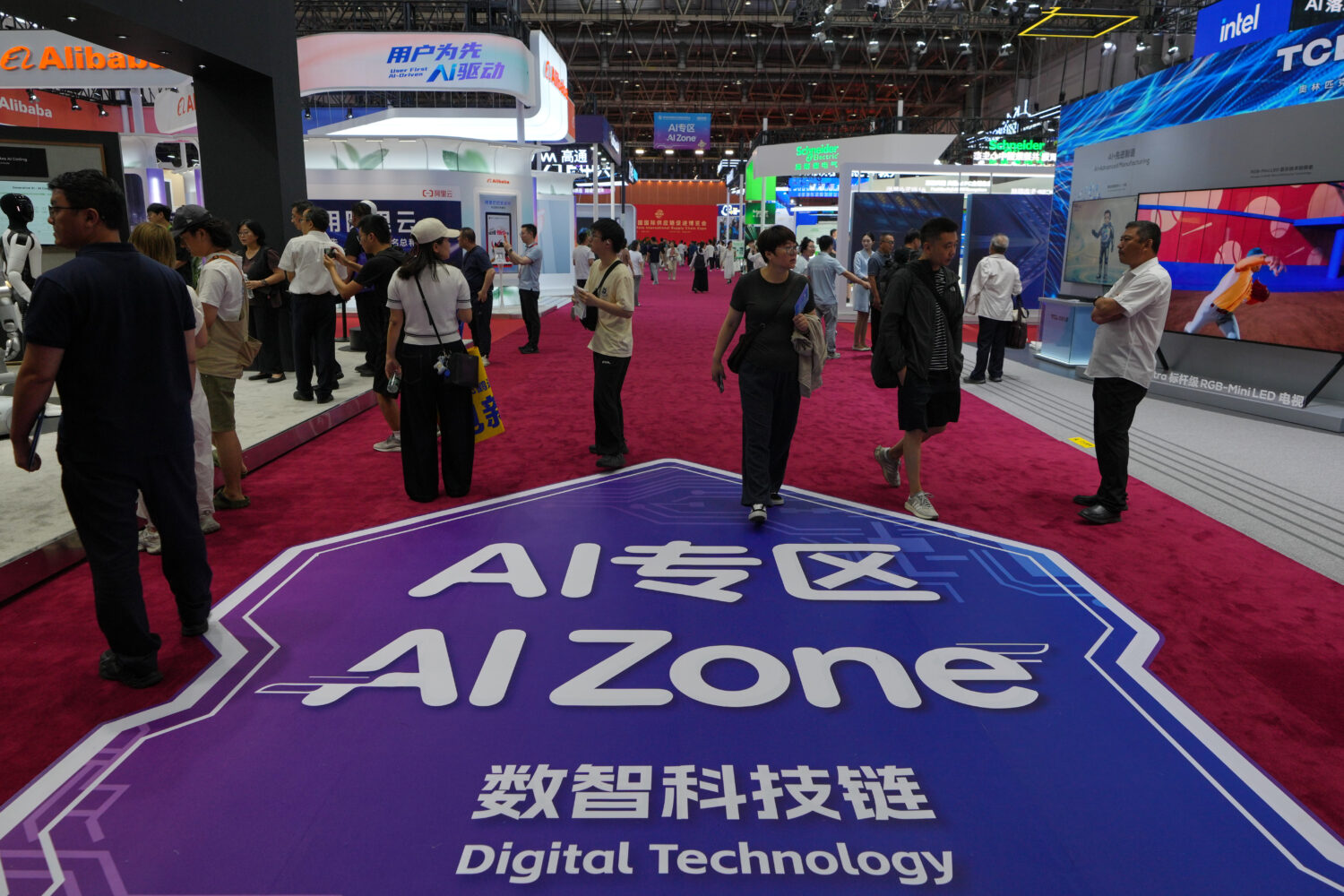
American technology laid the foundation for China’s surveillance apparatus that Chinese companies have since built on and in some cases replaced. Intel and NVIDIA helped China’s three biggest surveillance companies make their camera systems AI-powered. a deal struck this summer for NVIDIA to sell chips used in artificial intelligence to China, saying the technology would fall into the hands of the Chinese military and intelligence. NVIDIA said in 2022 that Chinese surveillance firms Watrix and GEOAI used its chips to train AI patrol drones and systems to identify people by their walk, but told the AP those relationships no longer continue. NVIDIA said it does not make surveillance systems or software, does not work with police in China and has not designed the H20 chips for police surveillance, and the White House and Department of Commerce did not respond to requests for comment.
Some U.S. companies ended contracts in China over rights concerns and after sanctions. IBM said it has prohibited sales to Tibet and Xinjiang police since 2015, and suspended business relations with defense contractor Huadi in 2019. NVIDIA and Intel also ended partnerships with China’s top two surveillance companies in 2019. However, sanctions experts noted that the laws have significant loopholes and often lag behind new developments. For example, a ban on military and policing gear to China after the 1989 Tiananmen massacre does not take into account newer technologies or general-use products that can be applied in policing. They also noted that the law around export controls is complicated.
What started in China more than a decade ago could be seen as a cautionary tale for other countries at a time when the use of surveillance technology worldwide is rising sharply, including in the United States. Emboldened by the Trump administration, U.S. tech companies are more powerful than ever, and President Donald Trump has rolled back a Biden-era executive order meant to safeguard civil rights from new surveillance technologies. As the capacity and sophistication of such technologies has grown, so has their reach. Surveillance technologies now include AI systems that help track and detain migrants in the U.S. and identify people to kill in the Israel-Hamas war. China, in the meantime, has used what it learned from the U.S. to turn itself into a surveillance superpower, selling technologies to countries like Iran and Russia.
“Because of this technology … we have no freedom at all,” said Yang Caiying, now in exile in Japan, whose family has been trapped in an increasingly tight noose of surveillance for the past 16 years. “At the moment, it’s us Chinese that are suffering the consequences, but sooner or later, Americans and others, too, will lose their freedoms.”
__
Yael Grauer is an independent investigative tech reporter. AP journalists Garance Burke in San Francisco, Larry Fenn in New York and Byron Tau in Washington contributed to this report, along with Myf Ma, an independent investigative journalist, researcher and programmer in New York covering China.
__
Contact AP’s global investigative team at Investigative@ap.org or https://www.ap.org/tips/