Seattle commission targets single-family zones for housing solutions
Dec 7, 2018, 1:16 PM | Updated: 2:52 pm
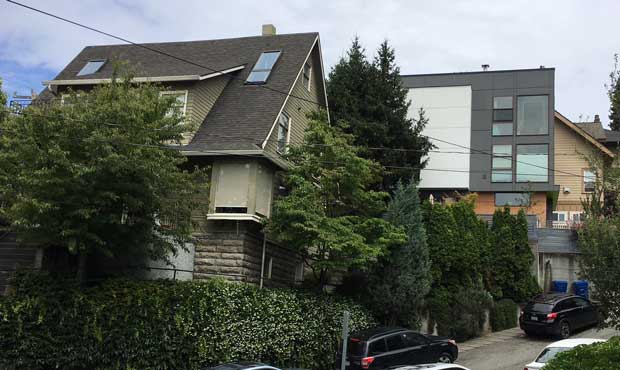
An older Craftsman house in Seattle sits next to a more modern addition to the street. (Dyer Oxley, MyNorthwest)
(Dyer Oxley, MyNorthwest)
The solution to Seattle’s modern housing woes could be found in the city itself — 100 years ago.
That’s when Seattle often built triplexes, duplexes and other buildings to accommodate more than one family, according to Tim Parham, a member of Seattle’s Planning Commission. He calls these neighborhoods — which developed around the 1920s — “streetcar suburbs” and points to Wallingford as an example. Today, much of it is considered nonconforming, but it’s a trend that needs to return. To do that, Seattle will have to overhaul its zoning, affecting nearly its entire landscape.
“This is not new, it’s just that we haven’t done it in a long time,” Parham said. “Why don’t we have more of that? It’s because we outlawed it in the ’50s, ’60s, and ’70s … The city grew that way for along time.”
RELATED: Neighborhood groups fight backyard cottages
RELATED: NIMBY, YIMBY, or just plain classism in Seattle
RELATED: How NIMBYs could harm Seattle’s tech boom
A recent report from the Seattle Planning Commission does not target any one specific neighborhood, but it does speak to Seattle’s single-family zoning, which is the majority housing in the city. As Seattle added 105,000 people since 2010, those newcomers were mostly absorbed in multi-family areas. Yet, single-family zones were largely unaffected. The commission wants to get new residents into the single-family areas, but properties will have to be dramatically changed to accomodate more people in smaller spaces. As the report states:
Allowing more housing in single-family zones, especially in high-cost areas, is critical to stemming the rapid increase of displacement in Seattle’s most vulnerable communities.
The commission is aiming its report at the city council and mayor with the hope that these neighborhoods will develop differently in the future, for more people.
Seattle housing
The commission is an advisory group for the mayor and the council. It’s a 16 member group composed of Seattle residents with expertise in land use, planning, or other related fields. Parham, for example, is an affordable housing developer.
Seattle’s single-family predicament is not entirely unexpected. Portland and Vancouver have a similar dynamic.
“It’s something that other cities in our region are facing as well, as how do we continue to grow equitably?” Parham said. “We’ve done a really good job of accommodating the rapid population growth. I think there are questions about how equitable that growth has been. We’ve seen 80 percent of our population growth in the last 10-12 years in the city’s urban villages. Nearly all the public schools and parks in our city are located in ¾ of our land area that is in single-family zoned areas.”
Therefore, while much of the population is stuffed into multi-family areas, the aspects of single-family areas are the reasons people move to a city. The planning commission’s report presents a series of incremental changes to Seattle zoning to solve this imbalance.
“We are not talking about glass towers in Magnolia or Laurelhurst,” Parham said. “We are talking about the same bulk and scale of buildings that you are seeing today that will accommodate more people in the same size housing.”
What’s happening more often in Seattle is people are tearing down old Craftsmen style houses and building large two-story buildings. Those new buildings, however, only accommodate a family of two, or three. One solution, according to the report, is to limit the allowed building size on single-family property, unless the developer is building housing for more than one family on the lot — same lot size, more families.
Addressing housing history
The planning commission’s recent report does not simply target zoning as it relates to Seattle’s housing problems. It points out a racial factor – Seattle’s single-family zoning tends to favor wealthier, white people.
Parham argues that past government policies — from the feds down to cities — have set up a type of segregated housing system.
“We feel like the changes we are proposing in our report really talk about a way to increase affordability without income restriction; smaller scale units that have different price points that might be affordable to a different variety people at different incomes but also across different races,” Parham said. “Frankly, if you look at the demographics of many of the neighborhoods we are talking about, they are predominantly higher income and they are white.”
“Those are the facts,” he said. “It’s not meant to be polarizing. We recognize this could be anxiety causing … there are other areas in the city that are more racially diverse, that has similar amounts of single-family zoning that needs to be explored.”
“One potential idea that we explore in our report is allowing people to stay in place as their property taxes triple and double over the years, and maybe they are retired and on a fixed income,” Parham said. “What if they were allowed to sell their backyard to a developer instead of having to sell their whole property and leave Seattle?”
Residents need resources from the city in order to navigate such plans, he adds. The commission hopes its report will be the first step toward those resources.
RELATED: Seattle working class is running out of solutions
Follow @http://twitter.com/Mynorthwest