SDOT unveils early research on congestion tolling in Seattle
May 23, 2019, 3:48 PM | Updated: 5:06 pm
(SDOT)
(SDOT)

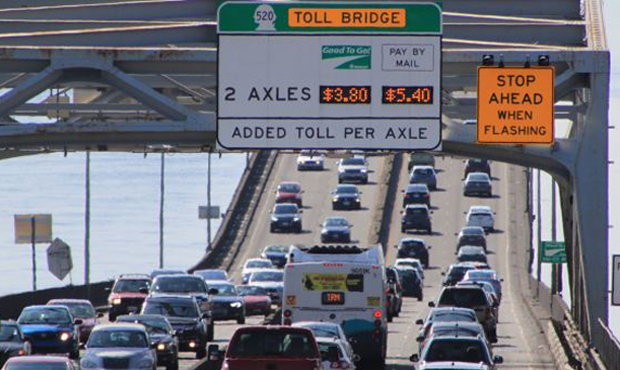
Researchers commissioned by the City of Seattle and SDOT have come back with early recommendations on what congestion tolling could look like for a city plagued by traffic.
How congestion tolling could help solve Seattle’s traffic woes
Studying successful models in Stockholm, London, and Milan, researchers found that congestion tolling in those cities reduced traffic delays by 30 percent, and greenhouse gas emissions by 14 to 20 percent.
The biggest question facing the city, though, has been where to focus its attention among the several different tolling models that exist.
“In Seattle, there are really, really important details — like who has to pay? How much do you pay? Where do you pay?” Washington State Transportation Center Director Mark Hallenbeck told MyNorthwest back in January.
Some tolling models cost a small fortune to implement, but greatly reduce congestion. Others raise money for vital public services, but do less to decrease traffic.
To get a better sense of what it’s working with, SDOT reviewed 11 different pricing tools. It ultimately narrowed that list down to four, based on criteria like equity, implementation, congestion relief, and climate health.
The study did note that it also wasn’t entirely ruling out the seven other models, and that the city may “re-evaluate the larger set of tools or prioritize others for additional study.”
The four models that it honed in on at least for this phase of research were:
- Cordon pricing: Charges vehicles for crossing a boundary into a specific zone (i.e. a tolling ring around downtown Seattle). Simple to explain and requires less infrastructure, but SDOT cited equity concerns.
- Area pricing: A subset of cordon pricing that charges drivers for traveling to, from, and within a specific zone. Requires more infrastructure, but also generates more revenue. Also creates possible equity issues.
- Fleet pricing: Targets specific types of vehicles, like taxis or rideshare services. Limits both congestion reduction and revenue generation, but is easy to implement. SDOT noted that fleet pricing could be used in tandem with cordon or area pricing as an interim step.
- Road usage charge: Charges for vehicle miles traveled on specific roads. “High potential” for congestion reduction, but the technology is not quite ready for full-scale implementation. Enforcement could also prove challenging.
The plan is still very much in the preliminary stages, with the city looking to zero in on things like “exact geography, methods, prices, discounts or exemptions, and other variables” in the near future.
SDOT labeled this the “Phase 1 Summary,” the prime focus of which was to develop a system that maximizes equity.
New York’s approval of congestion tolling not likely to sway Seattle
“We are committed to prioritizing racial and social equity, and to exploring how a pricing program might improve access to opportunities and reduce current inequities,” the study reads.
According to SDOT’s research, the system that accomplishes that goal best is one that uses variable pricing and targeted exemptions, and focuses on the needs of transit and low income communities.
Congestion tolling in Seattle is still currently in the “exploration” stage. After that, the city will define its goals and objectives, followed by convening an independent commission. Next, it will explore price options, before moving into large-scale program development. Finally, it will further narrow down its pricing options, and then enter into a lengthy approval and implementation period.
Ultimately, this study was designed to pin down “a starting point for discussions.”