Washington hospitals lacking in monoclonal antibody treatment
Sep 24, 2021, 1:30 PM | Updated: Sep 27, 2021, 7:55 am
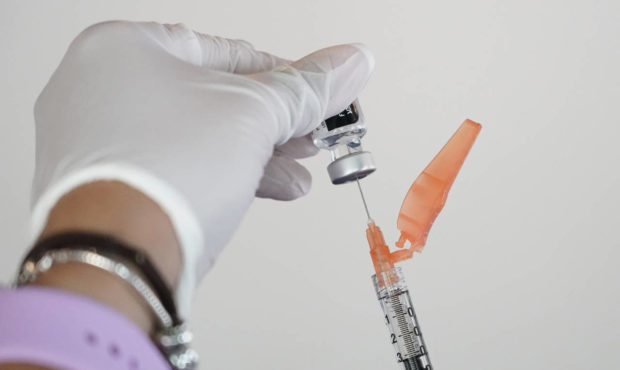
A dose of Pfizer's COVID-19 vaccine. (AP Photo/Rogelio V. Solis)
(AP Photo/Rogelio V. Solis)
Hospitals throughout Washington are desperately in need of more monoclonal antibody treatment — but at the moment, it’s in short supply.
Monoclonal antibody treatment is given to certain high-risk COVID patients through IV or injection as soon as possible after a diagnosis to prevent severe COVID symptoms. According to the U.S. Food and Drug Administration, “monoclonal antibodies are laboratory-made proteins that mimic the immune system’s ability to fight off harmful antigens such as viruses. Sotrovimab is a monoclonal antibody that is specifically directed against the spike protein of SARS-CoV-2 and is designed to block the virus’ attachment and entry into human cells.”
It can be administered at any hospital, clinic, or pharmacy as an outpatient procedure, before the point that a person would need to be hospitalized. Because everyone receiving the treatment is COVID-positive, the process needs to take place in a space that is completely separated from other vulnerable patients at the facility.
Dr. Marty Brueggemann, chief medical officer of Yakima Valley Memorial Hospital, said when given early enough after a positive test, the treatment can decrease a person’s chances of needing hospitalization by 50%.
Idaho crisis impacts Washington’s ability to care for patients
Brueggemann says this treatment is especially vital for more rural areas like his, where vaccination rates tend to be lower, masking is not as common, and COVID numbers have been especially high.
“The more you can get these into the hard-hit areas, which do tend to be the rural areas, … anything you can do to help get these treatments into those areas will help the overall picture in the state of Washington,” Brueggemann said.
Unfortunately, monoclonal antibody treatment is not easy to come by. Brueggemann said that there are only about 500 doses in the state right now, spread out among medical facilities.
“We currently have 41,” Brueggemann said. “Obviously, when hundreds of people are testing positive every day, you can go through that literally in an afternoon.”
Samaritan Hospital in Moses Lake has the same difficulty.
“We are doing, probably, on average, eight to 10 treatments a week, and we are seeing increasing demand for that,” said Theresa Sullivan, CEO at Samaritan Hospital. “If we don’t get more very soon, then, with our average, within two weeks, we’d be out.”
Sullivan said the hospital has asked the state for more, especially in the form of injection instead of infusion. An injection saves hours per patient, freeing up the precious space and staff time in overrun hospitals.
But like so many resources right now, there is a supply chain backup. Monoclonal antibody treatment is sent from the federal government to the state, which distributes it to individual hospitals.
“We’re making orders, but there’s only so much to go around, and the federal government controls the distribution of this at this point,” said Governor Jay Inslee during a press conference on Thursday.
Inslee said he and the Washington State Department of Health had also requested 1,200 federal health workers who could come to Washington to help with the hospital surge. Brueggemann is especially hopeful that Yakima Valley can get some federal workers to come in and administer the time-consuming treatment, so that the other hospital staff can work in other needed areas.
Unfortunately, federal teams are stretched thin right now. The National Guard told KIRO Radio that between COVID surges around the country, wildfires, and hurricanes, it will not be able to lend much of a hand.
Brueggemann said, ultimately, monoclonal antibody treatment is not the way out of the pandemic — that title belongs to vaccines.
“The vaccine is the gold standard,” Brueggemann said. “That is far and away the most effective way to protect you from getting ill in the first place — or, if you do still get ill, from having a bad outcome.”
Inslee agreed, adding that vaccines are also in much higher supply.
“There’s not enough monoclonal antibodies available in the United States to treat everyone who could use it, frankly, for COVID. That’s just a physical reality,” Gov. Inslee said. “But we’ve got plenty of vaccine to keep you from getting sick before you have to go to the hospital.”