Will 2025 be the year of pay-by-mile?
Dec 5, 2024, 5:59 AM | Updated: 9:15 am

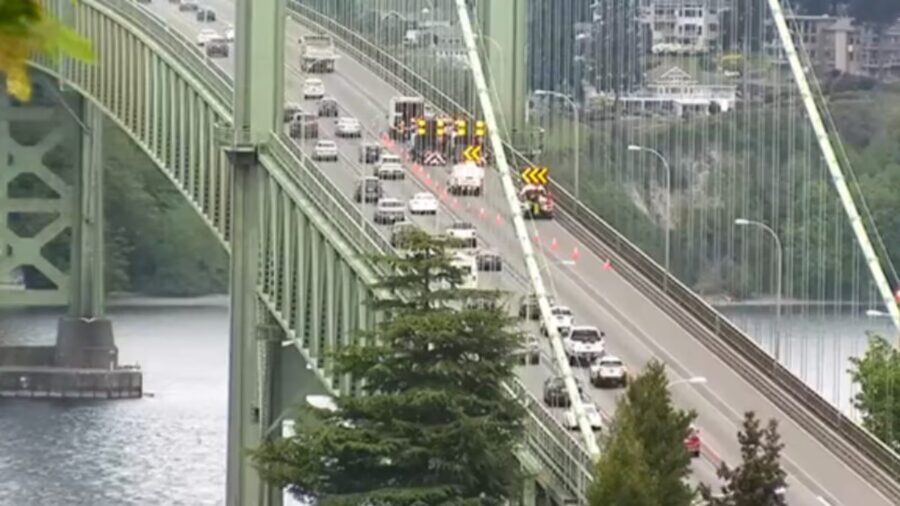
Cars driving on Sate Route 99 approaching Seattle. (Photo courtesy of WSDOT)
(Photo courtesy of WSDOT)
The state has been testing and researching a pay-by-mile system to fund road maintenance and preservation for years. Is the upcoming legislative session finally going to be the one where lawmakers take it seriously?
Twelve years. That’s how long the Washington State Transportation Commission (WSTC) has been working on the Road Usage Charge, and yet it has never had a serious discussion before lawmakers.
Lawmakers have been dragging their feet over privacy, whether it will hurt electric vehicle (EV) sales or other concerns, but one thing hasn’t changed. The gas tax, even though Washington has one of the highest in the nation, just isn’t going as far as it used to, and it really isn’t a stable or fair way to pay for the roads.
More stories on WA roads: WSDOT begins work to finish SR 520 Montlake Project
As cars become more efficient, the gas taxes don’t go as far. EVs do not pay gas taxes, so they aren’t paying for their road damage, which is extensive considering the weight of their batteries. EV owners do pay heavy fees, but those fees don’t necessarily go to the roads.
WSTC Executive Director Reema Griffith said a Road Usage Charge or a pay-by-mile system is a much more stable way to pay for roads.
“As our fleet becomes more electrified and relies less on gas, those drivers aren’t paying their fair share towards the roadways that we’re all using,” Griffith said. “Over time, that leveling of the playing field is what ensures we have that sustainable.
The state’s goal is to have a road usage charge in place for all vehicles by 2035. That’s just 10 years.
“I think that’s why it’s so critical that the legislature authorize a small-scale voluntary program, where people can just raise their hand and do it and start participating in a real program, not a test, and people then will learn it through real first-hand experience,” Griffith said. “That’s really, I think, what any change requires.”
And Griffith is hopeful this session is the one that finally put this into play.
“It appears that at least that discussion is going to happen, probably with a little more consideration than it has in the past,” she said. “We’re pretty optimistic that a good public debate is going to ensue, and hopefully something passes to get us going.”
How would a pay-by-mile system work?
Drivers would be charged $0.02.4 for every mile they drive. That should pencil out to just about what the average Washington driver pays in gas tax now. The average gas mileage in Washington is 20 miles to a gallon.
“The way it’s being looked at and has always been looked at, and the legislature has said so much in its direction to the Commission over and over, is this is a replacement to the gas tax,” Griffith said. “It’s not going to be in addition to.”
But there will be a period of time, maybe up to a decade, where the Road Usage Charge and the gas tax will be collected together. The state has bonded a bunch of construction loans to the gas tax that needs to be paid off during the transition.
More on WA roads: SR 99 traffic snarls expected between Sea-Tac/Des Moines through Summer 2025
In that transition, drivers will get credit for the gas taxes they have paid when their RUC bill comes due at the end of the year. The plan is to record your miles with a simple odometer read.
“It’s not going to track where you go,” Griffith said. “It’s not going to violate your privacy. It’s not going to be a lot of work. It’s not going to result in a huge bill.”
It will be different, though.
As the system matures, the state will figure out some of the other outstanding issues like paying road usage charges between states. Several of them, including Oregon, are already using this system on a limited basis.
Change is scary, but this system makes sense.
Chris Sullivan covers transportation for KIRO Newsradio. Check out more of Chris’ Chokepoints.
Follow @https://twitter.com/newsguysully