Why isn’t there more diversity among teachers in Washington schools?
Dec 26, 2018, 7:48 AM
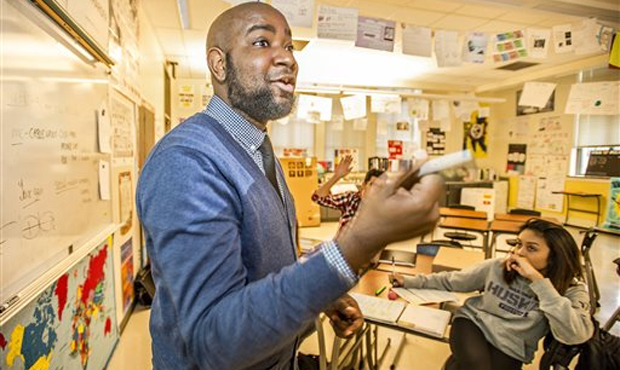
Nathan Gibbs-Bowling, a teacher at Lincoln High School, who was named Washington State Teacher of the Year speaks to students at the school in Tacoma, Wash. (David Montesino/The News Tribune via AP)
(David Montesino/The News Tribune via AP)
Last year, nearly a quarter of Washington students had zero teachers of color. Yet research finds that when a student doesn’t have a teacher that looks like him or her, the student has trouble excelling.
RELATED: Teacher of the year says it’s time to change education funding
“I frankly don’t think the tests are as big of a barrier or nearly the issue. I think there are isolated incidents where they have been the issue,” said 2016 Washington State Teacher of the Year Nate Bowling. “But I think there’s a bigger issue in schools where people of color don’t have a positive experience, and so they don’t feel comfortable returning there to be teachers.”
Bowling teaches American Government at Lincoln High School in Tacoma.
For the teacher core in Washington to be representative of the population, you would need 22,300 more non-white teachers. The biggest gap is not in the black population, but the Hispanic and Latino population where you’d need 12,000 more to reflect the demographics, reports The Seattle Times. So a student would have a better chance of seeing at least one teacher who shares culture, race or other elements with him or her.
“If you spend 13 years in the bureaucratic system where you don’t feel valued, where you feel like you are facing disproportionate discipline, and you feel like you’re going to school that’s under-resourced and understaffed … why would you want to return to that building or that community and be a part of it?” Bowling said.
For Bowling, this creates a bit of a chicken and an egg situation, in which because of the bad experiences, students of color are not necessarily going to be interested in becoming a teacher, but if more chose to, it would improve things for future students of color.
“Interrupting the cycle is one of the reasons why I’m a classroom teacher,” Bowling said. “One of the things I’m really passionate about is growing my teacher tree. In my government class, I had a student who was really good at explaining court cases. I used to say, ‘You should go into law.’ But if they can explain difficult content now, I say, ‘You should go into teaching.'”
“It’s hard to get somebody to be what they don’t see. If I’m the only black male teacher that these students have, then I have an obligation to talk to black male students about why I teach and how much I enjoy teaching.”
-
 Tune in to KIRO Newsradio weekdays at 5am for Dave Ross on Seattle's Morning News.