Bills aim to reduce rate of missing, murdered Indigenous women
Sep 21, 2020, 4:04 PM
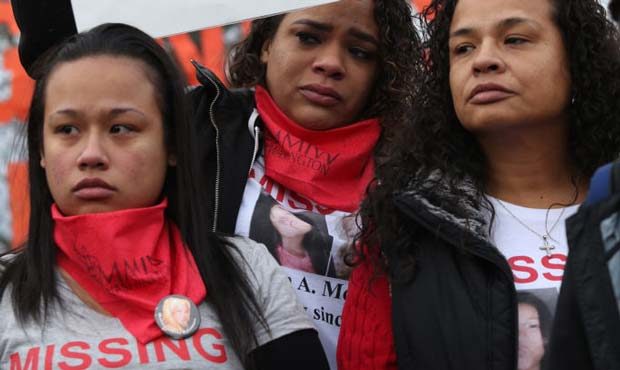
Family members of Alyssa McLemore, (L-R) Mykeal Quinanola, Tanya Raymond and Tina McLemore, join thousands at a rally at Cal Anderson Park prior to the Women's March on Jan. 20, 2018 in Seattle, Washington. (Photo by Karen Ducey/Getty Images)
(Photo by Karen Ducey/Getty Images)
In Washington and throughout the United States, Indigenous women face a disproportionate risk of going missing or being murdered, their loved ones neither seeing the cases solved nor the killers brought to justice.
A 2019 Washington State Patrol report found that while Native Americans make up 2% of the state’s population, 7% of the state’s missing women are Indigenous women.
That’s a statistic that Savanna’s Act and the Not Invisible Act — which unanimously passed the House and Senate, and are now on their way to President Trump’s desk to be signed into law — aim to lower.
Rep. Dan Newhouse (R-WA) of Sunnyside, who introduced Savanna’s Act and co-sponsored the Not Invisible Act, said communication and record-keeping between tribal, federal, state, and local law enforcement agencies will be improved by the bills.
SPD marks National Missing Children’s Day with tribute to 1979 case
Right now, he said too many tribal law enforcement agencies do not have access to the resources or databases that could provide important information in these cases.
“I was raised just across the river from the Yakama Nation Reservation in Central Washington, but I’ve got to say, I, like many others, was not aware of the disproportionate murder rate that Indigenous women suffer,” Newhouse stated to the House of Representatives last year.
A 2017 report by the Urban Indian Health Institute found that Washington state had the second-highest number of missing and murdered Indigenous women of any state since 1943 at 71, with Seattle ranking highest of any city at 45. The report noted that these numbers are likely much lower than the real statistics, as fewer records were available the further back they looked.
Washington tribes, such as the Yakama Nation and the Confederated Tribes of the Colville Reservation, are fervent supporters of the bills. Yakama Nation leaders traveled to Washington, D.C., to help get the bills passed.
“Today’s passage of Savanna’s Act and the Not Invisible Act are important steps in helping the Yakama Nation and tribes across the United States protect our loved ones,” said Athena Sanchey-Yallup, secretary of the Yakama Nation Tribal Council, and Chair of the Yakama Nation Missing and Murdered Indian Women Committee, in a statement. “The establishment of databases on missing and murdered Indian people and ensuring tribal law enforcement agencies have access to those databases will provide valuable information.”
“The statistics for the non-reporting, under-reporting and under-prosecuted cases of missing and murdered indigenous women is staggering,” said Rodney Cawston, chairman of the Colville Business Council, in a statement. “The Confederated Tribes of the Colville Reservation fully supports and thanks Congressman Newhouse for securing enactment of Savanna’s Act because it will improve law enforcement data to help prevent these horrific crimes against our daughters, mothers, grandmothers, sisters, aunties, and nieces.”
Savanna’s Act was named after Savanna LaFontaine-Greywind, a Native American woman in North Dakota who was murdered in 2017.