In King County’s opioid crisis, is kindness killing people?
Apr 25, 2025, 5:02 AM | Updated: 5:32 am

A homeless man checks on a friend who had passed out after smoking fentanyl at a homeless encampment in Seattle. (Photo: John Moore, Getty Images)
(Photo: John Moore, Getty Images)
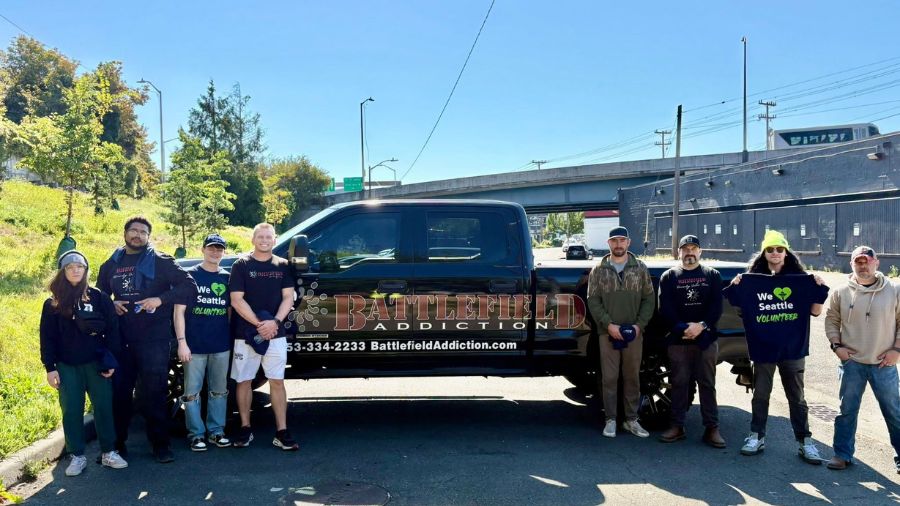
Art Dahlen isn’t one to mince words. And as the founder of Kent-based Battlefield Addiction, he’s grown tired of watching well-meaning policies inadvertently fuel a crisis he said is devastating families and claiming lives at record levels.
“It’s criminally negligent,” Dahlen told KIRO Newsradio bluntly, standing outside one of his sober-living recovery homes in Kent. “We’re losing people at an alarming rate. Fentanyl is killing people every day in ways we’ve never seen.”
It’s a strong claim, but in Washington state, the statistics back him up. According to preliminary Centers for Disease Control and Prevention (CDC) data, Washington is one of only four states to see opioid-related overdose deaths increase between May 2023 and April 2024.
Meanwhile, nationwide, those numbers are finally going down.
What’s going wrong here?
In King County, the prevailing wisdom is harm reduction. The idea: if you provide safer conditions, such as needle exchanges, fentanyl testing strips, safe consumption supplies, and wait patiently, many struggling with addiction will eventually opt into treatment voluntarily.
Supporters said this approach is compassionate, realistic, and non-judgmental. It reduces immediate harm, like infections or overdoses. But Dahlen sees something else entirely.
According to the Public Health – Seattle and King County, more than 1,000 people died of drug overdoses in 2024. It’s the second-highest death total in recorded history, only surpassed by overdose deaths in 2023. Back in 2015, only 324 people died in the county from overdoses.

Trends in overdose deaths that occurred in King County in 2015-2024. (Image courtesy of Public Health – Seattle King County)
“Letting people smoke fentanyl is the worst thing a state or city can do,” Dahlen said, frustration visible on his face. “They call it kindness, but it’s the opposite. It’s killing people, and it’s devastating families.”
He would know. Dahlen spent 17 years trapped in opioid addiction himself before becoming sober. For the past 14 years, he’s dedicated his life to helping others achieve sobriety through what he calls a “family-first, community-first” approach.
Battlefield Addiction takes a different approach to curb drug use
Battlefield Addiction is deliberately different. Dahlen and his team coach families on intervention strategies designed to disrupt drug use immediately. This isn’t about gentle encouragement; it’s about urgency and accountability.
“If someone is smoking fentanyl in one of our homes, we get it out of their hands and watch them with Narcan until they’re OK,” Dahlen explained. “Our approach starts with sobriety. Not tomorrow, not next year—today.”
It’s a stark contrast to policies championed in Seattle and King County, where supportive housing facilities often tolerate drug use inside rooms, focusing on housing stability first, with recovery second.
But Dahlen argued the drugs today, especially fentanyl and meth, are fundamentally different than the opioids of the past.
“We’re not dealing with the heroin of five or ten years ago,” he said. “The fentanyl now is killing people overnight. This is an emergency.”
Washington state’s rising overdose rates seem to back up Dahlen’s urgency. Despite record spending on harm reduction and supportive housing, the numbers are moving in the wrong direction.
Washington opioid deaths nearly doubled since 2019
As reported by the Washington State Department of Health (DOH), in the last six years, opioid drug overdose deaths in the state have nearly doubled.
“17,502 Washington residents died from a drug overdose over the past 15 years (between 2007 and 2021); 68% of those deaths involved an opioid,” DOH’s website stated. “Since 2019, the annual number of opioid drug overdose deaths has nearly doubled, from 827 deaths in 2019 to 1619 in 2021.”
So what does Dahlen recommend?
“I’d ask our politicians and lawmakers: are there behaviors we’re doing right now that perpetuate addiction?” he asked. “Are we handing out pipes, foils, making it easier for people to steal and continue their addiction? Yes. And it’s making things worse.”
Critics often dismiss abstinence-focused programs like Battlefield Addiction as too rigid or moralistic. Dahlen shakes his head at the notion.
“This isn’t about morality. It’s about saving lives,” he said. “I’ve never had anyone come back angry that we helped get them sober. People thank the cops who arrested them. People thank their families who intervened. For me, it was my father who held me accountable. He saved my life.”
Dahlen knows he’s swimming upstream politically. King County leaders and addiction experts overwhelmingly favor harm reduction, citing decades of research showing its benefits. But Dahlen insists there’s a crucial difference between harm reduction that saves lives and enabling that prolongs suffering.
“You can’t allow someone to continue smoking fentanyl and call that kindness,” he said. “It’s not harmful to ask someone to stop. It’s necessary.”
Battlefield Addiction to host fundraiser
RELATED STORIES


That’s why Battlefield Addiction is raising its voice, and some much-needed funds, with a community 5K run and fundraiser at Roegner Park in Auburn on May 10. It’s part outreach, part advocacy, aiming to shift public perception and remind people that abstinence-based recovery programs still exist, and they still work.
“We want families to understand that real recovery is possible,” Dahlen said passionately. “Even if you’ve been using fentanyl, even if things feel hopeless, you can get sober and have a productive life afterward.”
In King County, where compassion has become synonymous with harm reduction, Dahlen’s message is provocative. He argues compassion must include accountability and swift intervention, not simply a comfortable place to continue using.
“Don’t listen to the addiction,” he told families directly. “Don’t let the drugs tell you how to treat your loved one. You have to intervene, create boundaries, create urgency. It’s the only way to save their lives.”
Art Dahlen is used to being labeled a contrarian or harsh. But he brushes off those labels. After nearly three decades grappling with addiction personally and professionally, he says the truth is simpler.
“Fentanyl kills,” he said firmly. “Pretending that gently waiting (for someone to seek treatment) is a humane approach isn’t kindness. It’s neglect.”
Listen to “Seattle’s Morning News” with Charlie Harger and Manda Factor weekday mornings from 5-9 a.m. on KIRO Newsradio. Subscribe to the podcast here.