‘Grow a pair of sideburns’: Curley challenges Ferguson on $790M school tax credit as Seattle teachers threaten to strike
Aug 26, 2026, 6:55 PM | Updated: Sep 16, 2026, 11:42 am

KIRO host John Curley thinks Seattle’s teachers’ union is more interested in protecting its own power than protecting kids, and with teachers likely to vote on strike authorization Wednesday, he’s using the moment to challenge Washington Governor Bob Ferguson to do something about it.
Curley’s solution is the Federal Scholarship Tax Credit, a $1,700 dollar-for-dollar credit against a taxpayer’s federal tax bill that can be directed to any school or tutoring program.
“So then I got an idea,” Curley said on “The John Curley Show” on KIRO Newsradio. “Why doesn’t the government, and why doesn’t Ferguson allow people in the state of Washington, the federal scholarship tax credit, the FSTC? It’s a $1,700 dollar-for-dollar credit.
“It’s not a tax, and it goes right to you,” he continued. “You could take $1,700. You could give it to anybody or any school you want, private or public. You can give it to anything you want to be able to send it into for tutoring. Thirty states have already signed up for it. The states that have not primarily tend to be blue and have great, strong teachers’ unions that don’t want it.”
Curley estimated the credit could bring roughly $790 million into Washington schools.
“If you really did have the kids in mind, and they had their best interests in mind, why not let a bunch of taxpayers get the tax credit for $1,700 and direct it to whatever school they wanted to direct it to?” Curley said. “The unions are saying, ‘Absolutely not.’ They don’t want them to have even one taste of the freedom to determine where your money is going.”
He pointed a direct challenge to Ferguson, who he said has until the end of the year to decide whether Washington will participate.
“Come on, Ferguson, grow a pair of sideburns,” Curley said.
Curley says the budget crisis is self-inflicted
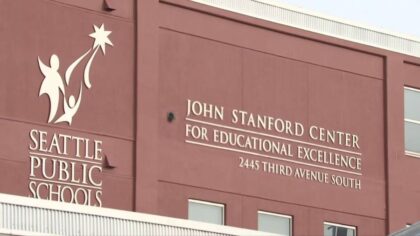
The Seattle Education Association and Seattle Public Schools are still negotiating a new contract with the school year set to begin Sept. 2 and 50 bargaining items still unresolved, according to The Seattle Times. The union is seeking wage increases and smaller class sizes while the district faces an $87 million budget shortfall.
Curley said the district created its own problem when it used COVID-19 relief money to fund a labor agreement it couldn’t sustain.
“So Seattle, when they got COVID money, so this was in 2022, teachers had a strike, and the district ended up giving a $231 million labor agreement,” Curley said. “Well, it took some of the COVID money, and then it had some other money in there, and what happened was they had all the money. They gave the teachers a bump off of the COVID dollars, but then they didn’t have additional money coming in in order to continue to fund at that level. So now they’ve got about an $87 million deficit that’s in place.”
RELATED STORIES

Curley defends teachers but questions the union’s motives
Curley acknowledged that teaching is one of the hardest jobs in the country.
“I always say to people like, when people, ‘Oh, the teachers,’ yeah, they only work 189 days, and they’re making like $60 an hour. It’s like, you go in and do that job,” Curley said. “You imagine what it would be like your first day on the job? You’re walking into a classroom, a bunch of third graders or fourth graders, or worse, eighth graders, and how they treat you, and then as a teacher, you can’t send them down to the principal’s office or the vice principal’s office. There’s no discipline. They’re screaming and yelling at you.”
But he drew a line between teachers and the unions that represent them.
“The unions want smaller class sizes because they get paid by the number of employees,” Curley said. “They want to increase the number of employees. They don’t have to worry about it. The Seattle teachers don’t need to worry about classrooms going up. They’re already losing the number of students. That’s part of their other big problem.”
KIRO producer Joe Wallace noted the job has only gotten harder with student devices and social media.
“Not just kids using devices in class, but also having this secret language where they communicate with each other and bullying each other and shaming teachers online, and there’s all these websites where they get rated,” Wallace said. “It was bad enough when kids were just mean.”
Seattle teachers have gone on strike eight times since 1976, despite it being illegal under state law, Curley noted.
Watch the full discussion in the video above.
Listen to “The John Curley Show” weekdays from 3 p.m. to 7 p.m. on KIRO Newsradio 97.3 FM.
Follow @https://twitter.com/jcurleyshow

-
 Tune in to KIRO Newsradio weekdays at 3pm for The John Curley Show.