Harger: Seattle’s own report says 27% of traffic deaths were homeless. The city’s safety plan barely touches on it
Sep 3, 2026, 6:58 AM | Updated: 12:22 pm
Recently, Seattle Mayor Katie Wilson announced a new executive order aimed at making Seattle’s streets safer for everyone who walks, bikes, drives, or takes transit.
This is part of a laudable goal by the city to reduce and maybe even eliminate traffic deaths and injuries.
We all want that. We all want needless deaths prevented.
Then a listener reached out and told me to look closer at the city’s own report. Homeless people make up about 1.2% of Seattle’s population. They make up 27% of the people killed on our streets. Do the division and a homeless person in Seattle is something like 20 times more likely than the rest of us to die on a city street.
This is a city and region that supplies the pipes, the needles, the foil, all the paraphernalia, to people in active addiction, without judgment and without pressing treatment on anyone who doesn’t ask for it, all in the name of harm reduction. This is a city and region that doesn’t insist on treatment and guardrails for people suffering debilitating mental health crises.
So if the overdose or the mania doesn’t kill them, the traffic gets its chance. Twenty times the odds.
This region runs one of the most permissive harm reduction systems in the country: needles, pipes, foil, no questions asked, no requirement to ever get sober. Treatment doesn’t get mentioned unless the addict asks. The pitch was fewer deaths. King County lost 1,339 people to overdoses in 2023, the worst year on record, more than triple the 426 lost in 2019, before this approach scaled up. By 2025, the number had fallen to 914, still more than double the 2019 number.
Radical harm reduction was supposed to be the answer. It isn’t working, at least not the way it was sold.
On page 17 of the Seattle Department of Transportation’s (SDOT) Top to Bottom Review of the Vision Zero program, in a section titled “Focusing on the most vulnerable people on our streets,” the department reported, “In 2021, 27% of people who were killed on city streets were unhoused compared with 13% of people killed between 2016 and 2021.”
Seattle doesn’t have many traffic deaths in absolute terms. The city has averaged around 30 a year over the last five years, a number small enough that one bad year or one good year shifts the percentages. Thirty people is a tragedy, and a small one in raw count next to a city of 750,000.
But that’s exactly why the 27% figure matters. When the total pool of deaths is small, who’s dying inside that pool tells you something a bigger, noisier dataset would bury. Out of roughly 30 deaths a year, more than a quarter are people who make up barely 1% of the city.
Seattle hands out the supplies, then loses the person at the crosswalk
Homelessness, addiction, and mental illness braid together on our streets. Some people out there are simply priced out and surviving; they deserve their own conversation. This critique is not about the people simply down on their luck. But a large share are in active addiction or serious psychiatric crisis, and this is the population wandering into arterials at 2 a.m.
And the harm radiates. Picture the driver on the other end. Dark arterial, middle of the night, a person steps out between parked cars, and now a stranger who did nothing wrong carries that for the rest of their life.
RELATED STORIES


The city’s press conference never mentioned the word
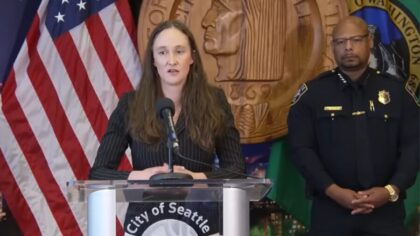
So the mayor holds a press conference on traffic safety, standing in front of Cleveland High School, and the group most likely to die on Seattle’s streets came up exactly once.
From the mayor: nothing. Not one mention.
From the whole event, one glancing reference, from Councilmember Alexis Mercedes Rinck, buried mid-list.
“The burden falls hardest on our elders, on people living with disabilities, on Black, Indigenous, and communities of color, our unhoused neighbors, and people who don’t drive cars,” Mercedes Rinck said. “Where you live and how you commute can be a factor in whether you get home alive. That is not a traffic problem; that is an equity problem.”
Equity.
The engineering in this order will help. Most of these deaths happen on the same brutal arterials the order targets, Aurora chief among them. Slower cars kill fewer people of every description. If the head-start crossing signals save lives on Aurora, some of those lives will be homeless ones, and I’ll cheer.
So yes, build the crossings. Slow the arterials. All of it.
But paint and flashing beacons are built for people who look both ways. They do very little for a man in psychosis walking the center line, or a woman so deep in fentanyl she doesn’t register the light changed. For that population, the traffic fix is upstream of traffic. It’s treatment. And that word wasn’t in the press conference.
Charlie Harger is the host of “Seattle’s Morning News” on KIRO Newsradio. You can read more of his stories and commentaries here. Follow Charlie on X and email him here.