Harger: Microsoft, Chase, United, and a router in Arkansas. Tell us the truth, even when it’s boring
Nov 17, 2026, 6:18 AM
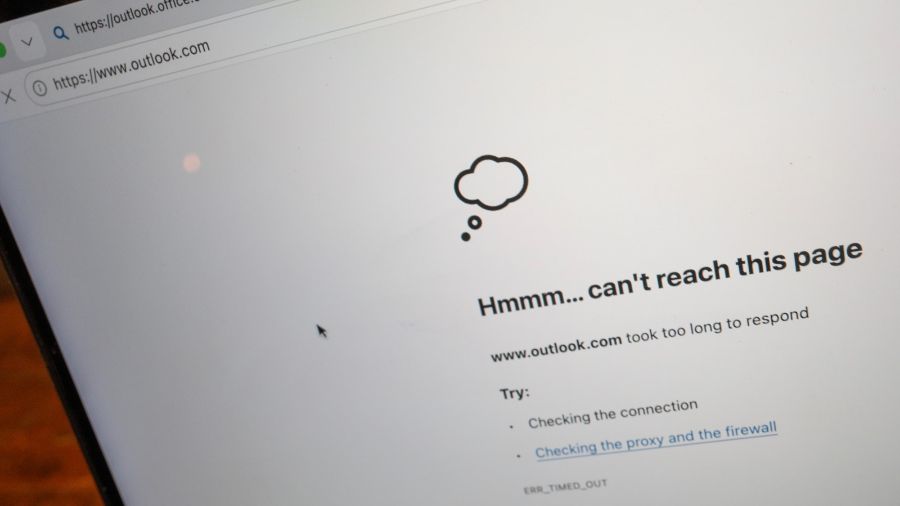
In this photo illustration, an error message is shown when trying to access Microsoft's Outlook. (Photo Illustration: Scott Olson, Getty Images)
(Photo Illustration: Scott Olson, Getty Images)
Last Friday afternoon, crews were finishing work on a new router at a radio site in El Dorado, Arkansas. A few hours later, every departing flight in the United States was grounded.
The day before, Microsoft went dark in 74 countries. Yesterday, Chase customers couldn’t log in, and the trouble spread to other big banks. United held flights because its system couldn’t tell pilots how much their planes weighed.
And overnight, we learned hackers broke into a company called Optimizely, whose code runs behind the scenes on big websites.
For hours yesterday, visitors to CNN, the BBC, Zoom, and many more were served malicious code designed to skim credit cards and target iPhones.
A router. An upgrade. A technical issue. A weight calculation. And one real, confirmed attack.
A week of outages, and a knot in the stomach
I’m not a conspiracy guy. But I’ve got a knot in my stomach this week, and I’m hearing the same from a lot of you. Normal, level-headed people are looking at all this and wondering what we’re not being told.
Nothing so far connects these events. But I understand why so many people are skeptical.
For years, companies and politicians have taught us not to take them at their word. Spin first. Facts later, maybe. So when the big moment comes, and they need us to believe them, the trust isn’t there.
This month, we’re watching what that does in real time.
United’s “no indication,” and what Microsoft got right
Listen to the wording. United says there’s “no indication” of a cyberattack. “No indication” isn’t the same as “it definitely didn’t happen.”
Compare that to Microsoft.
Its official statement opens with an apology, then says plainly: “This was a technical issue not related to cyber or AI / agents.” It explains the cause, a problem from an earlier network capacity upgrade that surfaced after a recent network change. And it makes a promise: “We will provide a full post-incident report once our review is complete.”
That’s what a straight answer sounds like. Now Microsoft has to deliver.
Sean Duffy’s FAA briefing led with the budget
Then there’s this. After Friday’s ground stop, Transportation Secretary Sean Duffy and Homeland Security Secretary Markwayne Mullin showed up more than half an hour late for a White House press conference.
Then they talked about the budget for 15 minutes before announcing the ground stop had been lifted.
Fifteen minutes.
Thousands of people were stuck in terminals. They were trying to figure out flight plans from their homes or hotel rooms. They needed one sentence: “Planes are moving again.” They got a lengthy budget request first.
Seattle has its own version. After the Bite of Seattle shooting, police had a press conference ready, and the mayor’s office paused it so the mayor could be in it. Podium first. Public second.
Every one of those moments chips away at public trust a little more.
Why the Arkansas router story sounds like a cover story
Because now, when the FAA says it was “one router in Arkansas,” plenty of people hear a cover story. When the White House says there’s “no credible threat from Iran,” people notice at least three Cabinet members have been moved onto military bases. And when Optimizely turns out to be a real attack, every hedge sounds a little shakier.
And on Sunday, 60 Minutes reported that Iran has hit at least 31 U.S. military and diplomatic sites in this war. That includes the destruction of the Navy’s Fifth Fleet headquarters in Bahrain. The Pentagon has acknowledged only some of it. The president disputes the report.
I have no evidence any of the outages were attacks, and I’m not saying they were. But trust is how a country gets through a week like this without panicking. And we’re running low.
RELATED STORIES



How to rebuild trust after a week like this
You rebuild it the boring way. The FAA puts out a full public report on the ground stop, including whether those routers were tested. A federal security official says on the record whether bad actors have been ruled out. The companies explain what happened, in plain English, the way Microsoft just did, and then follow through. And the next time something breaks, leaders lead with the facts, not the budget pitch.
Tell us the truth, even when it’s boring.
Because if one more big system falls over in the coming days, a lot of people will stop listening altogether.
Charlie Harger is the host of “Seattle’s Morning News” on KIRO Newsradio. You can read more of his stories and commentaries here. Follow Charlie on X and email him here.