‘A single router failing should not have been an Achilles’ heel for the whole system’: Calkins talks SEA holiday travel, FAA outage
Nov 24, 2026, 8:37 AM

Port of Seattle Commission President Ryan Calkins offered Thanksgiving travel advice and questioned how a single equipment failure could cause a nationwide aviation disruption.
Joining guests, fill-in hosts Tim Gaydos and Greg Tomlin, and producer Joe Wallace on “The John Curley Show” on KIRO Newsradio, Calkins discussed shorter security waits, airport improvements, and the recent FAA ground stop.
“And I wish I could tell you that I had some sort of insider information on what else went on behind there because it certainly feels like for a national outage like that, a single router failing should not have been an Achilles’ heel for the whole system,” Calkins said.
Thanksgiving crowds fall below summer peaks
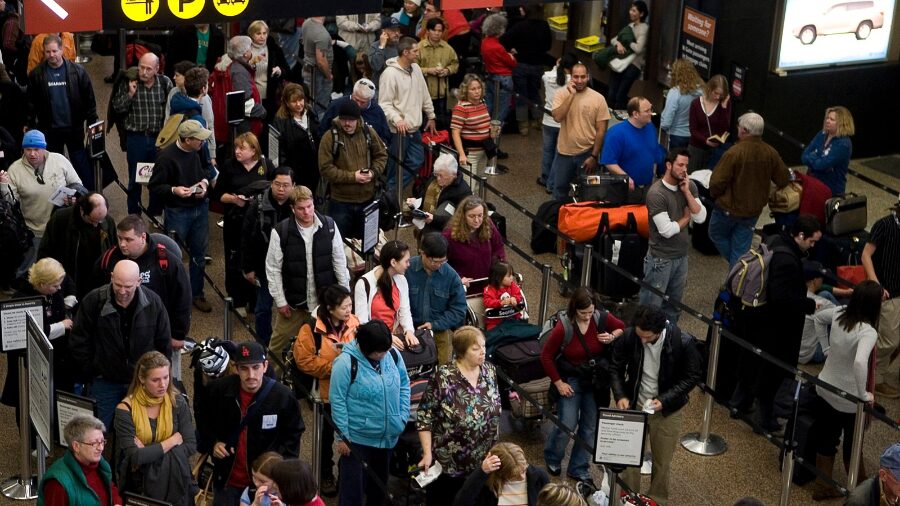
Calkins estimated SEA’s busiest Thanksgiving days would bring approximately 160,000 travelers through the airport, compared with roughly 200,000 on a busy summer day.
“So it’s not our busiest time of year anymore because the summer has become our peak season with the amount of tourism that we have in Seattle now,” Calkins said.
He recommended arriving two hours before domestic flights and three hours before international flights, explaining that he follows that advice himself despite knowing the airport well.
“Take some of the anxiety out of your travel and enjoy the amazing facility that we have at SEA,” Calkins said.
New checkpoints help shorten security lines
Gaydos highlighted a reported statistic showing 94% of passengers clearing security within 20 minutes. Calkins credited expanded checkpoint capacity and improved staffing for reducing waits.
He pointed to Checkpoint 1 on the baggage claim level at the airport’s south end and the refurbished Checkpoint 6 near Alaska Airlines ticketing at the north end.
“If you’re not having to check bags, you can go straight to security if you’ve already checked in for your flight,” Calkins said of the baggage claim-level checkpoint.
Calkins described SEA’s target as getting 95% of travelers through security within 15 minutes — a goal distinct from the statistic Gaydos cited.
Tomlin welcomed the improvement, noting his own recent experiences moving quickly through security.
“That’s quite a success story,” Tomlin said.
Parking reservations and the final days of Spot Saver
Calkins encouraged travelers to reserve airport parking ahead of time and download the Fly SEA app to compare checkpoint wait times and navigate the terminal.
“You remember you can use any of the checkpoints to get to any of the gates,” Calkins said.
He also explained that SEA Spot Saver, which lets passengers reserve a security screening time, would remain available through Thanksgiving before being discontinued. For travelers who still want to use the service, he offered a final reminder.
“We’re phasing that out because our metrics are so good on wait times; it’s not really necessary anymore,” Calkins said. “If you haven’t used it yet, use it before it goes.”
‘Think opposite’ to avoid terminal traffic
Gaydos asked about congestion on the airport’s arrivals and departures drives.
Calkins described an expanded approach to arrivals, including a lane providing direct access to the garage. He also outlined a Thanksgiving-weekend offer allowing people picking up passengers to park free for 90 minutes during designated evening hours.
“You can actually just come and wait in the garage, pick up your loved one, and we’ll give you free parking during that 90-minute window,” Calkins said.
His other recommendation was to use the less congested terminal level. Departing travelers can use arrivals in the morning and take an escalator upstairs, while evening pickups can use departures.
“And so we like to tell people to think opposite,” Calkins said.
FAA outage highlights the need for upgrades
Calkins praised airport employees and volunteer navigators for helping travelers affected by canceled flights. He reported that SEA returned to normal operations by the end of that weekend.
“I think our staff did a tremendous job helping travelers who were stranded because of canceled flights,” Calkins said.
Wallace questioned the explanation involving a router upgrade. Calkins emphasized that he had no inside information about the cause, but supported further analysis and modernization of aging infrastructure.
“That is not to say we don’t need to upgrade the system,” Calkins said. “We absolutely do.”
Regional growth requires options beyond SEA
Calkins estimated SEA would handle approximately 54 million passengers this year and could eventually accommodate around 66 million with continued improvements.
He supported additional commercial service at Paine Field and transportation alternatives for shorter trips, allowing SEA to focus on long-distance flights.
“So, you know, I’m a big fan of considering options for expanded rail,” Calkins said.
For SEA’s role in that regional system, he emphasized international and transcontinental connections.
“We want to be that large hub,” Calkins said.
RELATED STORIES


AI helps the Port process information
Tomlin asked how artificial intelligence is being used in aviation and at the Port of Seattle.
Calkins described applications including route planning, operational efficiencies around aircraft and cargo equipment, and faster analysis of information.
“So they’ve been incorporating a lot of machine learning in process management in aviation for a number of years now,” Calkins said.
He also identified a use within the Port itself.
“Within our own business intelligence office at the Port of Seattle, we are certainly using AI to essentially process data more quickly,” Calkins said.
Watch the full discussion in the video above.
Listen to The John Curley Show weekday afternoons from 3 – 7 p.m. on KIRO , 97.3 FM. Subscribe to the podcast here.
Follow @https://twitter.com/jcurleyshow

-
 Tune in to KIRO Newsradio weekdays at 3pm for The John Curley Show.