‘I almost got run over’: King County deputy’s close call is a reminder to slow down and move over
Aug 27, 2026, 5:00 AM | Updated: 4:01 pm
Most of us don’t have to worry about being run over while at work, but it’s a reality for first responders and construction workers. That’s why our Slow Down, Move Over law is so important.
If you have never stood on the side of a highway or freeway and felt your body shudder at each passing car, you really have no idea just how scary that spot can be. But that spot is the “office” for first responders and many construction workers. They feel that shudder every day, and it’s up to us to keep them safe.
King County deputy was standing feet away when a car sideswiped his patrol SUV
King County Sheriff’s Deputy Manjot Singh found himself on the side of southbound SR 167 near Kent recently. He had just pulled over a suspected drunk driver who blew by him at over 100 miles an hour. He was outside his SUV near the rear passenger door.
“All I remember is hearing what sounded like a crash,” Singh said. “It was loud. It was quick, and it was violent.”
He looked up at the car speeding away.
“He side-swiped the driver’s side of my patrol car, scraped the rear door, the driver’s side door, put a dent in it, blew a hole in my tire, left the tire flat, and then my push bars or my pit bars hit those and pushed them the opposite direction,” he said.
The car that hit his SUV hasn’t been found. For Singh, it was a near miss, but first responders and construction workers are killed every year by drivers who plow into them while they are simply doing their jobs on the side of the road.
The law is simple: Get over and slow down for any flashing lights
Washington’s law on approaching emergency zones on the road is nearly 20 years old and has undergone recent revisions, but it is really simple.
If you see flashing lights ahead, you must get over a lane, if you can safely do so, and drop your speed by 10 miles per hour. You are required to do both. And the lane shift starts 200 feet before the flashing lights and lasts 200 feet after. Your speed must not be above 50 miles per hour either.
As the Washington Driver’s Guide teaches, it doesn’t matter what kind of flashing lights they are.
Tow trucks, solid waste trucks, incident response, highway maintenance, utility vehicles, law enforcement, fire trucks, and ambulances. You must get over and slow down for all of them. Singh said you never know what you’re going to find near those flashing lights, and speed kills.
“You don’t know if there’s an emergency worker, if there’s a civilian standing at the driver’s side,” he said. “You don’t know if a police officer is outside of their car doing a field sobriety test. And it’s not just police officers, but maybe there’s a fire truck, maybe there’s a tow truck, or maybe there’s construction workers.”
All of those workers deserve to be safe at their jobs, and they all deserve to come home at the end of their shifts. Singh put it this way.
“Five minutes before I’m on the way home, and I can’t wait to go home, and I can’t wait to eat, put on the TV, and then, fast forward, it’s like, holy crap, I almost got run over on the side of the road,” he said.
RELATED STORIES
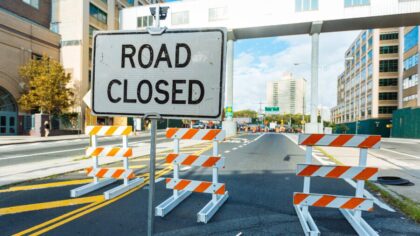
36% of drivers admit they don’t slow down or move over
A recent AAA survey showed that 36% of drivers nationwide admit to neither slowing down nor moving over in these situations. Most just do one or the other. In Washington, you are required to do both.
“How lucky I was that I wasn’t standing in the wrong place at the wrong time,” Singh said.
The only way to ensure Singh and other workers make it home every day is to be better behind the wheel ourselves.
Slow down. Move over. It’s not just a slogan. It can be a lifesaver.
Chris Sullivan is a traffic reporter for KIRO Newsradio. Read more of his stories here. Follow KIRO Newsradio traffic on X.
Follow @https://twitter.com/newsguysully