
American Dream in the way of Seattle’s homeless solution
Jun 30, 2017, 5:33 AM | Updated: 11:43 am
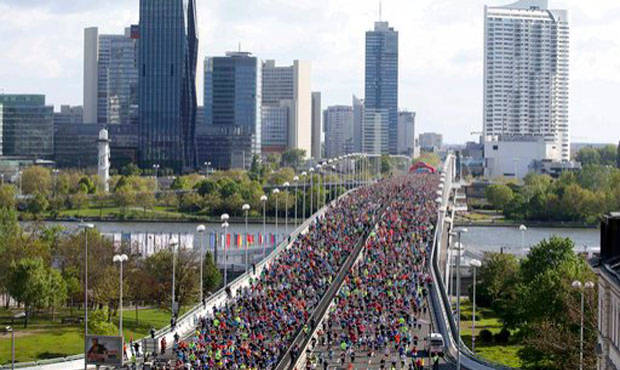
Thousands of people run in a marathon in Vienna, one of the few cities that has taken care of its homeless. (AP photo)
(AP photo)
Are there any cities where you can walk around and not see homeless people?
It turns out there is at least one: Vienna, Austria.
William Menking, curator of the Vienna Model exhibition, says there is a lot cities like Seattle could learn from them.
“Vienna, going all the way back to the 1920s just after World War I, made a decision that housing was going to be a right … so they began building housing in the 1920s,” he told KIRO Radio’s Dave Ross.
Menking says the city has continued to build housing for every sector of the population since then. There are options for seniors, families, students, Alzheimer’s patients, bicycle advocates, LGBTQ people.
Originally it was the commitment to house everyone, but there is a standard of quality architecture the call the Four Pillars. Menking explained that city will request design proposals once a property becomes available. A panel of peers will make a selection to fit the particular site and project. The winner gets to build the project.
“The design housing for the middle class, as well as for the poor, and everybody in between the poor and the very, very wealthy, who, predominantly, I suppose, live in large single-family homes or large apartments,” Menking said. “Every time they do one these competitions to find out who is the happiest cities, it’s either Copenhagen or Vienna that comes out on top of these things because people don’t worry about housing there.”
Once a resident is in unit, it’s for as long as they want. For example if a student graduates, gets married, and has children, and wants to stay, that is their choice. Menking says it creates a diverse living situation in buildings.
“They feel like overtime, communities develop in these housing units,” he said. “The reason I mention that is housing in the United States, most housing has upper limits and you’re supposed to move out.”
It create stability and residents may become invested in the community – not wanting to irritate their long-term neighbors or vandalize their potential forever home.
The system is completely foreign to Americans, Menking said, mostly because of the extremely high taxes that many Europeans pay. The American Dream of buying a home, sending the kids to college, paying off the mortgage, and moving to Palm Springs doesn’t happen in Vienna because housing isn’t a commodity there like it is in the U.S.
Not only that, but Menking says we may have intentionally began designing our public housing – based on the 1935 public housing legislation — so that it was physically inferior to hopefully motivate people to move on to the private market.
“The other thing that was a huge mistake was only having housing for the poorest members of the population. Had it been integrated with a more middle-class population, I don’t think you’d have that stigma attached to public housing that you have now.”
And in Germany, where Menking is visiting now, he said that they’re working on housing over a million refugees from the Middle East. Many are living at the airports in hangars or converted shipping containers. They get at least 450 euros/month and free health care.
“It’s a very different reality than in America,” Menking said.
Not everyone has a backyard and their own swimming pool in Berlin, but Menking says they also love their big screen TVs and you won’t see a BMW on the road older than three years. That and their housing and health care are paid for … by taxes, of course.
The idea of Menking’s show at the Vancouver Museum, “The Vienna Model: Housing for the 21st-Century City,” is to show other populations, Americans included, that there are things we could learn from. You get to see the vast variety of different types of public housing. You may see it in Seattle soon.
-
 Tune in to KIRO Newsradio weekdays at 5am for Dave Ross on Seattle's Morning News.