Is the US prepared for consequences after attack on Syria?
Apr 8, 2017, 7:21 AM
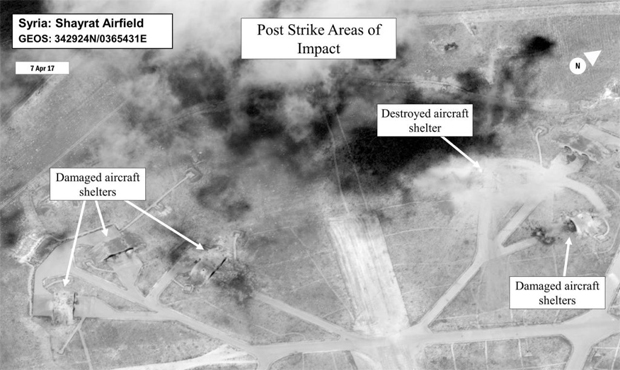
This satellite image released by the U.S. Department of Defense shows a damage assessment image of Shayrat air base in Syria, following U.S. Tomahawk Land Attack Missile strikes on Friday, April 7, 2017 from the USS Ross (DDG 71) and USS Porter (DDG 78), Arleigh Burke-class guided-missile destroyers. The United States blasted the air base with a barrage of cruise missiles on Friday, April 7, 2017 in fiery retaliation for this week's gruesome chemical weapons attack against civilians. (DigitalGlobe/U.S. Department of Defense via AP)
(DigitalGlobe/U.S. Department of Defense via AP)
Major Mike Lyons has been a CBS military analyst for 14 years. He has watched America pursue campaigns in the Middle East under George W. Bush, Obama, and now Trump.
And now he’s worried, Lyons told KIRO Radio’s Dave Ross, after the United States fired 59 tomahawk missiles at an air base in Syria. The base is suspected of recently launching a chemical weapon attack on civilians.
DAVE ROSS: People are right to be worried about Syria bombing
“I think the president is a little too trigger happy,” Lyons said of Trump’s first military action in office.
Trump was previously against increasing America’s involvement in the region. Then the deadly chemical incident made headlines with images of people and children killed by the military action.
“I’m concerned with the fact that pictures changed his mind,” Lyons said. “I mean, to make this tactical kind of strike without any change in the strategic vision of what we want Syria to look like. You hear Secretary Tillerson talking about how we want to do a regime change. That is not a good mission for us. We are 0-for-2 for regime change in the last 15 years …. I do believe we’ve gotten a little bit out over our skis.”
“A president that is impacted by pictures, to me, he hasn’t necessarily thought this through,” he said.
Lyons was also critical of President Obama over the past four years for a lack of military action in Syria. But things have changed since then, and that is something Trump has to consider, according to Lyons.
“The bottom line is, the United States should not be responding in what is the responsibility-to-protect type mission here…” Lyons said. “The United Nations has got to approve those kinds of attacks.”
“At this point, four years after what Obama failed to do, you have Russians that are aligned with Assad’s military. We could possibly kill Russian soldiers with these kinds of attacks. Now, we launch a military strike against Assad’s military. Are we prepared for the consequences of killing a Russian soldier?”
The Russian response is just one consequence of the United States becoming more involved in the Syrian conflict. There’s also Iran’s potential response to consider. Lyons details them all here.
-
 Tune in to KIRO Newsradio weekdays at 5am for Dave Ross on Seattle's Morning News.