
Lobbyist: We should let 100-story apartments in Seattle neighborhoods
Jun 19, 2015, 9:33 AM | Updated: 12:48 pm
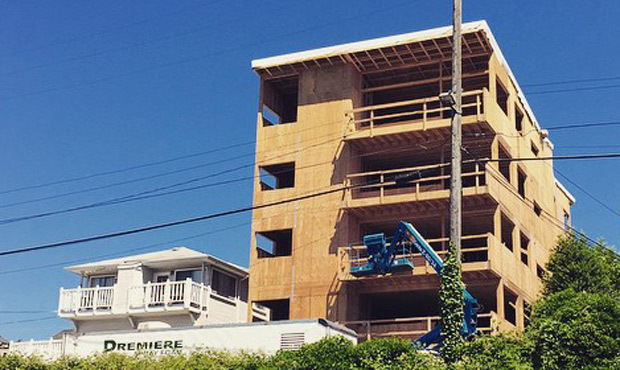
Local neighbors told the Seattle City Council at a recent hearing that new development has "ruined our neighborhoods." (KIRO Radio/Ron Upshaw)
(KIRO Radio/Ron Upshaw)
Seattle’s conversation continues over how to deal with rising rents and the cost of living, as well as the considerable landscape change — homes go down and bulky apartments go up.
It’s an emotional conversation that found its way to a Seattle council hearing Thursday.
“We are very, very fortunate to have a robust economy here in Seattle, but it shouldn’t always be about the people that are coming. What about the people that are here?” one woman told the council.
“I love my house,” another woman said, addressing the council. “I have always thought I would die in my house, and as soon as my daughter leaves school I am moving. I cannot stand what has happened to Ballard. You have ruined our neighborhoods.”
But while neighbors are expressing concern, another voice is speaking out for developers, saying that the city needs to accommodate the growth that is coming.
Roger Valdez spoke with KIRO Radio’s Dave Ross on Seattle’s Morning News Friday morning.
Valdez is director of Smart Growth Seattle, a lobbying organization funded by the Master Builders Association, the Washington National Commercial Real Estate Development Association, as well as other developers and real estate investors. Valdez said that growth can make neighborhoods better and that developers aren’t the bad guys.
“Our view is that when you get more people, more housing, and more opportunity, you get more jobs, more activity, eyes on the street, and it improves the neighborhood that we already have,” Valdez said.
“There is very little in what the neighbors are talking about that argues against that,” he said. “They are arguing against a building that ‘makes my neighborhood look fat.'”
Valdez said that he understands local “anxiety,” but further argues that somewhere out there is a family wanting to move to Seattle and “we have to make room for them.”
“That’s more important than whether a building looks too fat from the sidewalk,” he said.
And as those “fat” apartments continue go up in neighborhood, the city is considering new regulations that could impose fees for new development that would, in turn, fund more affordable housing in Seattle.
Related: Seattle may charge single-family home builders affordable housing fee
Valdez opposes the idea.
“When you impose a tax on something, you’re gonna increase the cost,” Valdez said, noting that more expensive development means more expensive living costs, which people already complain about in Seattle.
“If you take that money and try to spend it on affordable housing, you still have to buy the land, build the building, and you still have to operate it, so nonprofit housing is much more expensive than market-rate housing,” he said.
The lobbyist further said that a single-family home in Seattle is just inefficient and that homeowners are taking up land that could be used for more people — using a 5,000-square-foot lot with a single-family home as an example.
“I’m not advocating for no regulation,” Valdez said. “Health and safety, we should keep that stuff.”
“But if you can get a loan from the bank to build an 80- or 100-story tower for housing and there is enough demand for it, we should let that happen,” he said. “Our problem is that … we have this guy with a “New York Times” rolled up under his sleeve, and a latte, walking his dog, listening to NPR who feels like, ‘Well, it’s the rich guy’s problem. And somehow were are going to have to get him to take care of it.'”
Valdez endeavors to change that latte-drinking, dog-walker’s mind.
“We need to start updating our ideology and say, ‘Ya know, really, building more housing is a progressive, liberal, generous thing to do and if we make sacrifices for it. It is for the common good,'” he said. “It isn’t really about increasing profit for developers, it’s about lowering rents for the people that live here.”
-
 Tune in to KIRO Newsradio weekdays at 5am for Dave Ross on Seattle's Morning News.