All Over The Map: The disappearance of a piece of Columbia River history
Dec 13, 2019, 7:59 AM
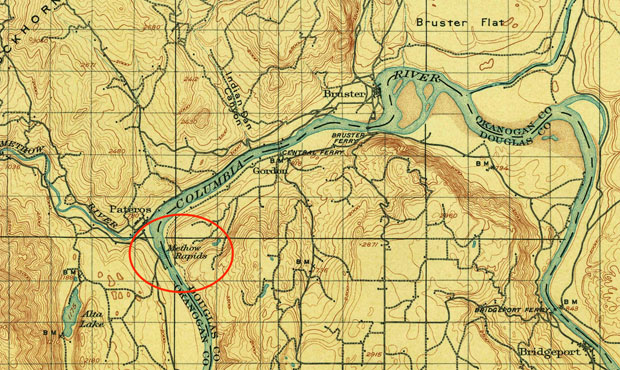

On the Columbia River not far from Lake Chelan, there was once a natural feature and navigation hazard known as the Methow Rapids.
The rapids were not far from the riverside community of Pateros, which was originally called “Ives” or “Ives Landing” for Lee Ives, who built a hotel and steamboat landing there in 1886.
A later resident who was a Spanish-American War veteran who had fought in the Philippines renamed Ives for a town near Manila, once made famous by its ducks and duck farms. It’s believed by many that in Tagalog, Pateros may translate as “duck farmer.”
Much like The Dalles, the Cascades and Celilo Falls – other long-gone natural navigation hazards on the Columbia – the Methow Rapids made it tough but not impossible for canoes and steamboats to move up and down the river back in the 19th century and early 20th century, before highways and bridges came along.
In July 1811, Northwest Company explorer David Thompson and his companions paddled their canoes past the mouth of the Methow and the Natives who lived there — both of which he called “Smeethowe” – and made it safely down the Methow Rapids. This is thought to be the first time that non-Natives had done so.
This was not too far from where John Jacob Astor’s rival Pacific Fur Company, who had recently founded Astoria, established Fort Okanogan later that same year, near what’s now the town of Brewster.
For most of the 19th century, the Methow Rapids were just a fact of life that anyone traveling that part of the Columbia simply had to deal with.
In 1881, the U.S. Army Corps of Engineers undertook an extensive survey of the Upper Columbia to determine the feasibility of steamboat travel. The report said this about the Methow Rapids:
The Methow River is a stream of considerable size, being fordable only at the lower stages of water. It shows evidence that during high water it becomes a terrible torrent—deep, wide, and swift. The country in its vicinity is strewn with great bowlders [sic], which extend into the Columbia River, being the principal cause of the Methow Rapids, which here form an impediment to the navigation of the Columbia. These rapids are not bad enough to prevent steamers from going up or down, at any rate during low and medium stages of water, although the water is very swift. It is highly probable that during high water steamers might not be able to ascend without the use of a line.
The phrase “use of a line” meant that steamboats, in addition to firing up their boilers to try and power their way up the rapids, would attach a line to big cast iron “u-bolts” set into the rocks by the U.S. Army Corps of Engineers. The crew would then use a capstan, which is a kind of powered winch mounted to the deck, to pull the steamboat up the river and through the rapids.
In 1907, the Seattle office of the U.S. Army Corps of Engineers, led by Hiram Chittenden, namesake of the Ballard Locks, led a team to the Upper Columbia. They used dynamite to blast away some portion of those “great bowlders” to make passage through the Methow Rapids easier.
The steamboat era on that part of the Columbia – which meant service between Wenatchee downriver and the community of Bridgeport upriver – lasted from the 1880s until about 1928, when the Brewster Bridge was built across the river and the era of highway travel began in earnest.
Those dynamited remnants of the Methow Rapids ultimately went away completely – inundated with water – back in the mid 1960s, when the nearby Wells Dam was built by Douglas County PUD. Lake Pateros was created as reservoir in the Columbia upriver from the dam.
Along the river in the Methow Rapids Natural Area Preserve, other examples of “great bowlders” left by melting glaciers 12,000 years ago are still visible.
In Pateros in the public park by the river, an outdoor display includes one of the old u-bolt rock sections. The stone was cut from the riverbank before the Methow Rapids disappeared completely under the waters of the now tamed Columbia.
While dams have been a mixed blessing for the overall health of the Columbia, the huge chunk of granite with its oxidized metal ornament is a fitting monument to the struggles more than a century ago to make travel and commerce more feasible in that part of Washington.