WA went from No. 29 to No. 4 in drug overdose deaths. One expert says that explains the homeless crisis.
Jul 19, 2026, 7:55 AM | Updated: 8:06 am
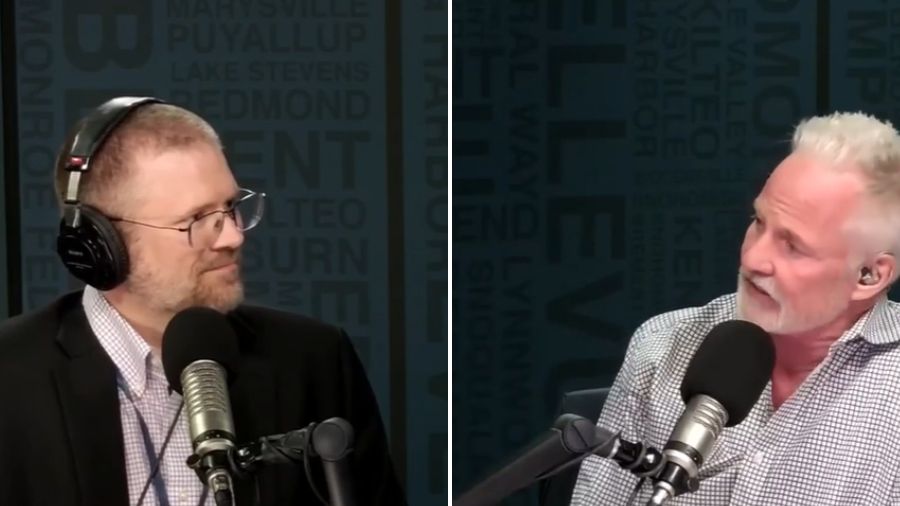
A side-by-side photo of Eric Zimmerman of the Washington Policy Center, and John Curley. (Photo courtesy of KIRO Newsradio)
(Photo courtesy of KIRO Newsradio)

As Seattle continues to struggle through a homeless epidemic, the problem in Washington has grown to dire levels as the state ranks No. 2 in the country for its total population of people experiencing homelessness.
Eric Zimmerman, the head of Washington Policy Center’s research and analysis team and Mayor of Normandy Park, joined “The John Curley Show” on KIRO Newsradio to provide the basic facts and statistics that outline why there is a homeless problem, rather than pointing to rent, income, and affordability.
“I’ve heard those things almost as much as I’ve heard someone say hello to me in Washington,” Zimmerman said. “It’s the prevailing narrative. It’s important to care about facts and evidence, and one thing I’ve seen in Washington is that the storytelling around homelessness has, over time, gotten further and further away from what we can objectively observe in gold-standard federal data.
“We could talk about income, rent, and drugs, but whatever the narrative and explanation may be that’s popular in politics in Washington, you can go to quite a few important, annually gathered federal sources that directly contradict that narrative,” Zimmerman continued. “Especially when you’re doing a 50-state comparison. The story just does not hold water.”
Zimmerman says WA’s spike defies the national trend
Zimmerman pointed to national data showing Washington as a severe outlier in the homelessness crisis.
“If it weren’t for Washington and California, the increase in homelessness nationally would have actually been fairly small over the last decade,” Zimmerman said. “If you look at the worst period of growth, 2020 onward was just a complete catastrophe in Washington. It’s unprecedented how much it grew, but that was a point in which the growth of rent in Washington was growing more slowly than the national average.
“This is difficult to reconcile,” Zimmerman continued. “How are we growing more slowly in our rental costs than the national average, at the time in which our homelessness crisis was unprecedentedly accelerating in a way we’d never seen before?”
RELATED STORIES


Zimmerman notes one factor changed more than any other: drugs
Zimmerman argued that drug use, not rent, offers the clearest explanation for the crisis.
“The thing we’re looking for is to see a big change that matches a big change,” Zimmerman said. “If you look at Washington and what’s happened with drug overdose deaths and other metrics for drug use, we have had the biggest change that I think exists in the epidemiological record of drug use in America. In 2014, we were 29th in the country, according to the CDC, for drug overdose deaths per capita.
“Then, fast forward to 2024, we were fourth, and this is against an index of 50 states,” Zimmerman continued. “Everybody was experiencing fentanyl being bad, methamphetamine, and COVID, but Washington was uniquely changed more than anyone else in the country. We had the most growth of drug overdose deaths, almost triple the level of 2014 by 2024. It’s almost impossible to explain the difference by saying, ‘Oh, it’s rent.’ No, it’s a policy choice.”
Watch the full discussion in the video above.
Listen to John Curley weekday afternoons from 3 – 7 p.m. on KIRO Newsradio, 97.3 FM. Subscribe to the podcast here.
Follow @https://twitter.com/jcurleyshow

-
 Tune in to KIRO Newsradio weekdays at 3pm for The John Curley Show.