Harger: Copper wire theft is crippling Sound Transit. Olympia had a fix, but they didn’t vote on it
Feb 25, 2026, 11:58 AM

A metal scavenger picks up discarded copper wire. (Photo: Spencer Platt, Getty Images)
(Photo: Spencer Platt, Getty Images)
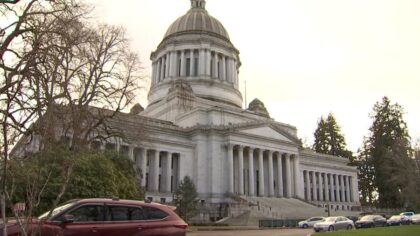
Sound Transit’s board meets this Thursday. One of the items they are to discuss is copper wire theft, according to KOMO News. It’s the right conversation to be having. It’s just a shame Olympia couldn’t find a few minutes to have it first.
The legislation that could have helped died last week without ever getting a vote. The bill would have required metal recyclers to photograph wire purchases, upload records to a searchable statewide database, and hold materials long enough for law enforcement to investigate. Simple stuff. Modeled on rules pawn shops already follow.
It didn’t matter. The Senate ran out of time, or interest, or both.
“I unfortunately have bad news,” Gary Ernsdorff, a senior deputy prosecuting attorney with the King County Prosecuting Attorney’s Office, wrote in an email to KIRO Newsradio after the bill died. “[It] faced a deadline on Wednesday to pass the Senate. And it never got a vote. I heard varying reports that the Senate was too busy on tax issues and was otherwise distracted. But it is very disappointing that they couldn’t find a couple of minutes to finish this important business.”
Ernsdorff was being diplomatic. But the frustration in that email is hard to miss. Legislation that could have helped protect a multi-billion dollar transit system, keep neighborhoods’ lights on, and safeguard 911 infrastructure didn’t get a vote.
RELATED STORIES


Sound Transit has been hit three times in the past month
The timing stings. Sound Transit’s new Federal Way light rail extension has been hit by copper wire thieves at least three times since it opened in December. The most recent theft, on Feb. 20, shut down service for six hours between the Angle Lake and Federal Way downtown stations. Before that, thieves struck on Feb. 11, the same morning as the Seahawks Super Bowl parade, when the system set a single-day ridership record.
Sound Transit said in a statement that “some recent incidents have been extremely brazen, including tampering with wires while trains are in service.”
This isn’t just a Sound Transit problem. Lumen alone reported more than 350 incidents of copper wire theft in Washington last year. The West Seattle Bridge lost its streetlights for weeks. At least 30 incidents hit state freeways in early 2025. Thieves have been targeting communication lines that carry 911 service, internet, and medical device monitoring. Cut the wire, and you don’t just kill a train. You can kill a neighborhood’s emergency response capability.
“That leaves entire communities without potential 911 service. Security systems aren’t monitored. Medical devices aren’t monitored,” Ernsdorff told KIRO Newsradio earlier this month. “There’s a significant impact both on the customers and on the industry.”
The bad recyclers know. They just don’t want to slow down
On our “Crime and Punishment” segment Monday morning on “Seattle’s Morning News,” Casey McNerthney from the King County Prosecuting Attorney’s Office explained the problem with the current system: law enforcement has to visit each individual metal buyer one by one to see if a theft report matches what they’ve purchased. It’s slow, it’s inefficient, and thieves know it.
The database this bill would have created solves that. One search. Remote access. The same way pawn shops already work.
And speaking of pawn shops: under Washington state law, once law enforcement flags an item as potentially stolen, a pawnbroker must hold that property intact for 120 days. Gold, silver, jewelry: All of it sits until investigators can check it out. Recyclers argue that they need to melt down purchased wire quickly to capture spot prices, which currently range from $3.50 to $4.50 per pound, in a market that shifts daily. That’s a real business concern. But the recyclers are in the same business of buying valuable goods from strangers for cash. It’s hard to explain why different rules should apply.
Ernsdorff didn’t mince words about it when he joined us earlier this month.
“My dad’s 97 years old. He can’t see well enough to drive. He can’t hear very well,” Ernsdorff said. “But if a dude came up to him in a ratty old pickup truck with a pair of bolt cutters and a whole bunch of four-foot sections of communication copper wire transmission line, he could spot a thief a mile away.”
I’ll be honest. I had a hard time keeping my composure
Sitting across from McNerthney on Monday morning, I had to say something.
“Is it OK that Sound Transit has had copper wire stolen so badly at least three times in the past month that they’ve had to shut down service for tens of thousands of people?” I asked on air. “Are you OK with power substations going offline, neighborhoods plunging into darkness, because people feel they can go unfettered, unprosecuted, and able to get away with these crimes?”
Because when they’re bringing this wire to recyclers, it’s not subtle. These are cut-up power lines. There’s no mistaking what they are.
“Where do they think these people are getting all these wires?” I asked. “Is it just magically from home remodel projects? Of course not.”
McNerthney was fair about it. Most recyclers are running legitimate businesses and are as frustrated as anyone by the bad actors in their industry.
“The only optimistic thing is it’s not all metal buyers,” McNerthney said. “The good ones are frustrated by the bad ones who are looking the other way.”
The rotten few are the problem. And they’re exactly who this bill was designed to address.
A guy was caught red-handed. He got out for a thousand bucks
On Friday night, a man was arrested in Ravensdale after allegedly digging under a fence and stealing about $1,000 worth of copper wire from a power substation. He admitted to it. Deputies found him quickly. It looked like a clean case.
Prosecutors asked for $50,000 bail. The judge set it at $10,000. That means the suspect likely needed $1,000 out of pocket to walk out.
That’s because a bail bondsman typically charges 10%. $50,000 sounds serious. $10,000 still sounds like something. $1,000 to get out after allegedly stealing copper wire from a power substation is a different conversation.
“Lucky he didn’t sell that wire,” McNerthney said Monday. “Maybe he would have had that thousand bucks.”
The catalytic converter playbook gives some reason for hope
McNerthney reminded me Monday that we’ve been here before.
“Remember catalytic converters?” he said. “What a major problem that was three or four years ago. Everybody knew somebody who had one ripped off, especially on Priuses. That was Gary’s last big bill. Once that bill went through, the demand dried up. When’s the last time you heard of somebody getting their catalytic converter ripped off?”
It’s a genuinely striking data point. Catalytic converter theft was everywhere. It felt like every other week, someone you knew was dealing with it. Then the legislation passed, the market dried up, and the problem essentially vanished. Not reduced. Almost gone. That’s what happens when you take away the ability to profit from a crime.
Copper wire theft can go the same way. But it took about three years for the catalytic converter bill to pass, even when the problem seemed obvious to everyone. Ernsdorff, Prosecutor Leesa Manion, and Representative Cindy Ryu aren’t dropping this. They’ll be back next session with largely the same bill and, Ernsdorff said, a better shot in a longer legislative session.
“What we’ve seen is that it often takes multiple efforts to get a bill successfully through both houses and enacted into law,” Ernsdorff said. “The word for our community and our communications industry is: sorry, you have to wait another year.”
Another year. More shutdowns. More neighborhoods in the dark. More 911 infrastructure at risk.
It appears Sound Transit’s board will talk about it Thursday. That’s something. But until Olympia decides this is worth their time, the criminals already know the math. And apparently, it works in their favor.
Charlie Harger is the host of “Seattle’s Morning News” on KIRO Newsradio. You can read more of his stories and commentaries here. Follow Charlie on X and email him here.