Harger: North Seattle residents begged for action after 95 Aurora Avenue shootings. Katie Wilson’s City Hall gave them process.
May 27, 2026, 5:00 AM | Updated: 1:01 pm
We are getting a raw look at what frustration sounds like in North Seattle.
Not polished frustration. Not the kind that shows up in a public comment period with a two-minute timer and a prepared statement. This is the sound of people who have been woken up by gunfire, found shell casings near their homes, watched bullets hit houses, emailed city leaders, testified at hearings, waited for action, and finally decided the city was not moving fast enough.
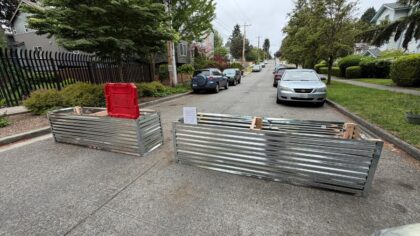
So they moved steel planters into the street.
Alison Holcomb, Katie Wilson’s public safety advisor, met the neighbors Saturday morning
It’s 2026. Somebody always has a phone out. A neighbor started recording the discussion Saturday morning between residents near Aurora Avenue North and Alison Holcomb, who oversees public safety initiatives for Seattle Mayor Katie Wilson, and shared the video with me. Holcomb is a longtime former American Civil Liberties Union (ACLU) of Washington policy director and was most recently deputy general counsel to King County Executive Girmay Zahilay.
The exchange is tense, sometimes emotional, sometimes remarkably restrained.
The discussion happened just a few hours after neighbors placed large industrial planters across residential side streets near Aurora. They did it after another shooting. They did it after years of asking. They did it because pimps, johns, drug dealers, and gunmen are using their residential side streets as a loop: customers cruise Aurora, turn onto the side streets, circle back, and repeat. All night. The residents live inside that circuit.
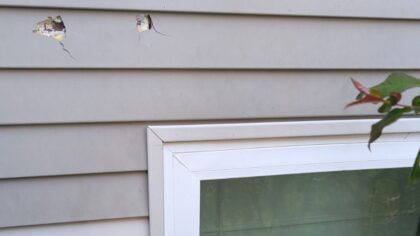
And the shootings aren’t just happening on Aurora. Most people hear “Aurora Avenue gun violence” and picture a commercial strip. But the gunfire follows the circuit. Pimps are shooting at each other on the residential side streets, the same blocks where families are sleeping, where kids wait for the bus, where a six-week-old was in his bassinet when bullets came through the wall. The violence follows the loop into the neighborhood.
Ninety-five shootings in that area in two years.
Ninety-five.
This is not a nuisance complaint. This is not a neighborhood asking for prettier traffic calming. This is a public safety emergency.
‘The shootings are literally happening every night. They hit my house.’
One resident said it plainly: “There was a major shooting on our block last night, again over 20 shots.”
Another talked about bullets hitting near a child’s room and cars.
Jake, the neighbor whose home was hit by gunfire last week, bullets passing within inches of the window where his six-week-old son was sleeping, said it directly: “The shootings are literally happening every night. They hit my house, as you know. Exactly. We can’t not do something.”
“We can’t not do something.”
For the people who live there, doing nothing is no longer neutral. Waiting is no longer harmless. Studying is no longer responsible.
Holcomb talked strategy. The neighbors talked bullets.
Holcomb tried to explain that the city is working on it.
“The police chief and deputy chiefs and assistant chiefs,” she said, “are all working really hard to figure out what the most strategic way forward is.”
But the neighbors kept pulling the conversation back from City Hall language to street-level reality.
“We need action, though, we can’t wait,” one resident said.
Then came the line that captures the whole problem: “It took this for you guys to come out.”
Holcomb said she had come out that morning after hearing about the 4 a.m. shooting, not because of the planters.
A resident corrected the scale of it: “The seventh shooting in less than two weeks.”
And that count is almost certainly low. Neighbors say they hear single gunshots on nights that never generate a police response. The sound gets captured on security cameras, but when officers arrive, they can’t find casings. So it doesn’t make the official count. After one of those reports, a resident recorded 13 shell casings on the ground the next morning as he walked his kids to the bus stop.
Not one shooting. Not one bad night. Seven that made the official count in less than two weeks. The real number is higher. And still, the city response sounds like process.
‘I’m pretty sure if the pimps and johns can’t circle our block every night, that will affect their ability to operate.’
A resident had a more immediate theory: “I’m pretty sure if the pimps and johns can’t circle our block every night, that will affect their ability to operate in our neighborhood.”
That is the divide. The city is talking about systems. The neighbors are talking about traffic patterns used by criminals. The city is talking about strategy. The neighbors are talking about bullets. The city is talking about what takes time. The neighbors are asking what can be done before someone is killed.
One resident pointed to what happened on North 101st Street a couple of years ago, when the city closed a street after similar violence.
“On 101st, we had the same thing,” the resident said. “We had bullets through people’s houses and people’s cars, and the city actually took action. The city was like, ‘We’re actually going to close the street.’ And that made a big impact.”
That is why the planters matter. They are not just planters. They are a neighborhood’s vote of no confidence.
‘Is this the one that’s going to hit our house?’
Another resident put the frustration in human terms. She talked about being woken up by gunshots three or four nights a week.
“We woke up,” she said. “I was under the bed because I was like, is this the one that’s going to hit our house?”
A Seattle resident should not have to calculate, half-asleep, whether this is the bullet that comes through the wall.
Yet when residents asked what the mayor could do immediately, they heard about complications. They heard about the Seattle Department of Transportation (SDOT). They heard about fire access. They heard about ambulances. They heard about meetings.
Then Holcomb said something that deserves more attention than it got in the moment.
“We also have to deal with collective bargaining agreements with the Seattle Police Officers’ Guild,” she said. “So our ability to order officers around to different shifts is, a little to a large degree, dictated by collective bargaining agreements. The collective bargaining agreement we’re dealing with right now is not one that the Mayor negotiated.”
The mayor’s own public safety advisor, on camera, is telling residents that City Hall cannot deploy officers where it needs them because of a police union contract this administration didn’t negotiate. After 95 shootings.
One resident finally said what many of them clearly believe: “This is within the mayor’s control, and she’s done nothing.”
Holcomb responded that the mayor had assigned staff across her office and that people were working on it. But the resident was not asking whether people were busy. The resident was asking whether anyone was leading.
Another resident described calling the mayor’s office every day that week. The response he got: go to a face-painting community meeting up the street from the mayor’s office.
Face painting. While the neighbors count shell casings.
‘Talking about things is just not helpful.’ The most Seattle sentence in the whole exchange.
“We don’t need a community meeting,” one resident said. “We need something actionably done in our neighborhood.”
Another said, “Talking about things is just not helpful.”
That may be the most Seattle sentence in the whole exchange.
Because this city has become very good at talking. It talks in committees. It talks in frameworks. It talks in equity analyses. It talks in pilots, workgroups, and implementation plans. It talks until everyone involved has a title, a liaison, a portfolio, and a follow-up meeting.
Meanwhile, the neighbors are picking up condoms in the street and counting gunshots at night.
‘I’ll let somebody sleep in the bed. That’s fine.’
One resident’s anger boiled over: “I’ve been picking up condoms in the street for years now. And it’s not fun. It’s not fun to have PTSD from multiple 20 shootouts with Glocks.”
He suggested city council members should swap houses with residents and live there for a few weeks.
Another resident immediately offered: “Yes, I’ll let somebody sleep in the bed! That’s fine!”
That sounds sarcastic. It also sounds like a serious invitation. Come sleep here. Come hear it. Come feel the calculation of whether to get under the bed.
Seattle SOAP zones, City Attorney Erica Evans, and the government maze
Residents brought up the city’s Stay Out of Areas of Prostitution zones, known as SOAP zones, tools meant to restrict people accused of prostitution-related crimes from returning to certain areas. The neighbors helped get SOAP zones established in their community. They testified. They organized. They did what the system asked them to do.
Seattle City Attorney Erica Evans campaigned on not enforcing them. She called SOAP zones ineffective. She called them racist. She promised she would not file charges under them. She has kept that promise. The zones still exist on paper. She just doesn’t use them. That is a choice. That is her choice. The people who live inside those zones never got a vote on it.
Evans is separately elected and does not report to the mayor. That is true. But it is also exactly the kind of answer that makes residents feel trapped in a government maze.
The mayor does not control the city attorney. The city attorney does not control the police chief. The police chief has staffing limits. SDOT has access concerns. Fire needs review. Officers have bargaining agreements. Every part of the system has an explanation.
And somehow the explanation always points back to the residents being asked to wait.
One resident summed up the exhaustion: “We’ve heard for two years, we got meetings, we got studies, we’re reaching out to this, we’re reaching out to that. Nothing has happened.”
Holcomb showed more leadership ‘just by talking to us’ than the mayor
Holcomb deserves some credit for standing there and taking the heat. Several residents acknowledged that she showed more responsiveness by coming out than many others had shown. One even told her, “You are showing far more leadership just by talking to us than the mayor.”
But that is also the indictment.
When the bar for leadership is showing up after the seventh shooting in less than two weeks, the bar is on the floor.
RELATED STORIES
95 shootings in two years. The neighbors moved faster than City Hall.
Seattle has treated Aurora like a complicated policy problem for years. It is complicated. Prostitution, exploitation, addiction, trafficking, guns, police staffing, prosecution, street design, and politics all collide there.
But complexity cannot become an excuse for paralysis.
A neighborhood with 95 shootings in two years does not need another explanation of why every solution is hard. It needs the city to act like 95 shootings in two years is unacceptable.
The neighbors already did. They put planters in the street.
City Hall should ask itself why residents with shovels moved faster than the government with all the power.
Charlie Harger is the host of “Seattle’s Morning News” on KIRO Newsradio. You can read more of his stories and commentaries here. Follow Charlie on X and email him here.