Harger: San Francisco’s homelessness hit a 15-year low. Seattle’s mayor is running the opposite experiment.
May 15, 2026, 6:59 AM
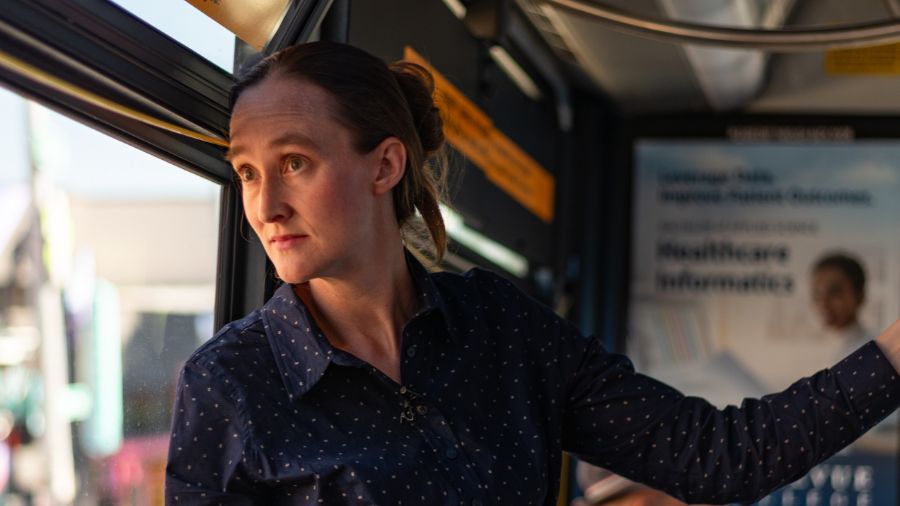
Katie Wilson looks out of a window while riding public transit. (Photo courtesy of Katie Wilson's mayoral campaign)
(Photo courtesy of Katie Wilson's mayoral campaign)
San Francisco Mayor Daniel Lurie announced his city’s homeless count results this week, standing in front of Hope House, a transitional housing facility in San Francisco run by the Salvation Army.
Hope House is sober. If you want to stay there, you don’t use.
That detail matters. Because Lurie didn’t just pick a random backdrop. He picked the philosophy, and the numbers suggest the philosophy is working.
San Francisco’s 2026 Point-in-Time Count: unsheltered homelessness down 22%, tents down 85%
San Francisco’s preliminary 2026 Point-in-Time Count shows unsheltered homelessness down 22% since 2024, the lowest level since 2011. People living in tents: down 85%. Youth homelessness: down 54%. Veteran homelessness: down 44%. A record 57% of the city’s homeless population was sheltered on the night of the count.
Overall, homelessness dropped 4%, from 8,323 to 7,973. Family homelessness rose 15%, driven by rising rents and new arrivals. Lurie didn’t hide that number. He said it’s a major area of focus.
Critics point to methodology changes. The count moved from nighttime to morning. Surveyors asked people about their housing status instead of guessing from a distance. Fair caveats. But an 85% reduction in tents isn’t a methodology issue. It’s visible.
Homelessness is 3 crises, not 1: addiction, mental illness, and people who just fell behind
The word “homeless” collapses three distinct crises into one. The first group is the person who lost a job, lost a lease, or fell behind. They’re often invisible. Living in a car. Staying on a friend’s couch. Not on drugs. Not mentally ill. Ready to work if someone gives them a path back.
The second group is the most visible: people in active addiction. Smoking fentanyl on the sidewalk, in a tent, or in an RV. They’re the face of the crisis because they’re the hardest to look away from.
The third group is the severely mentally ill. Untreated schizophrenia. Psychosis. Cycling between the street, the ER, and jail. A housing voucher doesn’t begin to address what’s wrong.
Groups two and three overlap heavily. And in most cities, including Seattle, we’re doing very little to turn that tide. The current approach manages the visible crisis. It doesn’t resolve it.
What San Francisco Mayor Daniel Lurie actually did: enforcement, sobriety, and faith-based recovery
Lurie is a progressive. A Levi Strauss heir who ran a nonprofit before running for mayor. He simply decided that results matter more than ideology and compassion without accountability is just neglect with better branding.
He opened Hope House, the city’s first abstinence-based shelter built into its official homeless response system. It’s run by the Salvation Army through their “Way Out” Recovery System of Care. The program is full. Zero overdose deaths reported.
A resident named Tyrone said it plainly: “I need a sober environment, a supportive environment, for me to get and stay sober.” San Francisco built one, and the mayor made it the flagship of his Breaking the Cycle strategy.
Sober shelters have always existed. The Salvation Army and missions like it have been doing this work for decades. What Lurie did differently was treat them as partners in the city’s official response instead of treating sobriety as a barrier to participation. He brought the recovery model inside the system.
He created RESET centers for people picked up for public drug use. More than 140 people came through in the first week. Roughly 25% accepted substance treatment. At the Geary Street crisis stabilization center, staffed with trauma-informed nurses, the rate hit 50%.
He consolidated siloed outreach teams under the Department of Public Health. Shelter placements went up 40%. Response times dropped 40%.
He changed the rules on harm reduction: Outreach workers can no longer hand out fentanyl smoking kits without connecting people to counseling or treatment.
He enforced camping bans and coupled them with expanded shelter and treatment beds so there was somewhere to go.
He issued 127 layoff notices to city workers. He told San Franciscans he was going to cut spending to get the city on firmer financial ground. He said it out loud.
His approval rating: 74%. Quality of life was rated excellent or good by 67% of voters, up 28 points since 2024.
A progressive mayor, in one of the most progressive cities in America, enforced the law, required sobriety, partnered with the Salvation Army, made cuts, and pushed back against his own political base. Voters love him for it.
San Francisco stopped doubling down on failure and started measuring results
Lurie’s Breaking the Cycle plan looked at years of rising homelessness, rising overdose deaths, and rising spending and concluded that doing more of the same would produce more of the same.
The orthodoxy says that enforcement criminalizes poverty. Sobriety requirements are punitive. You don’t put conditions on shelter. Lurie heard all of that and made a calculation: The people dying on the street aren’t being saved by the current approach. The people smoking fentanyl in subsidized housing with no pressure to recover aren’t recovering. The money being spent isn’t producing outcomes anyone can point to.
So he changed direction. Still progressive. Still investing in housing, outreach, and services, but with standards and enforcement, with the expectation that the goal is to get people well.
RELATED STORIES

Seattle Mayor Katie Wilson is about to run the experiment in the other direction on homelessness
Eight hundred miles north, Mayor Katie Wilson is taking the opposite approach. Seattle’s primary shelter model, permanent supportive housing, has no sobriety requirement. No treatment expectation. Drug use is allowed inside. Staff doesn’t bring up rehab unless a resident asks.
Seattle has organizations doing recovery-based work. The Salvation Army. Union Gospel Mission. They require sobriety and produce results. But they’re largely sidelined by the city’s official response, in part because they’re faith-based and in part because they require the one thing the system won’t demand: that you stop using.
Wilson told the Seattle Channel that “there is no world in which we need less funding for homelessness.” She called budget cuts “a terrifying prospect.” She won’t name a single program to reduce. The King County Regional Homelessness Authority can’t account for $13 million. And Seattle keeps concentrating new shelter sites in its poorest neighborhoods because wealthier communities have the political power to say no.
Two progressive cities. Same crisis. Same political base. Opposite instincts.
Lurie decided things were getting worse, and the old playbook was failing. He stood up to the far left’s worst impulses and said what a lot of people were thinking: if we keep doing this, nothing changes.
Wilson is doubling down on the model Lurie walked away from.
One city decided people were worth managing. The other decided they were worth saving.
Charlie Harger is the host of “Seattle’s Morning News” on KIRO Newsradio. You can read more of his stories and commentaries here. Follow Charlie on X and email him here.