Air conditioning battery program for renters could help cities manage grid stress during heat waves
May 7, 2026, 6:06 AM
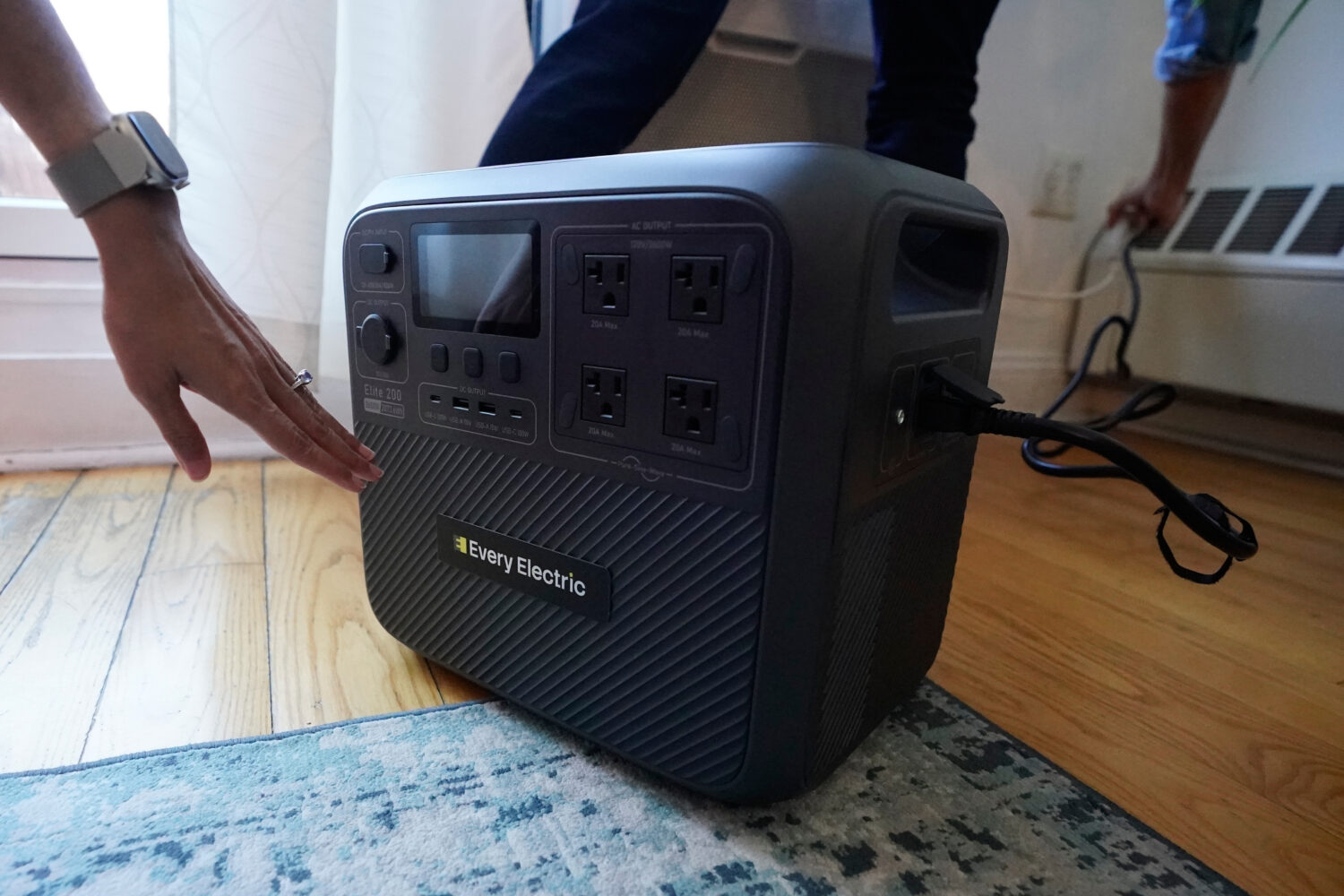
Sonam Velani and Yan Sim plug in a battery from Every Electric to power an air conditioner as part of a pilot program with the city's energy company Con Edison to reduce pressure on the electrical grid Monday, April 27, 2026, in the Brooklyn borough of New York. (AP Photo/Alyssa Goodman)
Credit: ASSOCIATED PRESS
(AP Photo/Alyssa Goodman)

NEW YORK (AP) — When a heat wave hits, millions of air conditioners switch on at once, straining the electric grid and driving up the risk of outages — and residents’ power bills. To ease that strain, power companies may ask customers to do something many probably won’t: Set the air conditioner a few degrees higher.
Now, a renter-friendly pilot program in New York City is testing a different approach: plug-in batteries that can power air conditioners offline during peak demand, helping take pressure off the grid at its most stressed moments while still keeping residents cool.
“It’s basically a souped up version of the power bank that you would use to charge your phone when you go out,” said Andrew Wang, the chief executive officer of Every Electric, the company behind the pilot, which has partnered with the city’s energy company Con Edison.
The devices, about the size of a microwave, charge when electricity demand is low and then run window AC units for a few hours when demand spikes. It’s one of many partners participating in Con Edison’s demand response programs, which pay customers to reduce or shift electricity use to support the grid.
The pilot program is expanding to more than 1,000 homes this summer and participants can get rewarded in cash rebates.
Experts say this initiative reflects the broader shift toward so-called virtual power plants, in which many small, distributed energy resources are coordinated to reduce strain during peak demand. When scaled, solutions like this could have a significant impact on power reliability and affordability.
When electricity demand spikes, utilities often turn to backup power plants that don’t run as often, and are typically less efficient and more polluting, said Kevin Brehm, a manager at RMI, a nonprofit that researches energy systems and the transition to clean power.
Over time, those spikes can push utilities to build more power plants, often fossil-fuel based, to meet demand, with the costs eventually passed down to consumers.
“There’s a question of emissions, and then there’s also a really important question around affordability,” said Brehm.
That’s why power companies often ask residents to conserve energy during the hottest days of the year, and set higher rates during peak hours to encourage people to conserve power. Those strategies “can be hard to rely on because they don’t know exactly how consumers are going to behave,” Brehm added.
That’s where solutions like Every Electric’s can help.
Utilities and governments are increasingly looking for ways to manage rising electricity demand as heat waves become more frequent and intense.
One approach is Every Electric’s demand response program, which pays customers to reduce or shift electricity use during periods of high demand.
Virtual power plant programs are another solution expanding state by state. They connect thousands of small energy devices, like home batteries or smart appliances, and coordinate them to send power back to the grid when demand spikes, easing strain without building new plants. California, for example, is working to develop one of the world’s largest, paying hundreds of thousands of participants to send stored energy back to the grid during extreme climate events. Most of these programs are limited to homeowners with solar panels.
Con Edison said batteries can help reduce peak demand, support renewable energy and lessen the need for new infrastructure.
Every Electric’s program works specifically for people with window AC units, who are typically renters, though it does not export power back to the grid. Instead, it reduces demand by using stored battery power.
Still, Brehm said programs like it are part of the broader push to integrate consumer energy devices into the grid and reward the services they provide.
“I can’t put solar panels on my roof,” said Bianca Pasternack, a New York City renter enrolled in the program. “This is at least something that’s accessible and easy. It was very set-it-and-forget-it.”
The battery plugs into the AC unit, then into the wall outlet. It’s connected to a smartphone app that detects when demand is low, charging the battery during off-peak hours and using it to power the AC during peak times, usually from 1 to 4 p.m. or 4 to 8 p.m. during the hottest months.
Participants can also earn money for taking part, roughly the equivalent of the cost of a July electric bill, according to the company. Pasternack said she received a $100 gift card at the end of the season.
The company says its pilot is growing from about 200 kilowatts of flexible capacity last year to roughly 2 megawatts this summer, and could expand much further. By comparison, California’s program exceeds 200 megawatts. The company is looking to expand to other cities, Wang said.
Although Every Electric’s program currently operates at a small scale, Brehm says systems like this could meaningfully reduce strain on the grid if they reach enough households.
“It’s a matter of how we’re able to get to that scale,” he said, noting that widespread adoption is a key issue that depends on how easily the technology can be deployed and integrated into the grid. He added that Every Electric’s installation process is easily accessible. “It’s plug-and-play and you don’t need a ton of permissions.”
___
The Associated Press’ climate and environmental coverage receives financial support from multiple private foundations. AP is solely responsible for all content. Find AP’s standards for working with philanthropies, a list of supporters and funded coverage areas at AP.org.