Most sunscreens harm corals. Here’s what you can do
Apr 28, 2026, 6:16 AM | Updated: 7:36 am
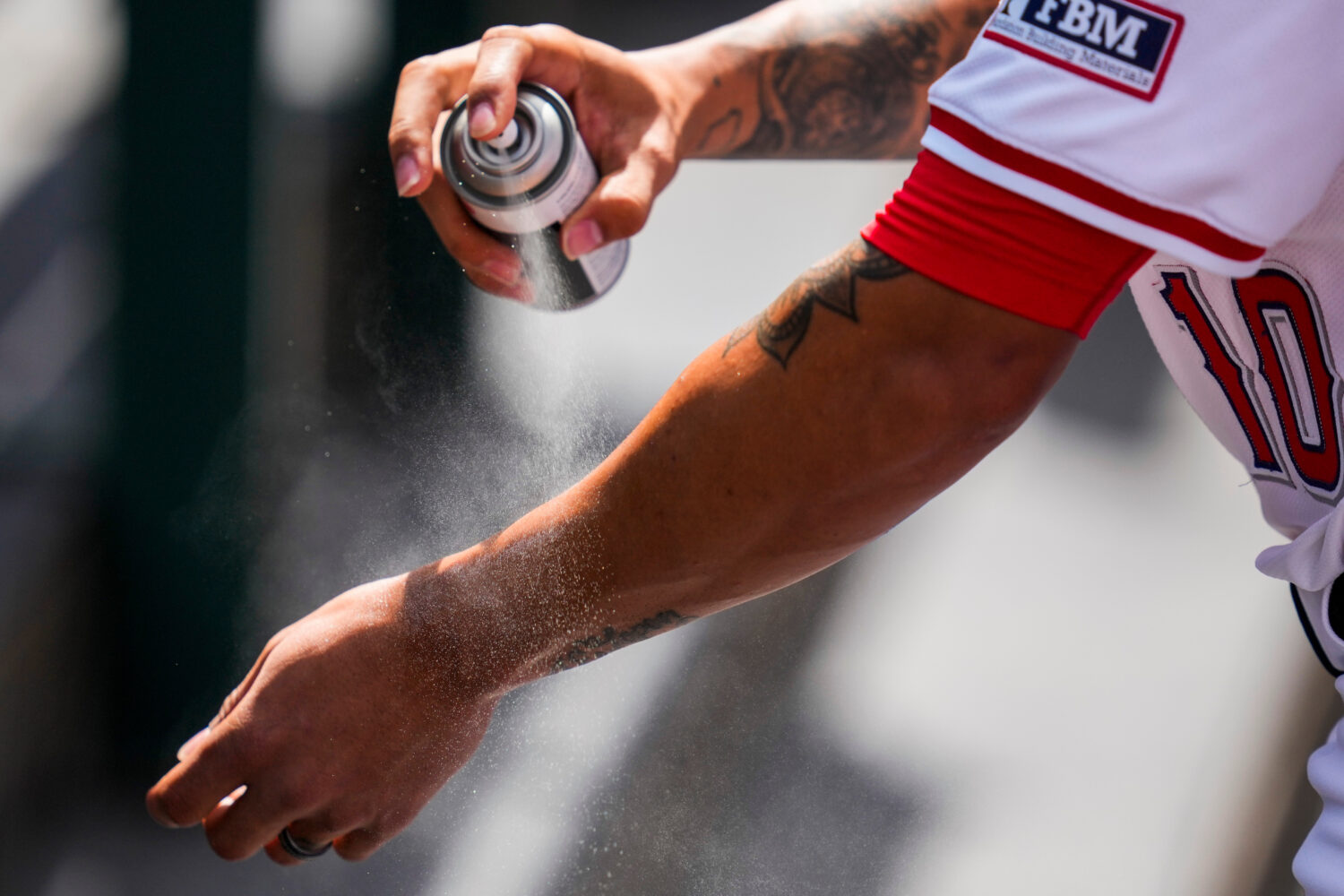
FILE - Sunscreen is applied at a baseball game in Anaheim, Calif., Sept. 18, 2024. (AP Photo/Ashley Landis, File)
Credit: ASSOCIATED PRESS
(AP Photo/Ashley Landis, File)

Every time you go for a swim, some of your sunscreen gets left behind.
An estimated 25% of applied sunscreen washes off during recreational water activities, releasing some 5,000 tons annually in reef areas alone, according to a study in Environmental Health Perspectives. That’s equivalent to the weight of about 1,000 elephants, and many of those chemicals are toxic to corals. Some researchers argue that may be a low estimate, noting the experiment did not replicate the friction caused by swimming, which could cause more sunscreen to rub off.
Coral reefs support about a quarter of all marine species despite covering just 0.1% of Earth’s oceans. Already under mounting pressure from warming waters, pollution, overfishing and coastal development, reefs face an additional threat from sunscreen chemicals that can damage coral larvae, trigger bleaching and disrupt growth. Scientists say it’s a smaller stressor than climate change, but one consumers can actually address.
The pollution doesn’t just come from swimming. Sunscreen chemicals can enter waterways when people shower, wash towels or urinate after beach trips. Sewage is the largest source of sunscreen contamination in oceans, as conventional treatment plants can’t effectively remove many UV filter compounds, studies show. The chemicals flow from wastewater facilities into rivers and ultimately the sea.
While sunscreen prevents sunburn and reduces skin cancer risk, not all formulas carry the same environmental footprint.
The strongest evidence of harm centers on oxybenzone and octinoxate — two widely used chemical UV filters. A 2016 study published in Archives of Environmental Contamination and Toxicology found oxybenzone transforms coral larvae from healthy, mobile organisms into deformed, immobile ones. The chemical causes corals to expel the algae that provide much of their food and color, a stress response known as bleaching. Bleached corals are weakened, more vulnerable to disease and can starve or die if stressful conditions persist. Researchers also found oxybenzone damages DNA and triggers premature skeleton formation that can encase entire larvae. It can also cause corals to bleach at lower temperatures, worsening the effects of marine heat waves driven by climate change.
The chemical proves toxic at concentrations as low as 62 parts per trillion — equivalent to one drop in six Olympic-sized swimming pools. At Hanauma Bay, a popular Hawaii snorkeling spot, nearly 2,600 daily visitors left around 412 pounds of sunscreen in the ocean each day, according to a 2017 study by nonprofit Haereticus Environmental Laboratory.
Scientists have growing concerns about octocrylene, avobenzone and homosalate as well.
These chemicals don’t stay put. UV filters have been detected in fish and other marine organisms, raising questions about seafood safety.
“We measured the level of oxybenzone in locally caught fish. It was scary,” said Craig Downs, executive director of nonprofit Haereticus Environmental Laboratory, who led the 2016 study. “These chemicals move through the food chain, then we eat it.”
Zinc oxide and titanium dioxide are generally considered safer alternatives to chemical UV filters, but they come with caveats. Experts say they should be in non-nano form, as their larger particle size makes them less likely to be inhaled or absorbed by marine organisms.
Zinc oxide can also contain trace heavy metal impurities such as lead, chromium and mercury, Downs said, and few products have undergone comprehensive ecotoxicity testing.
Consumers should also pay attention to inactive ingredients, since oils, fragrances and other additives can harm marine life.
Some mineral sunscreen manufacturers add UV filters such as butyloctyl salicylic acid and ethylhexyl methoxycrylene to prevent SPF levels from degrading in zinc oxide, which Downs has linked to potential cancer risks and coral toxicity.
Experts recommend covering up with clothing, rash guards, hats and shade.
“If you put on a rash guard or long sleeve swim shirt, you basically cover up 50% of your body, which means you don’t need 50% of the sunscreen,” Downs said. “From a conservation perspective, that’s a massive win.”
When sunscreen is needed, look for products with non-nano zinc oxide or titanium dioxide as active ingredients. While research continues into how these minerals behave in marine environments, many experts consider them preferable to chemical UV filters.
Though mineral sunscreens have a reputation for leaving a white cast, newer formulations offer sheerer alternatives.
Experts also recommend avoiding aerosol sprays, which can disperse sunscreen into the air and surrounding environment. Waiting at least 15 minutes after applying sunscreen before swimming allows it to better adhere to skin rather than wash off immediately.
In 2018, Hawaii became the first U.S. state to prohibit the sale of sunscreens containing oxybenzone and octinoxate, citing their harm to coral reefs. Key West, Florida, has followed with a similar measure. Palau and the U.S. Virgin Islands have gone further, restricting a broader list of chemicals linked to reef damage.
Beyond those bans, the marketplace remains largely unregulated. Labels like “reef safe” or “reef friendly” have no universal definition or standard.
“People can just write whatever they want on a bottle, and there’s no validation, no testing, no standardization,” said Michael Sweet, head of the Nature-based Solutions Research Centre and the Aquatic Research Facility at the University of Derby in England.
In lab experiments, some formulations “have decimated corals before my very eyes,” he said. “When you see that, you wonder what’s being put into our oceans on a daily basis, from shampoos, skin care, conditioners and shower gels. All this stuff goes into our rivers and ultimately our oceans.”
Some independent certifications have emerged to help consumers make informed decisions. One example is Protect Land + Sea, a label created by Downs’ laboratory that verifies products are free of ingredients such as oxybenzone, octinoxate and parabens. Experts note that ingredient screening can be useful, though it is not the same as comprehensive ecological safety testing of an entire formula.
“Reefs are being hammered left, right and center,” Sweet said. “Every little bit we can do tips the balance a little bit further up and hopefully gives them that bit of a fighting chance.”
___
Follow Annika Hammerschlag on Instagram: @ahammergram.
___
The Associated Press receives support from the Walton Family Foundation for coverage of water and environmental policy. The AP is solely responsible for all content. For all of AP’s environmental coverage, visit https://apnews.com/hub/climate-and-environment