Preservationists are working to extend the life of a rare Revolutionary War ‘witness tree’
Aug 24, 2026, 4:03 AM
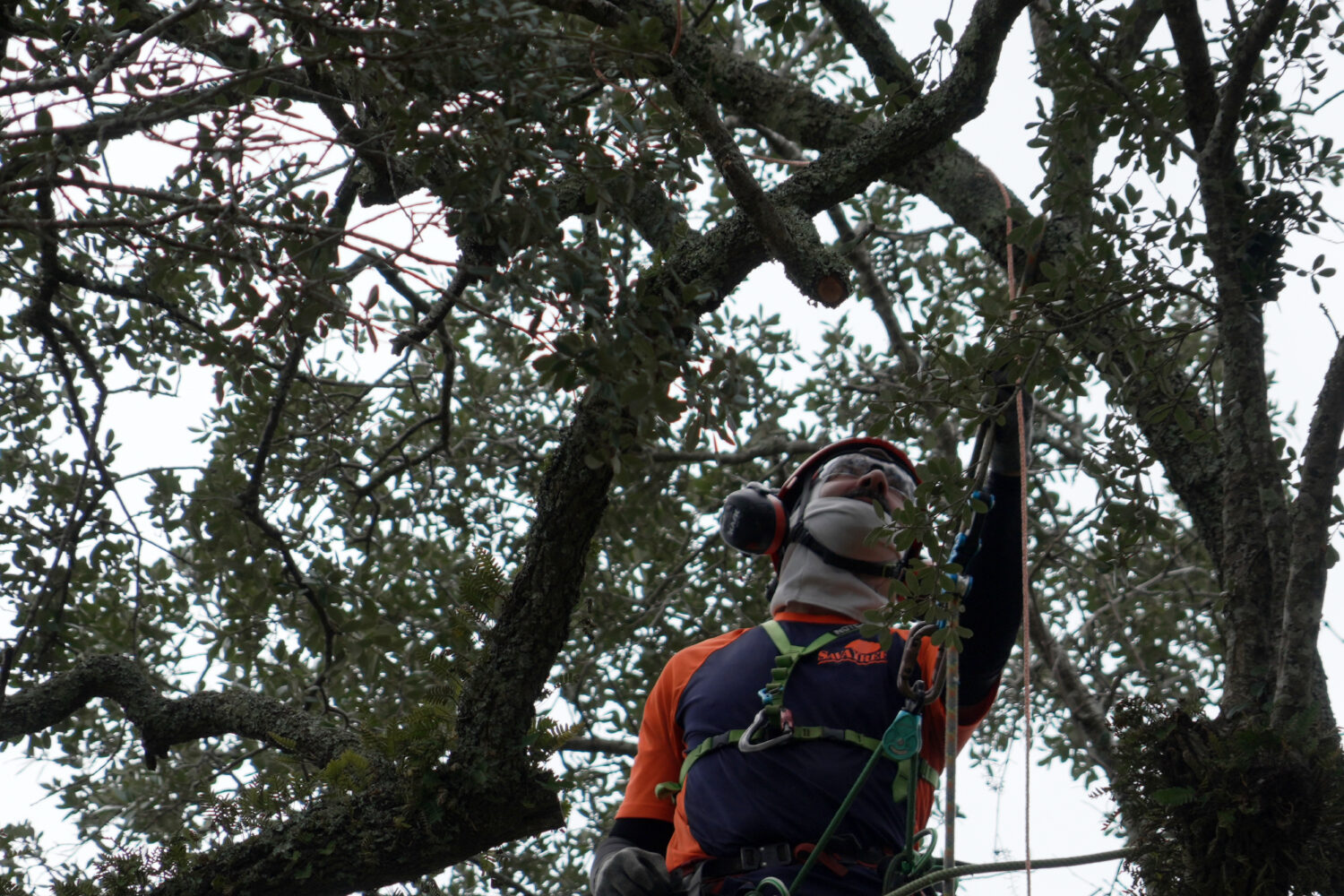
Andrew Giordano, plant and tree health care specialist, installs copper lightning rod cable in the branches of a Revolutionary War "witness tree" at the Battle of Eutaw Springs, S.C., historic site on Wednesday, Aug. 12, 2026. (AP Photo/Allen G. Breed)
Credit: AP Photo/Allen G. Breed
(AP Photo/Allen G. Breed)

EUTAW SPRINGS, S.C. (AP) — Standing beneath the spreading branches of a massive live oak, historian Garrison Marcoux tries to imagine what this scarred, struggling tree saw 245 years ago.
Did one of the British soldiers encamped at this South Carolina crossroad near the end of the Revolutionary War sit in the oak’s shade to recuperate from the series of attacks in American Maj. Gen. Nathanael Greene’s “war of posts?” Did he or his comrades take cover behind its then slender trunk and fire at the onrushing Continental Army?
Perhaps a soldier took his last breath beneath its canopy, watering its roots with his blood.
“I’m a spiritual person,” Marcoux, with the South Carolina Battlefield Preservation Trust, said as workers clamber among the limbs above. “To say that a place that experienced a lot of violence and intense emotion and things like that doesn’t hold some kind of energy is probably not likely. I think that energy exists where something like this happened.”
This is a “witness tree.” And it now faces its own fight for survival.
After multiple attempts to stave off its death over the decades, it is being choked by the chains and cables meant to support it. Preservationists are working to save this unique, living reminder of an oft-overshadowed chapter in U.S. history.
Arborists estimate that the tree was about 50 years old on Sept. 8, 1781, when British and colonial forces clashed during the Battle of Eutaw Springs — considered by historians to be the last open field engagement of the American Revolution.
“It’s very rare to have a witness tree, especially from the Revolutionary War,” Marcoux said on a recent sultry morning as gnats and mosquitoes buzzed around his head. “To have the tree that witnessed this battle and still standing is short of a miracle.”
Among the officers were famous names like Lt. Col. Henry “Light-Horse Harry” Lee and Brig. Gen. Francis Marion, better known as the “Swamp Fox.”
About 2,500 Americans attacked the roughly 2,000 British and Loyalist troops camped around a fortified brick house. Greene, who had a horse shot out from under him during the battle, called Eutaw Springs “by far, the hottest action I ever saw, and the most bloody for the numbers engaged.”
Lt. Col. Alexander Stewart, the British field commander that day, later wrote to Gen. Charles Lord Cornwallis, “I assure you the Action was bloody and obstinate.”
There were 1,461 killed, wounded, captured or missing. Both sides would claim victory.
“That tree probably took a few lead balls itself,” says arborist Aron Landsaw.
The combatants would move on. The oak remained — and faced several more battles of its own.
Hung with swaying Spanish moss, its branches festooned with bright-green resurrection fern, the tree reaches 45 feet (13.7 meters) into the sky, its canopy spreading about 130 feet (40 meters). Its trunk is 72 inches (1.83 meters) in diameter at breast height.
The twin springs that gave the Revolutionary War battle its name are no more, inundated by the 1940s project that flooded the Santee River basin for hydroelectric power and flood control. Development in the 1960s swallowed up much of what the lake project spared.
The tree survived it all.
Then, about 50 years ago, lightning struck the oak’s crotch, splitting the tree nearly in two. Workers lashed the broad branches together with steel cables and chains.
But the mechanisms that saved the oak are now slowly killing it.
As the tree grew, the metal bands cut into the trunk and branches, in some places disappearing beneath a scar-like covering of bark.
“The chains and cables are actually choking it out,” says Landsaw. “It can’t pull nutrients up from the soil.”
Preservationists hope to reverse that.
South Carolina 250 and the American Battlefield Trust joined forces to hire Maryland-based SavATree for the project as the U.S. marks the 250th anniversary of the signing of the Declaration of Independence.
Crews recently used a supersonic air tool to de-compact the ground around the tree’s roots, then injected a kelp mixture to add nutrients to the soil. The day of Marcoux’s visit, SavATree workers hammered little blunt lightning rods into the main branches, connecting them with shiny copper cables that converge on a longer copper rod pounded deep into the ground about 10 feet (3 meters) from the trunk.
“If lightning does hit it, it’ll run down the copper cables and dissipate into the ground,” says Landsaw, who is consulting with SavATree.
Next, workers will install new cables, bolted into the five main branches, to stabilize the tree before removing the old supports.
“There’s going to be a center hub in the middle that connects all these cables and allows the tree to sway with the wind and move around when it needs to,” Landsaw explains.
Landsaw says this is the most significant project he’s ever worked on.
While he can’t promise the tree will live another three centuries, Landsaw is confident it will be around to inspire new generations of Americans.
“We’re focusing on another 100 years at least,” he says. “Hopefully longer.”