Millions of Americans behind on car payments, missing credit due dates
Feb 21, 2019, 5:55 AM
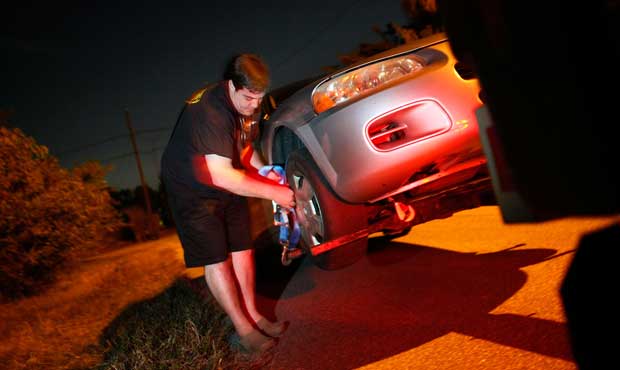
(Photo by Joe Raedle/Getty Images)
(Photo by Joe Raedle/Getty Images)
Despite a thriving economy and job market, signs are showing that millions of Americans are having trouble keeping up, while missing payments on car loans and credit cards.
RELATED: Test driving a LimePod in Seattle
RELATED: Do millennials face ‘scariest financial future’
According to the Washington Post, the Federal Reserve recently reported that many American’s can’t afford their car loans. A record 7 million Americans are three months behind on their car payments. Experts say it’s a red flag for the nation’s economy, indicating that lower-income and working class people are not all benefiting from the labor market.
The Washington Post further reports:
Most of the people who are behind on their bills have low credit scores and are under age 30, suggesting young people are having a difficult time paying for their cars and their student loans at the same time.
Becky House is communication director for American Financial Solutions, a nonprofit, based in Seattle, that provides free credit counseling. She says a lot of the people who come to them for credit counseling are often so desperate to make ends meet they commit to loans they can’t afford — sometimes as high as 29 percent.
Becky also says you might want to think twice about signing the dotted line when banks ask if they can put a tracker in your car.
“The ease in which now lenders, not just car dealerships, are able to get back the vehicles when they are not paid,” House said. “I don’t think people talk about how ‘I got a lower interest rate because they put a locator in my car.’ Well, a lower interest rate is all relative. I don’t consider a 15 percent interest rate a lower interest rate. It’s lower than 20 percent, but it’s still high on something that is depreciating. It’s making it easier for the person to come back and repossess if you don’t make your payment.”
Julia Kellison with NW Justice project, a non profit that provides free legal services, says they help clients on the back end once the car has been repossessed or when it breaks down. But clients are still on the hook for the car payments even if it doesn’t work. That’s why she recommends getting a used car inspected.
“We do see folks getting into high-interest loans for cars that are not in good condition,” Kellison said. “Those cars may break down within days or weeks of car purchase, so they are now stuck with a high-interest loan, a car that is inoperable, they might stop making payments because they don’t have an operable car. And that car is going to get repossessed by the lender and it will get sold at auction. The amount sold at auction will be applied to the loan, which is often a very low amount. Then the lender has a right to come after the borrower for the deficiency”
“Again, this is a high interest rate,” she said. “Now the person is without a car and stuck with a very high interest car loan. If they get sued, and garnish their bank or their wages, that could put someone in a really destabilizing, financially insecure situation immediately.”
For more information about legal services go to washingtonlawhelp.org and for credit counseling go to myfinancialgoals.com.
Credit card debt
An echo of concerns over car payments comes from the credit card market. WalletHub reports that 40 million people say they expect to miss at least one credit card due date in 2019.
A survey conducted by the credit website indicates that most groups are evenly split when it comes to missing a payment. About 15 percent of men and 16 percent of women expect to miss a due date; and 18 percent of Republicans and 17 percent of Democrats will miss a payment.
WalletHub also says that people between 18-44 are most worried about missing credit card payments, partially overlapping with concerns of people 30 and younger missing car payments (ages 45-59 are worried about mortgages, and 59 and older are worried about tax payments). About 20 percent of millennials expect to miss a payment, contrasted with boomers which are at 8 percent.
One interesting point that WalletHub found is that people with high incomes are more likely to miss a credit card payment. They are twice as likely to miss a payment than low-income credit card holders. In fact, forgetting to pay is the most common reason cited for missing a payment (46 percent), not having enough money is the second (29 percent).