Scary picture of past global warming event painted in UW study
Dec 11, 2018, 6:33 AM | Updated: 12:15 pm
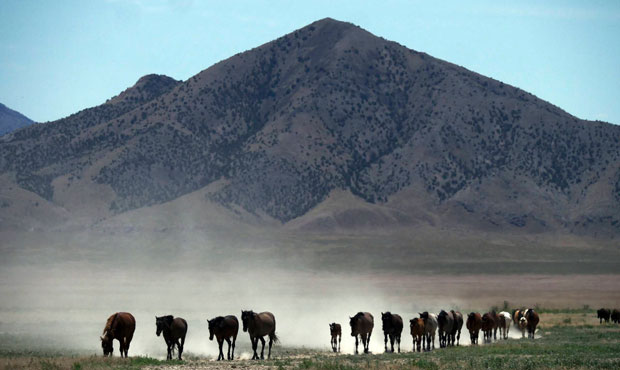
Harsh drought conditions in parts of the American West are pushing wild horses to the brink and forcing extreme measures to protect them. Federal land managers have begun emergency roundups in the deserts of western Utah and central Nevada. (AP Photo/Rick Bowmer)
(AP Photo/Rick Bowmer)
Curtis Deutsch recently released a study in the journal Science that is the stuff of nightmares, or at least a major motion picture about a dystopian past.
The associate professor of oceanography at the University of Washington essentially ran a computer simulation of the end of the Permian geological period to try to determine why most of the Earth’s species were snuffed out 252 million years ago.
What’s extraordinary is what happened when Deutsch combined his model with data from fossils and information that scientists at Stanford have collected on animal species. They were able to conclude that greenhouse gases released from massive volcanoes warmed the Earth and depleted oxygen from the oceans, thus cooking or suffocating 96 percent of marine species and 70 percent of terrestrial species.
“Today, of course, we are the volcanoes,” Deutsch said. “We are accessing deep reservoirs of carbon stored in the Earth and we’re releasing that carbon dioxide in those fuels into the atmosphere. That’s ultimately what warms up the climate.”
RELATED: Gov. Inslee’s new climate plan nixes coal power
RELATED: Federal report lays out grim NW future with climate change
RELATED: UW prof says climate change is here and now
But, unlike the volcanoes of the Permian Period, humans can control how much carbon dioxide we release into the atmosphere. Deutsch says there’s more promise now that humans have the ability to move away from fossil fuels and harness the power of solar and wind.
“It’s true that we are well behind schedule and in many cases, including in this country, often lack the political willpower to do it, but scientifically and technologically, we can do it,” Deutsch said.
If humans end up dragging their feet and have to deal with another near-total extinction, there’s pretty good past evidence that shows the Earth will rebound and life will flourish once again. But, of course, paleontologists say it’ll take a few million years to build back the diversity of life that existed pre-mass extinction.
“Even knowing that diversity will return, I still think it’s better not to induce a large extinction event,” Deutsch said.
Fortunately for us, we’re smarter than marine life and we’re not living in a massive cloud of volcanic ash. So can’t we just invest in more air conditioning?
Deutsch says humans certainly have the ability to adapt to many of the results of global warming. For example, we’re able to plan for droughts, fight summer forest fires, and sit in front of air conditioners.
“The Permian Period extinction is a good example because there is a very clear signal in the data that shows us that when you push the climate to that level – 10 degrees of warming on the Celsius scale – you clearly are beyond the limits of adaptation. Temperatures get beyond what species would accommodate today and oxygen gets extremely low – beyond what most species can handle today.”
The problem with the extinction of the ocean is there is nothing we know of that will reverse the damage, according to Deutsch. It’s technologically infeasible to cool off the ocean and add more oxygen. The only way to avoid major disruption is to not allow the ocean to warm in the first place while also hoping that marine life is able to adapt. They must also contend with avoiding large fishing nets, which obviously weren’t around during the Permian Period.
Follow @http://twitter.com/Mynorthwest