Will $15 minimum wage work in Seattle? Study attempts to find out
Aug 5, 2015, 10:26 PM | Updated: Aug 6, 2015, 7:20 am
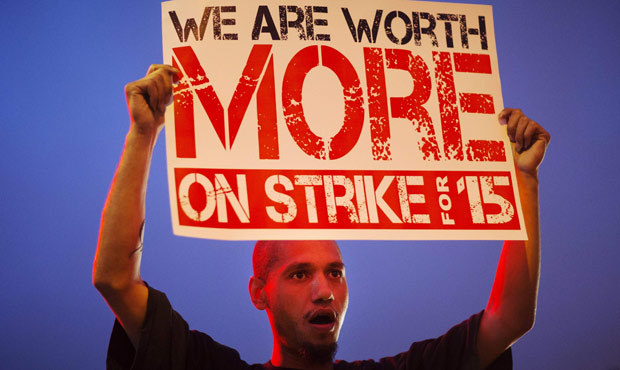
A University of Washington study will attempt to determine if Seattle's current $15 minimum wage is for better or worse. (AP file photo)
(AP file photo)
Seattle’s $15 minimum wage has come under fire from critics, but now someone is studying the process to determine whether it will be successful or ultimately fail.
Tacoma will vote for $12 or $15 minimum wage
University of Washington Professor Jacob Vigdor, with the Evans School of Public Policy and Governance, is conducting a study of the effects of Seattle’s minimum wage experiment currently underway.
“It’s complicated. That’s the best way I can summarize it,” Vigdor told KIRO Radio’s Dave Ross.
As Ross put it, Seattle is an “incubator” for the $15 minimum wage that many communities are pushing for in the state and even across the nation. Businesses such as Ivar’s have already put their minimum wage at $15, but have banned tips and raised prices. A Seattle pizza shop closed citing the rise in wages, however, another pizza shop ended up moving into the exact same space.
Beginning April 1, the city’s minimum wage rose to $11; the first step toward full implementation of $15 an hour.
Just before April 1, Vigdor’s study began collecting data. That data collection continues and will come to a head when he presents his results to the Seattle City Council in June 2016. It will cover the first 3-6 months of the wage increase. The study involves input provided by Seattle businesses; so far nearly 700 have responded. It also takes into account administrative data from the state on every Seattle employer.
“If business owners don’t automatically know what’s going to work and what’s not going to work, there is going to be a period of trial and error and I think we are in the thick of that right now,” Vigdor said.
“The studies that are out there on the minimum wage do not come to any consensus. In fact, they don’t go nearly as far as our study will,” he said.
Vigdor notes that such studies haven’t looked at factors outside of employment, and give an incomplete picture.
“What’s happening to benefits? What’s happening to prices? What’s happening to the workers enjoying this higher income? How much of that income is being eaten up by higher prices? How much of that is being offset because these workers are no longer eligible for things like food stamps?” Vigdor posed.
“As [employees’] income goes up, most of those extra dollars are being eaten up by reductions in their benefits. So there are some workers in that category, but there are others who are not and that’s why we are trying to follow as many as we can, individually, to see which story is actually the more common story,” he said.
So far, responses to the wage increase have echoed the conversation in the media, on both sides of the issue, Vigdor said.
“We’ve talked to a lot of businesses who have said that they are finding ways to adapt, and we’ve talked to businesses who say they really don’t want to raise prices and they are committed to doing that and are finding ways to adapt,” he said. “But we have found quite a few others who are raising prices and we’ve heard from business owners who are cutting back on staffing, they are cutting back their operating hours.”
“The question is to what extent are the good outcomes for workers occurring more frequently than the bad outcomes?” Vigdor said.