Exclusive: KIRO Newsradio obtains income tax bill draft. Lawmakers say it’s real. Governor’s office says it isn’t theirs.
Jan 27, 2026, 7:00 PM | Updated: Jan 29, 2026, 3:31 pm

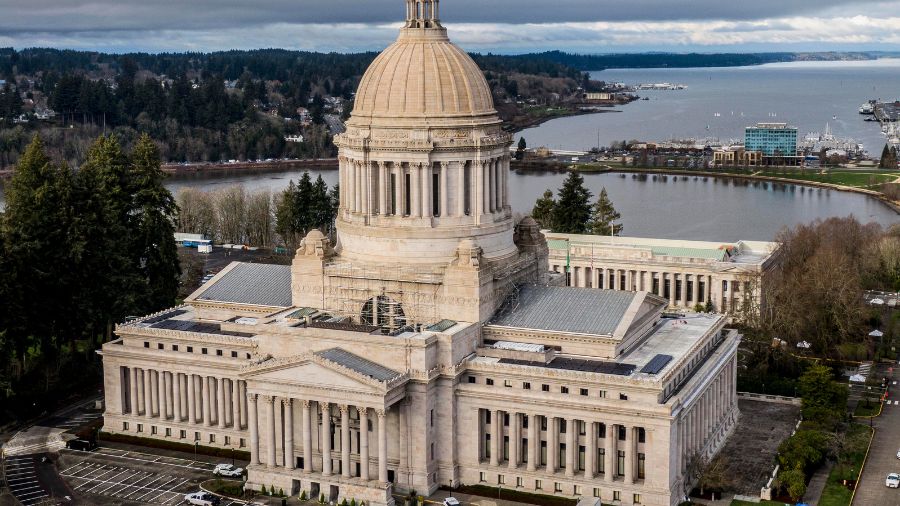
The Washington State Capitol in Olympia. (Photo: Ted S. Warren, The Associated Press)
(Photo: Ted S. Warren, The Associated Press)
KIRO Newsradio has reviewed what appears to be a working draft of the income tax on high earners being developed in Olympia, offering the first detailed look at legislation that has been crafted largely out of public view.
House Majority Leader Joe Fitzgibbon confirmed the authenticity of the draft but said it remains “a work in progress and the bill as introduced will have changes.”
Aaron Wasser, communications director for Senate Democrats, said in an email that the document “looks like a draft of it, but not the final bill,” adding that “the final version is still actively being edited.”
Governor Ferguson’s communications director, Brionna Aho, pushed back on characterizing the document as the governor’s proposal.
“No, that is not the governor’s proposal,” Aho wrote in an email. “It would not be correct to refer to it as such.”
Aho did not dispute any of the specific provisions in the draft, nor did she provide an alternative version or explain how the governor’s proposal differs. She reiterated the conditions Ferguson has set for signing any income tax: expanded eligibility and amounts for the Working Families Tax Credit, “significant tax relief for small businesses,” and measures to make life more affordable, such as eliminating the sales tax on diapers.
The document, shared with KIRO Newsradio by a source with knowledge of the drafting process, reveals several provisions that have not been part of the public debate, including language that would explicitly override Initiative 2111, the legislature-approved measure banning state and local income taxes that passed in 2024.
Note: All statements from elected officials in this article are drawn from previous public remarks.
RELATED STORIES


Key findings from the draft:
- 9.9% tax on income above $1 million, starting 2029
- Overrides legislature-approved Initiative 2111
- Married couples share single $1 million deduction
- Visiting athletes taxed on games played in Washington
- Public pensions above $1 million would be taxed
Why Ferguson says WA needs an income tax
Ferguson has framed the tax as a necessary step to address both a budget crisis and what he calls an “unfair” tax system. Washington faces a projected shortfall of $12 billion to $16 billion over the next budget cycle, according to the Washington State Standard.
The state’s tax structure ranks among the most regressive in the nation. Families in the bottom 20% of income pay nearly 14% of their earnings in state and local taxes, while those in the top 1% pay roughly 4%.
“Folks who are very wealthy pay a very small percentage of their income in taxes, about 4%,” Ferguson told TVW earlier this month. “Almost all other Washingtonians pay about 13% of their total income in taxes. That’s regressive. That’s not fair.”
The proposed 9.9% tax on income above $1 million could generate more than $3 billion per year, but Washingtonians would not see that money for years. The draft sets a start date of January 1, 2029, nearly three years after the bill could become law. That delay reflects two realities: the state has never collected income tax and would need to build the systems to do so, and a legal challenge is almost certain. Supporters want the tax to survive the courts before the state begins collecting.
“Beginning January 1, 2029, a tax is imposed on the receipt of Washington taxable income,” the draft states. “Only individuals are subject to payment of the tax, which equals 9.90 percent multiplied by an individual’s Washington taxable income.”
The tax would not apply to the first $1 million someone earns. Only income above that threshold would be taxed at the 9.9% rate. A person making $1.5 million would pay the 9.9% tax only on the $500,000 above the threshold, resulting in a tax bill of $49,500.
WA income tax draft would override Initiative 2111
What Ferguson has not addressed publicly is how the tax would coexist with I-2111, which prohibits state and local governments from imposing or collecting any tax on personal income. The draft document answers that question directly: it amends the initiative’s language to carve out an exemption for this specific tax.
Section 1001 of the draft explicitly states: “Subsection (1) of this section does not apply to the tax authorized in chapter 82A.— RCW (the new chapter created in section 1003 of this act).”
Initiative 2111 passed with support from a bipartisan majority of legislators in 2024. Overriding it through legislation, rather than sending the question back to voters, is legally permitted under Washington law but politically significant. Voters have rejected income tax proposals 11 times since 1932.
Senate Majority Leader Jamie Pedersen signaled in December that Democrats view the 2024 ban as easily reversible.
“That was, what did Mary Poppins call that, a ‘pie crust promise.’ Easily made, easily broken,” Pedersen told KUOW. “We put that language into statute, and we can amend it any time we want to. I wouldn’t take that super-seriously.”
The $1 million threshold isn’t locked in
The $1 million standard deduction is set in statute, not the state constitution. That’s an important distinction. A future legislature could lower the threshold with a simple majority vote. No constitutional amendment, no supermajority, no ballot measure required.
The Tax Foundation, a center-right tax policy organization, raised this concern in a January analysis: If courts and lawmakers conclude the state constitution permits taxing high earners’ income, “it’s highly possible that this tax would eventually be applied to everyone else as well.”
That concern has historical context. Washington voters have rejected statewide income taxes eleven times since 1932. Supporters of those ballot measures often pitched them as taxes on the wealthy that would allow cuts elsewhere. Opponents of the current proposal argue this bill follows the same playbook: establish the tax with a narrow base, then expand it once the legal and political framework is in place.
Proponents counter that the bill includes an inflation adjustment starting in 2030, which would raise the threshold over time, not lower. But that adjustment is also just statutory. A future legislature could freeze it, modify it, or eliminate it entirely.
Republicans oppose WA income tax, warn threshold could drop
Republicans are united in opposition, and their argument goes beyond the merits of this particular tax. They warn that once the mechanism exists, future legislatures will lower the threshold to reach more taxpayers.
“First it was ‘tax the billionaires,’ now it’s ‘tax the millionaires,’ and tomorrow it’ll be ‘tax the thousandaires,'” Representative Travis Couture told The Inlander during a pre-session budget panel.
Representative Jim Walsh, a House Republican and chairman of the Washington State Republican Party, was blunt after an opening-day meeting with the governor.
“This was not subtle,” Walsh said. “The income tax is the governor’s priority.”
Couture, the lead budget voice among House Republicans, called the income tax a “nonstarter” given legal precedent and the 2024 initiative, telling the Washington State Standard that the proposal avoids “doing the hard work of stopping the spending addiction in Olympia.”
When pressed on whether they would ever support a universal income tax down the road, top Democratic budget leaders Representative Timm Ormsby and Senator June Robinson did not give a definitive answer, according to Fox 13 Seattle.
Married couples would share single $1 million deduction
One provision likely to draw scrutiny: married couples would not each get their own $1 million threshold. Instead, spouses would share a single $1 million deduction between them.
Here’s what that means in practice: A single person earning $1.2 million would owe tax on $200,000. But a married couple where each spouse earns $600,000, the same $1.2 million total, would also owe tax on $200,000. Two unmarried individuals, each earning $600,000, would owe nothing because neither crosses the $1 million threshold on their own.
Under the federal tax code, married couples filing jointly typically receive higher income thresholds than single filers. This draft does the opposite. For some high-earning Washington households, marriage would mean a higher state tax bill.
The same rule applies to registered domestic partners.
“In computing a taxpayer’s Washington taxable income, a taxpayer may deduct from the taxpayer’s Washington base income a standard deduction of $1,000,000 per individual, or in the case of spouses or domestic partners, their combined standard deduction is limited to $1,000,000, regardless of whether they file joint or separate returns,” Section 307 of the draft specified.
WA income tax draft includes ‘jock tax’ on visiting athletes
The draft also confirms what The Washington State Standard’s Jerry Cornfield told KIRO Newsradio last week: visiting professional athletes would owe Washington income tax on earnings attributable to games played in the state.
“For nonresident members of a professional athletic team, the portion of compensation attributable to athletic performances in the state must be apportioned to Washington as provided under this section,” Section 404 stated.
“The portion of the compensation of a member of a professional athletic team apportioned to Washington is that portion of compensation received for the tax year that bears the same ratio to total compensation received for the tax year as the number of duty days within this state bears to the total number of duty days spent both within and outside this state during the tax year,” the draft continued.
When the Houston Astros visit T-Mobile Park to face the Seattle Mariners this April, their players keep every dollar of their game checks. But if this legislation passes and survives legal challenge, future visits would come with a tax bill. The Astros are scheduled to play six games in Seattle this season, three in April and three in September.
Major League Baseball players typically have around 220 duty days per year, including spring training, regular-season games, travel days, and team activities.
For a visiting player earning $10 million annually, a three-game series in Seattle with one travel day would allocate roughly $182,000 of income to Washington and generate a tax bill of approximately $18,000. Over a full season with two series in Seattle, the same player could owe around $45,000 to Washington.
The Mariners, Seahawks, and other Washington-based professional athletes would owe tax on their full earnings above $1 million, regardless of where games are played.
Would wealthy residents leave?
Critics have a high-profile example to point to: Jeff Bezos. The Amazon founder left Washington for Florida in late 2023, shortly after the state’s capital gains tax took effect. By selling stock as a Florida resident, Bezos has saved an estimated $1 billion in Washington state taxes. He cited family and his rocket company as reasons for the move, but the timing was hard to ignore.
The Tax Foundation warned that a new income tax “could prove the last straw” for the tech sector, “driving any subsequent expansion to other states, and quite possibly taking existing jobs with them.”
Supporters argue that most wealthy residents won’t uproot their lives over a tax bill. But critics counter that remote work has made relocation easier than ever, and states like Nevada and Texas remain tax-free alternatives.
Key sections of Washington income tax draft remain incomplete
The draft obtained by KIRO Newsradio is not a final product. Section 1, which would typically contain a statement of legislative intent explaining the bill’s purpose, contains only placeholder text: “INTENT. …” This section often becomes important in court challenges, where judges look to legislative intent when interpreting ambiguous provisions.
Other notable features of the draft include Section 201, which prohibits taxpayers from carrying forward losses to offset income in future years. Under federal tax law, if a business owner or investor loses money one year, they can use that loss to reduce their tax bill in a future profitable year, for up to 20 years. This draft would not allow that. A Washington resident who loses $500,000 in 2029 and then earns $1.5 million in 2030 could not apply the previous year’s loss to reduce their taxable income. They would owe the 9.9% tax on the full $500,000 above the $1 million threshold.
“If an individual’s Washington taxable income is less than zero for a taxable year, no tax is due under this section and no amount is allowed as a carryover for use in the calculation of that individual’s Washington taxable income, for any taxable year,” the draft stated.
Section 1005 exempts the entire act from the state’s standard tax preference review process. Washington law typically requires the state to periodically evaluate whether tax policies are achieving their stated goals, a kind of built-in accountability check. This draft opts out of that review. Legislators would not receive automatic reports assessing whether the millionaire tax is generating projected revenue or producing the economic effects supporters promised.
“RCW 82.32.805 and 82.32.808 do not apply to this act,” the draft stated.
What happens next with Washington’s income tax proposal
The 60-day legislative session runs through March 12. House Republicans indicated on opening day that they expect the bill to be formally introduced during week three of the session, which began Jan. 25.
Senate Majority Leader Jamie Pedersen has acknowledged there is no path to bipartisan support but said Democrats likely have the votes to pass the tax without Republican help.
“You know, we’re going to find out, but I think the answer is yes,” Pedersen said when asked whether the votes exist.
Washington’s constitution requires taxes to be applied uniformly, and in 1933, the state Supreme Court ruled that a graduated income tax, in which higher earners pay a higher rate, violated that requirement. That decision has blocked income tax proposals for nine decades. But in 2023, the same court upheld the state’s capital gains tax, rejecting arguments that it was an unconstitutional income tax. Supporters of Ferguson’s proposal believe that the ruling cracked open the door for a direct income tax to survive legal challenge. Opponents disagree, and a lawsuit is widely expected if the bill passes.
Charlie Harger is the host of “Seattle’s Morning News” on KIRO Newsradio. You can read more of his stories and commentaries here. Follow Charlie on X and email him here.
Follow @https://twitter.com/kirocharlie