Trump threatens to cut federal funding to sanctuary cities, putting billions of WA dollars at risk
Jan 14, 2026, 10:14 AM | Updated: 4:08 pm

U.S. President Donald Trump takes questions from the members of the press aboard Air Force One on Jan. 11. (Photo: Samuel Corum, Getty Images)
(Photo: Samuel Corum, Getty Images)
President Donald Trump said he will halt all federal payments to sanctuary cities and states starting Feb. 1, a threat that could impact billions of dollars flowing to Washington and the city of Seattle.
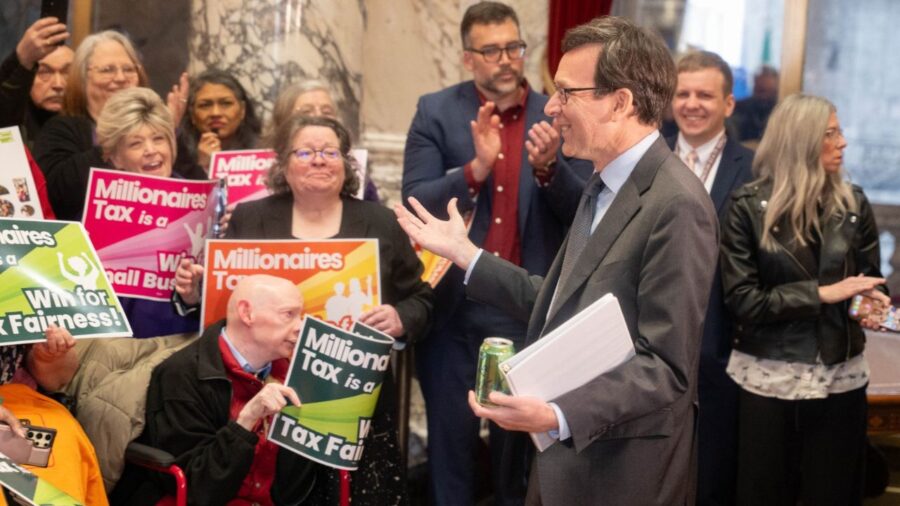
Former Washington Attorney General Rob McKenna told KIRO Newsradio the threat has likely set off urgent conversations in Olympia.
“They would be evaluating where the federal money is coming from, how it’s being spent, and how losing that funding would impact the state budget and local budgets,” McKenna said.
Washington received approximately $28 billion in federal funding last year. Seattle and several other cities in the state have declared themselves sanctuary jurisdictions, which generally means they limit cooperation with Immigration and Customs Enforcement.
Trump unveiled the threat Tuesday during a speech at the Detroit Economic Club.
“Starting Feb. 1, we’re not making any payments to sanctuary cities or states having sanctuary cities, because they do everything possible to protect criminals at the expense of American citizens,” Trump said, according to The Associated Press.
When asked what kind of funding would be affected, Trump said, “You’ll see. It’ll be significant.”
RELATED STORIES



Courts have blocked Trump’s sanctuary city funding cuts twice before
McKenna said the president’s ability to follow through on the threat depends on the type of funding involved.
“While the president can no doubt stop some funding by executive order, funding that’s provided by statute would be a lot harder to cut,” McKenna said. “It isn’t clear to me that he’d be able to stop federal Medicaid funding in our state, which the state matches, because that’s provided by statute.”
The distinction matters. When Congress passes a law directing money to be spent on a specific program, like Medicaid, the president cannot simply refuse to distribute those funds. That would require an act of Congress to change. Discretionary spending, on the other hand, gives the executive branch more flexibility in how funds are allocated, making programs like transit projects and transportation grants more vulnerable to cuts by executive order.
Medicaid would likely be the single largest item at stake, McKenna said. If the federal government somehow cut off that funding, it would have a “huge impact” on the state budget.
“But again, that’s provided by statute, as opposed to discretionary spending like transit and transportation projects,” he said.
Courts have rejected similar efforts by Trump before. In his first term in 2017, courts struck down his attempt to cut funding to sanctuary cities. Last year, a California-based federal judge struck down a similar executive order, with government lawyers arguing it was too early to stop the plan when no specific conditions had been laid out, according to The Associated Press.
How Seattle responded to earlier sanctuary city funding threats
When U.S. Attorney General Pam Bondi announced plans in 2025 to pause federal funding for sanctuary cities, then-Mayor Bruce Harrell’s office pushed back.
Harrell’s press secretary Callie Craighead noted that immigration law and enforcement “is solely the domain of the federal government and the City does not interfere with, nor carry out, the federal government’s duties.”
Harrell took several steps in response to the threat. He issued a mayoral directive to all executive branch departments regarding federal immigration enforcement “to ensure that as a city, our policies protect the safety, privacy, and constitutional rights of Seattleites while complying with applicable law,” Craighead said.
Harrell also met with immigrant, refugee, and asylee community organizations to discuss anticipated needs.
“Strong constitutional protections exist that limit the federal government’s ability to coerce cities by conditioning funds,” Craighead said.
Seattle Mayor Katie Wilson’s office has not yet commented on Trump’s latest threat.
WA already facing budget deficit before Trump’s federal funding threat
McKenna said the timing of Trump’s threat comes as Washington state is already facing a significant budget shortfall.
“You have to ask: why do we have such a big deficit?” McKenna said. “Putting aside the federal funding, the budget has gone up from thirty-two billion to seventy-six or seventy-eight billion dollars in twelve or fourteen years, fifty percent faster than inflation and population growth.”
McKenna noted lawmakers raised taxes by more than $9 billion last session.
“How are they facing a deficit? That’s puzzling,” he said. “But the federal move, if it happens, obviously creates a big hole for them.”
The Department of Justice published a list last year of three dozen states, cities, and counties it considers sanctuary jurisdictions. The list is overwhelmingly made up of places where Democrats control the government, including California, Connecticut, and New York, according to The Associated Press.
Charlie Harger is the host of “Seattle’s Morning News” on KIRO Newsradio. You can read more of his stories and commentaries here. Follow Charlie on X and email him here.
Follow @https://twitter.com/kirocharlie