WA bill that would bar most police from wearing face coverings, masks clears first committee
Jan 15, 2026, 5:18 PM | Updated: 5:21 pm

Border Patrol agents make an apprehension on Jan. 11 in Minneapolis, Minnesota. (Photo: Scott Olson, Getty Images)
(Photo: Scott Olson, Getty Images)
Washington lawmakers are moving forward with a bill that would limit when police officers can cover their faces while interacting with the public.
Senate Bill 5855 cleared the Senate Law and Justice Committee Thursday. It now moves to the Senate Rules committee.
The bill adds a new section to state law requiring law enforcement officers to be clearly identifiable, including a visible name or identifying information, and generally prohibiting officers from wearing opaque facial coverings while performing their duties. The bill defines facial coverings as items that conceal an officer’s identity, such as balaclavas or tactical masks.
“We’re all aware of incidents that started occurring last year where we started seeing law enforcement officers throughout the country where they were bringing intimidation tactics and bringing fear in neighborhoods, our families and communities,” Senator Javier Valdez, the bill’s sponsor, explained after formally introducing his bill during a Senate Law and Justice Committee meeting Tuesday. “Just last week, in my own district, in the 46th District, three individuals were detained by ICE officers, all hiding behind shielded masks.”
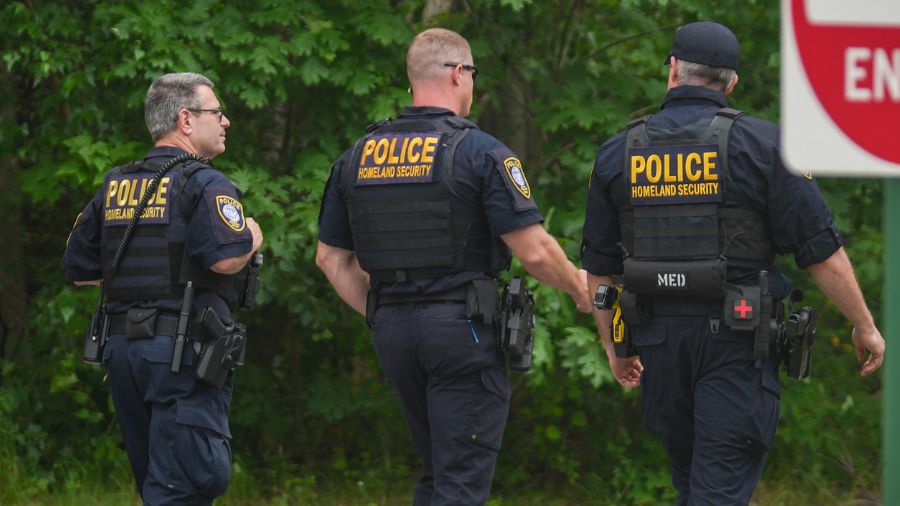
There are specific exceptions. Officers working undercover, SWAT officers wearing protective gear, and those using medical masks or safety equipment, like respirators or helmets, would still be allowed to cover their faces when necessary.
The proposal also gives people a new legal option. Anyone detained by an officer who violates the rule could file a civil lawsuit, seeking damages, attorneys’ fees, and court orders to stop future violations.
RELATED STORIES


Washington governor’s office supports bill
Governor Bob Ferguson’s office supports the bill.
“Knowing who is protecting and serving in their community helps build trust between law enforcement personnel and who they serve,” Nathan Olson, a policy advisor with the Governor’s Office, said. “This bill builds on that and continues the work of our reasonably identifiable statute, which only applies to state-commissioned law enforcement officers.”
U.S. Border Czar, Tom Homan, recently defended ICE agents’ use of masks to conceal their identity and said it was no different than protestors wearing masks during Black Lives Matter protests.
“We’re not even talking about the doxing of agents, their spouses and their children, so they’re wearing masks to give themselves some sort of protection,” Homan told Politico. “The same people who are complaining about ICE wearing masks have they ever said anything about a BLM protestor wearing a mask?”
During the hearing, interim U.S. Attorney for the Eastern District of Washington, Pete Serrano, cited the U.S. Constitution’s Supremacy Clause, which establishes that federal law takes precedence over state laws, and the Intergovernmental Doctrine, which prevents the federal government and individual state governments from intruding on each other’s sovereignty, as barriers to the bill’s successful passing.
“With those base principles, there is a concern this bill lacks constitutionality,” Serrano explained.
Serrano also called the bill dangerous for federal officers.
“The bill recklessly endangers the lives of the members of our law enforcement communities,” Serrano said at the Senate committee hearing. “As of last fall, doxxing increased by 1,000% and 8,000% death threats to our members of the law enforcement community.”
Last year, California became the first state to pass a law banning most law enforcement officers from wearing masks that conceal their identities while on duty, with narrow exceptions for things like medical masks and undercover work. That law is now being challenged in federal court by the U.S. Department of Justice, which argues that some of its provisions are unconstitutional because only the federal government can set requirements for federal officers.
State Republican Senator, Jeff Holy, suggested the committee and Valdez, the bill’s sponsor, should delay the issue until after the federal courts make a concrete decision.
“I understand exactly what you’re trying to do, and it’s a noble cause. What you’re doing is linear, it’s direct, it’s on point,” Holy said. “I’m not sure this is ready for prime time until it is resolved in California.”
Similar bills are being considered in Illinois, Michigan, Massachusetts, and Oregon.
This story was originally published on January 13, 2025. It has been updated and republished since then.
Follow Luke Duecy on X. Read more of his stories here. Submit news tips here.