Harger: Top WA Senate Democrat’s last-minute bill would strip corporations of legal existence for opposing income tax, unions exempt
Mar 9, 2026, 4:33 PM | Updated: Mar 10, 2026, 4:26 am

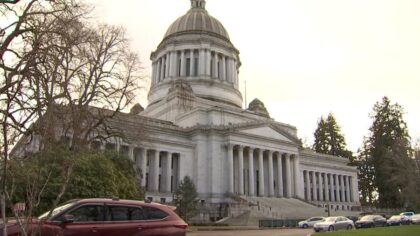
The Washington State Capitol in Olympia. (Photo courtesy of KIRO 7)
(Photo courtesy of KIRO 7)
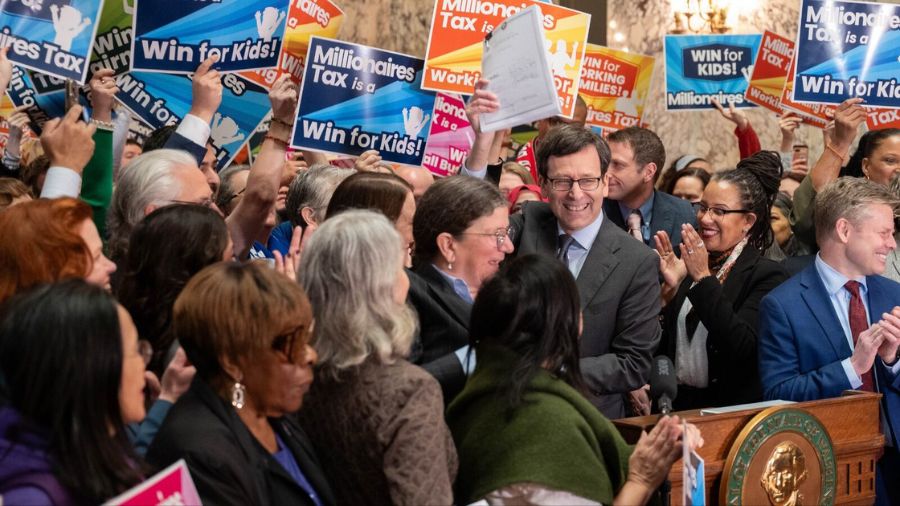
Washington state Democrats are racing to pass an income tax on millionaires before the legislative session ends Thursday. A bill introduced Monday suggested some of them want to make sure no one could stop it.
Senate Majority Leader Jamie Pedersen said the bill is already dead, but the fact that a member of Democratic leadership introduced it in the first place is worth understanding, because it tells you exactly what’s coming next.
Senate Bill 6358, introduced Monday by Senate Majority Caucus Chair Bob Hasegawa, D-Tukwila, would strip any corporation, LLC, or nonprofit of its legal existence if it spent money trying to defeat a ballot measure or influence an election. Spend money fighting a ballot measure in Washington, and your company could legally cease to exist.
Pedersen told KIRO Newsradio the bill cannot move forward.
“Under our state constitution, the legislature cannot consider any bill introduced in the final 10 days of the legislative session, including this one,” Pedersen wrote. “The bill is dead and will not be the subject of committee hearings, briefings, or floor action.”
That may be true for this session. But critics tell us Hasegawa’s introduction of the bill this week could also be laying the groundwork for the next legislative session in 2027, when the income tax, if it passes and survives a ballot challenge, could face a renewed push to insulate it from corporate opposition.
Hasegawa responded Tuesday with a statement saying the bill was never intended to pass this session. “This bill won’t progress this session. I introduced it to start a conversation about big money influencing our elections, similar to ideas that are being talked about in Montana, California and elsewhere,” Hasegawa wrote. “My intent is to shift power back to people, not corporations, in political campaigns.”
Hasegawa pointed to the growth of outside spending since the Citizens United ruling. “Between 2008 and 2024, reported independent expenditures by outside groups exploded more than 28-fold, from $144 million to $4.21 billion, plus unreported dark money also skyrocketed,” he wrote.
Hasegawa did not directly address the union exemption in the bill, nor did he say whether he intends to reintroduce the legislation in 2027.
Pedersen’s response to our question about whether he welcomes a citizen initiative on the income tax was also revealing.
“I fully expect that opponents will use the initiative process to challenge the enactment of the Millionaires Tax,” he wrote. “I welcome the public conversation about our state’s tax structure and the chance for a strong defense of the legislature’s work on this issue.”
This suggests that if the bill passes and becomes law, the income tax fight isn’t over. It’s just moving to a different battlefield.
RELATED STORIES


What the bill would do
Under SB 6358, any Washington corporation, LLC, limited partnership, or nonprofit that engages in ballot measure or election activity would be acting outside its legal authority. The penalty isn’t a fine. It isn’t a lawsuit. It’s the loss of everything: limited liability protection, corporate charter, and the right to legally exist in Washington. Owners would become personally liable for every corporate debt.
The bill covers any entity whose existence or limited liability shield is conferred by Washington state law. That sweeps in businesses of every size, chambers of commerce, nonprofits, trade associations, and groups like Let’s Go Washington.
It does not cover labor unions.
Traditional unions derive their legal existence from federal law, specifically the National Labor Relations Act, not Washington state law. Under the bill’s own definition, they don’t qualify as corporations. Unions could continue spending freely on ballot campaigns and elections. Every other corporate entity in Washington could not do so without risking its existence.
The bill was introduced by Hasegawa, a 32-year Teamsters leader before his election to the Senate. Whether the union exemption is intentional or simply convenient is a question KIRO Newsradio put directly to Hasegawa. He did not answer the question,
Pedersen declined to say whether he was briefed on the bill before its introduction.
‘A shakedown bill’
Brian Heywood, founder of Let’s Go Washington, told “Seattle’s Morning News” on KIRO Newsradio what he thinks the bill is really about.
“I think this is a shakedown bill of the Washington Roundtable,” Heywood said. “It’s a ‘hey guys, we can threaten the very structure that you’re built on in this state if you don’t play ball with us on the income tax.’ If Amazon and Microsoft just said, ‘we think this is bad for business, bad for our industry, bad for employees, bad for customers,’ it would kill this thing right away. Bob Ferguson would not have a fig leaf to hide behind. So it’s a threat: either you tacitly endorse it or sit on the sidelines, or we’re going to come after you.”
The Washington Roundtable is a nonprofit organization made up of senior executives from the state’s largest private sector employers, including companies like Amazon, Microsoft, Boeing, and Puget Sound Energy, and is one of the most influential business lobbying voices in Olympia.
Heywood added that smaller players are in the crosshairs, too.
“If any donor, any group, any small business wants to politically donate to us, they are at risk. This bill would go after them and shut their voice down.”
The bill doesn’t stop at Washington’s borders. Any out-of-state corporation that spends money on Washington elections would be treated as a Washington corporation and face the same consequences.
“If you’re out of state, the threat is: if you dare to participate in politics here, we will treat you like a Washington corporation,” Heywood said.
This isn’t just about the income tax
Heywood said the bill’s reach extends far beyond any single ballot measure.
“It’s not just initiatives. My reading of the bill says any campaign activity, period,” Heywood said. “This takes corporations out of supporting candidates, supporting ideas. It sidelines all corporate money in politics in Washington state.”
He pushed back hard on the idea that this only affects opponents of the income tax.
“Any cause for any side now gets silenced. This is a direct threat on speech, a direct threat on political activity,” Heywood added. “What this bill sends a message to is that they really don’t care whether it’s someone they oppose or someone on their side. They’re going to do whatever they want, and your input is not needed.”
The three-part playbook
Many see SB 6358 as the third piece of a larger strategy to protect the income tax from a ballot challenge.
The income tax bill already contains a necessity clause, which blocks the faster referendum process. Opponents cannot quickly gather signatures to put a repeal straight to voters. A second bill this session, SB 5973, attempted to ban paid signature gatherers and add new barriers to the initiative process. That bill died after a public backlash.
SB 6358 may be dead for now, but three attempts to lock the door on any ballot challenge to the income tax, across a single legislative session, is a pattern worth watching heading into 2027.
The constitutional question it raises
The bill attempts to sidestep the U.S. Supreme Court’s Citizens United ruling through what legal scholars call the Corporate Power Reset theory, arguing Washington never had to grant corporations political powers in the first place. If the power was never granted, there’s nothing for the First Amendment to protect.
Heywood wasn’t buying it.
“The Supreme Court ruled very clearly that money is speech. This is knowingly unconstitutional, like the income tax itself,” Heywood said.
The Montana Supreme Court rejected a similar measure in January. If a version of SB 6358 were ever passed and signed into law, an immediate federal court challenge would be virtually certain. Critics argue the chilling effect on corporate political activity would kick in the moment the bill passed, not when courts finally ruled. The 2026 initiative window could close long before any court delivers a final answer. The law wouldn’t have to work to work.
Heywood said, regardless of what comes next, Let’s Go Washington isn’t going anywhere.
“I think this is something that can’t stand. The only option otherwise is to give up, and I don’t think that’s an option here,” he said.
The session ends on Thursday. The initiative fight starts after that.
Charlie Harger is the host of “Seattle’s Morning News” on KIRO Newsradio. You can read more of his stories and commentaries here. Follow Charlie on X and email him here.