‘Zip it and vote’: Washington House Speaker breaks 132-year tradition to end debate on…Well, debate
Apr 15, 2025, 5:29 PM

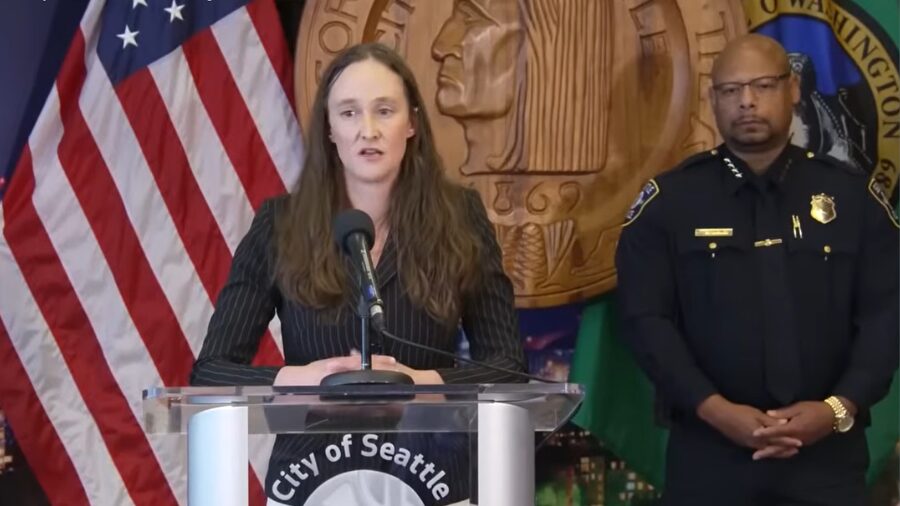
Washington State House Speaker Laurie Jinkins and Speaker Pro Tem Chris Stearns shut down a debate on the Parents' Bill of Rights. (Photo courtesy of TVW)
(Photo courtesy of TVW)
In a dramatic twist during one of the most contentious debates of the session, Washington State House Speaker Laurie Jinkins (D-Tacoma) and Speaker Pro Tem Chris Stearns (D-Auburn) used what one Republican lawmaker called the legislative equivalent of a “red card”—effectively telling lawmakers to sit down and shut up.
In soccer, a red card means a player is immediately ejected from the game for a serious foul or misconduct, and their team has to play with one fewer player.
This all went down Monday, during a marathon five-and-a-half-hour debate over the Parent Bill of Rights—a bill that’s already sparked fireworks this session. At the request of Rep. Monica Jurado Stonier, the House invoked a rarely used procedural maneuver to cut off debate. In doing so, they shattered a 132-year-old tradition that protected open-floor discussion in the chamber.
Let’s rewind
Until recently, House rules required a two-thirds majority—that’s 66 out of 98 lawmakers—to shut down debate on a bill. That rule stood for more than a century. But in late January, the House voted 54-33 to ditch the supermajority requirement. Now, it only takes a simple majority (just over 50%) to pull the plug on floor speeches.
With 59 Democrats and 39 Republicans currently in the House, that rule change gave Democrats a much easier path to wrap up debates—without needing a single Republican vote.
And on Monday, they used that power. Twice.
Wait, what even is the ‘previous question?’
In legislative lingo, “moving the previous question” is basically the political version of saying, “Enough talking—let’s vote already.” It’s a motion to end debate and go straight to a vote, whether on an amendment, a bill, or some other motion.
Four hours into Monday’s debate on Senate Bill 5181, lawmakers were arguing over an amendment to remove the bill’s emergency clause—a provision that would make the bill take effect immediately once signed by the governor and, more controversially, block voters from using a referendum to overturn it.
Republican Reps. Ed Orcutt and Jim Walsh had just finished grilling the clause, even taking a swipe at State Superintendent Chris Reykdal.
That’s when House Majority Floor Leader Representative Monica Stonier (D-Vancouver) had apparently heard enough. She requested a “previous question,” and Speaker Pro Tem Stearns reached for his notes—because, let’s be real, it’s not something they’ve had to do much in the last century.
Here’s how it works:
- At least 1/6 of the lawmakers present must support bringing the “previous question” to a vote. (If all 98 are there, that’s 16 people.)
- Once that threshold is hit, the full House votes on whether to end the debate.
- There’s no debate allowed about ending debate (yes, really).
- If the majority votes yes—boom, debate is over. No more speeches. Straight to the vote.
That’s exactly what happened with the amendment to remove the emergency clause.
Don’t talk about what just happened
Later on, during a debate over a separate amendment, Rep. Jeremie Dufault (R-Selah) tried to bring up the earlier use of the “red card.” Speaker Jinkins immediately cut him off, gaveling him down and insisting he stay on topic. He sat down without continuing.
Hours into the debate, Stonier again moved for the “previous question”—this time to end discussion on the bill itself. Because they were voting on final passage (or a motion to kill the bill, known as “postpone indefinitely”), rules allowed one person from each side to make a final 3-minute pitch.
Rep. Jim Walsh (R-Aberdeen), who called the move “a red card,” gave the Republican rebuttal. Rep. Kristine Reeves (D-Federal Way) delivered the Democratic argument in favor.
The bill passed 57-38. All Democrats voted yes. All Republicans voted no. Three members were excused.
So…why are people mad?
RELATED STORIES


Some lawmakers—especially Republicans and free-speech purists—see the rule change as a muzzle. Cutting off debate feels a lot like saying, “Shhh, your opinion doesn’t matter anymore.” And now, the majority can do it with a simple vote? That’s a power move, no question.
Their argument: “This is a democracy. We should get to speak our minds about the laws we’re passing.”
On the flip side, supporters say: “Debate is fine, but at some point, we’ve got to get things done.” The rule helps prevent floor speeches from turning into filibusters and keeps business moving.
To critics, it’s silencing. To fans, it’s streamlining.
Bottom line: if you hear someone yell “Previous question!” on the House floor, just know what they’re really saying is: “Time’s up—zip it and vote.”
Matt Markovich is the KIRO Newsradio political analyst. Follow him on X.