What will happen if there’s a government shutdown at day’s end
Sep 29, 2025, 9:04 PM | Updated: Oct 1, 2025, 11:06 am
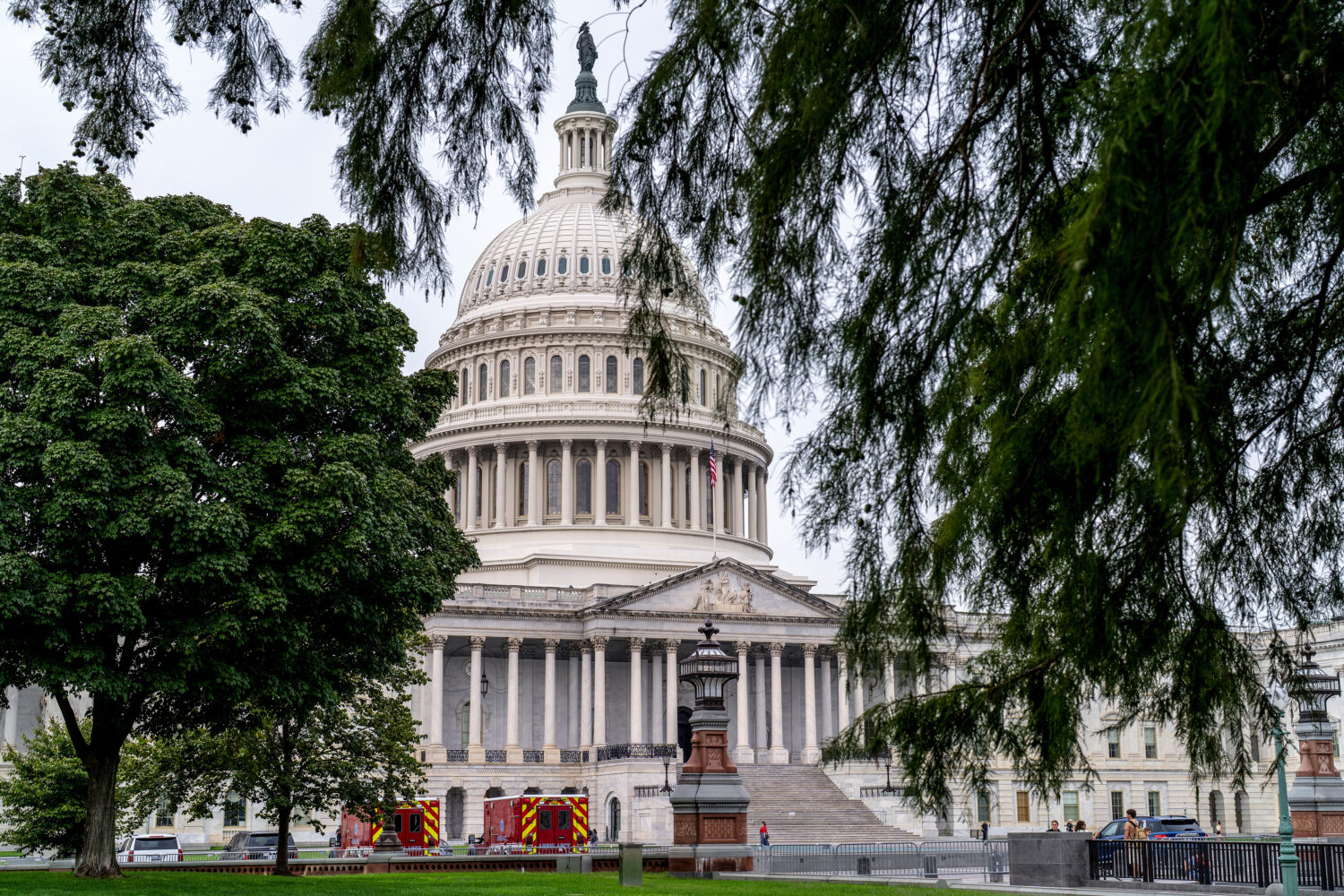
The Capitol in Washington, Wednesday, Sept. 24, 2025, with just days to go before federal money runs out with the end of the fiscal year on Tuesday, Sept. 30. (AP Photo/J. Scott Applewhite)
Credit: ASSOCIATED PRESS
(AP Photo/J. Scott Applewhite)

WASHINGTON (AP) — Washington is just hours away from yet another federal government shutdown, with prospects looking rather bleak for a last-minute compromise in Congress to avoid federal closures beginning at 12:01 a.m. Wednesday.
Republicans have crafted a short-term measure to fund the government through Nov. 21, but Democrats have insisted that the measure address their concerns on health care. They want to reverse the Medicaid cuts in President Donald Trump’s mega-bill that passed this summer as well as extend tax credits that make health insurance premiums more affordable for millions who purchase through the marketplaces established by the Affordable Care Act. Republicans say the Democratic proposal is a non-starter.
Neither side is showing any signs of budging, with the House not even expected to have votes this week.
Here’s a look at how a shutdown would occur.
When a lapse in funding occurs, the law requires agencies to cease activity and furlough their “non-excepted” employees. Excepted employees include those who perform work to protect life and property. They stay on the job but don’t get paid until after the shutdown has ended.
During the 35-day partial shutdown in Trump’s first term, roughly 340,000 of the 800,000 federal workers at affected agencies were furloughed. The remainder were “excepted” and required to work.
A great deal, actually.
FBI investigators, CIA officers, air traffic controllers and agents manning airport checkpoints continue to work. So do members of the Armed Forces.
Those programs that rely on mandatory spending also generally continue during a shutdown. Social Security checks continue to go out. Seniors who rely on Medicare coverage can still go see their doctors and health care providers and submit claims for payment and be reimbursed.
Veteran health care also continues during a shutdown. Veterans Affairs medical centers and outpatient clinics will be open and VA benefits will continue to be processed and delivered. Burials will continue at VA national cemeteries.
Yes. In 2019, Congress passed a bill enshrining into law the requirement that furloughed employees get retroactive pay once operations resume.
While they will eventually get paid, the furloughed workers as well as those who remain on the job may have to go without one or more of their regular paychecks, depending upon how long the shutdown lasts, which will create financial stress for many families.
Service members would also receive back pay for any missed paychecks once federal funding resumes.
Yes. The U.S. Postal Service is not affected by a government shutdown. It is an independent entity that is funded through the sale of its products and services, not by tax dollars.
All administrations get some leeway to choose which services to freeze and which to maintain in a shutdown.
The first Trump administration worked to blunt the impact of what became the country’s longest partial shutdown in 2018 and 2019. But in the selective reopening of offices, experts say they saw a willingness to cut corners, scrap prior plans and wade into legally dubious territory to mitigate the pain.
Each federal agency develops its own shutdown plan. The plans outline which agency workers would stay on the job during a government shutdown and which would be furloughed.
In a provocative move, the White House’s Office of Management and Budget has threatened the mass firing of federal workers in the event of a shutdown. An OMB memo said those programs that did not get funding through Trump’s mega-bill this summer would bear the brunt of a shutdown.
Agencies should consider issuing reduction-in-force notices for those programs whose funding expires Oct. 1, that don’t have alternative funding sources and are “not consistent with the President’s priorities,” the memo said.
That would be a much more aggressive step than in previous shutdowns, when furloughed federal workers returned to their jobs once Congress approved government spending. A reduction in force would not only lay off employees but eliminate their positions, which would trigger yet another massive upheaval in a federal workforce that has already faced major rounds of cuts this year due to efforts from the Department of Government Efficiency and elsewhere in the Trump administration.
Some agencies have recently updated plans on their websites. Others still have plans that were last updated several months or years ago, providing an indication of past precedent that could guide the Trump administration.
Here are some excerpts from those plans:
— Health and Human Services will furlough about 41% of its staff out of nearly 80,000 employees, according to a contingency plan posted on its website. The remaining employees will keep up activities needed to protect human life and property.
The Centers for Disease Control and Prevention will continue monitoring for disease outbreaks. Direct medical services through the Indian Health Service and the National Institutes of Health Clinical Center will remain available. However, the Centers for Disease Control and Prevention communications to the public will be hampered and NIH will not admit new patients to the Clinical Center, except for whom it is medically necessary.
At the Food and Drug Administration, its “ability to protect and promote public health and safety would be significantly impacted, with many activities delayed or paused.” For example, the agency would not accept new drug applications or medical device submissions that require payment of a user fee.
— The Education Department will furlough about 1,500 of 1,700 employees, excluding federal student aid workers. The department will continue to disburse student aid such as Pell Grants and Federal Direct Student Loans. Student loan borrowers will still be required to make payments on their outstanding debt. The department would cease new grantmaking activities, but most grant programs typically make awards over the summer so there would be limited impact.
— National Park Service: As a general rule if a facility or area is inaccessible during non-business hours, it will be locked for the duration of the lapse in funding, said a March 2024 plan. At parks where it is impractical or impossible to restrict public access, staffing will vary by park. “Generally, where parks have accessible park areas, including park roads, lookouts, trails, campgrounds, and open-air memorials, these areas will remain physically accessible to the public.”
— Transportation: Air traffic controller hiring and field training would cease, as would routine personnel security background checks and air traffic performance analysis, according to a March 25 update.
— Smithsonian Institution: “The Smithsonian’s National Zoo and Conservation Biology Institute, like all Smithsonian museums, receives federal funding. Thus, during a government shutdown, the Zoo — and the rest of the Smithsonian museums — must close to the public.”
Phillip Swagel, director of the Congressional Budget Office, said a short shutdown doesn’t have a huge impact on the economy, especially since federal workers, by law, are paid retroactively. But “if a shutdown continues, then that can give rise to uncertainties about what is the role of government in our society, and what’s the financial impact on all the programs that the government funds.”
“The impact is not immediate, but over time, there is a negative impact of a shutdown on the economy,” he added.
Markets have not reacted strongly to past shutdowns, according to Goldman Sachs Research. At the close of the three prolonged shutdowns since the early 1990s, equity markets finished flat or up even after dipping initially.
A government-wide shutdown would directly reduce growth by around 0.15 percentage point for each week it lasted, or about 0.2 percentage point per week once private-sector effects were included, and growth would rise by the same cumulative amount in the quarter following reopening, writes Alec Phillips, chief U.S. political economist at Goldman Sachs.
___
Associated Press writer Ali Swenson contributed to this report.