‘Time is the fire in which we burn’: 2 major cast losses rock the passionate ‘Star Trek’ universe
Oct 30, 2026, 4:47 AM
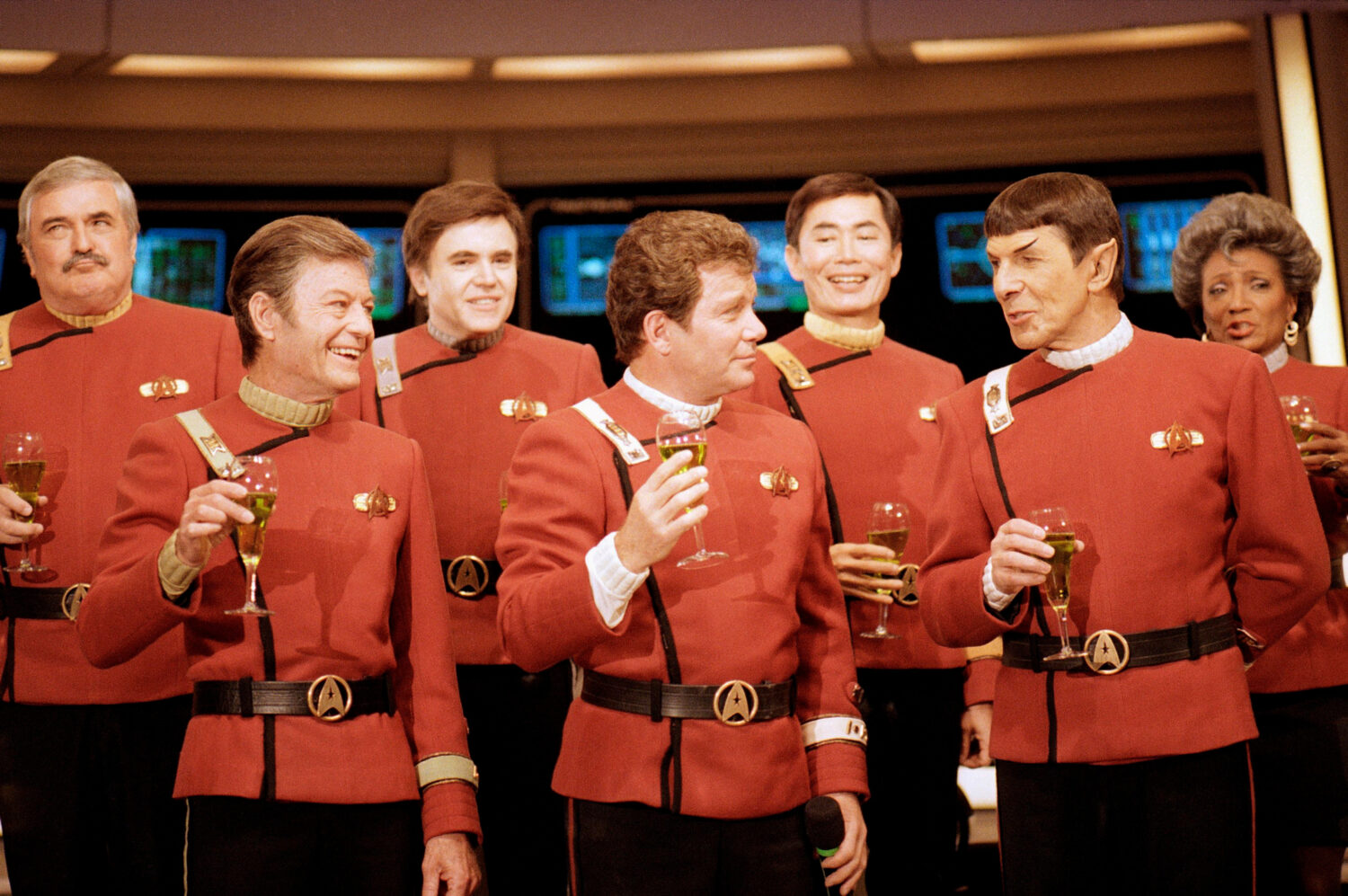
FILE- Members of the "Star Trek" crew, from left, James Doohan, DeForest Kelley, Walter Koenig, William Shatner, George Takei, Leonard Nimoy, and Nichelle Nichols, toast the newest "Star Trek" film at Paramount Studios on Dec. 28, 1988. (AP Photo/Bob Galbraith, File)
Credit: AP Photo/Bob Galbraith
(AP Photo/Bob Galbraith, File)

WASHINGTON (AP) — One of the countless memorable lines that have tumbled out of the “Star Trek” universe over the years is this gem, originally from a 20th-century poet named Delmore Schwartz: “Time is the fire in which we burn.”
It was uttered as an existential warning to Capt. Jean-Luc Picard in the 1994 film “Star Trek Generations.” But it feels equally apt this week after a one-two punch of loss that is hitting hard for devotees of the epic, six-decade science fiction saga.
First, on Sunday, Walter Koenig, who played Ensign Pavel Chekov in the original series during the 1960s, died at age 90. Then, on Thursday, the cosmos lost Patrick Stewart, a Shakespearean actor who in 1987 began to inhabit Picard, the poetic face of that show’s sequel, “Star Trek: The Next Generation,” and decades later the anchor of the darker streaming drama “Star Trek: Picard.”
For a fan base that has long signed on as acolytes of a brighter, more equitable future, recent days have given the present an unwelcome sting.
“What a heartbreaking week it has been,” said William Shatner, who played Capt. James T. Kirk in the original series from 1966 to 1969 and went on to star in six movie sequels. He is one of only two members of that long-ago cast still living; Leonard “Spock” Nimoy, his best friend on the show — and off and on in real life — died in 2015.
For all the characterizations of it as nerdy over the years — something many fans have come to accept cheerfully — “Star Trek” has long been at the vanguard of modern-day mythmaking. That has helped it seep into the culture in various ways, vacuuming up disciples as it goes.
The earliest space shuttle was christened “Enterprise” after the show’s flagship after a mass letter-writing campaign persuaded President Gerald Ford to rename it, and the cast attended the ship’s introduction. The handheld “communicators” from the show helped inspire early flip phones. Phrases like “Beam me up, Scotty,” “He’s dead, Jim” and “Make it so” have infiltrated society ad nauseam. (The first one was never actually spoken verbatim on the show.)
Today, as the end of a decade-long streaming run of “new Trek” approaches and the franchise’s longtime godfather, Paramount, rumbles into a new corporate era, Trek fans are legion and global and wondering what happens next.
They haunt online forums by the millions, discussing and arguing about themes, stories and minutiae — particularly “canon,” or how well the fictional universe adheres to or violates its own rules. Things can get contentious and aggressive for a fan base that has signed on for peaceful and utopian tomorrows.
This week, those same forums, now turned somber, are awash with tributes and laments — first for Koenig and now for Stewart. At the same time, the sense of mortality is palpable. “Bubble wrap George Takei and William Shatner ASAP,” one post on X said.
Fellow actors in the now-sizable cadre from various shows — and those behind the scenes, too — weighed in on the loss of two people who were, for them, legends.
“His Captain Jean-Luc Picard permanently expanded the universe of Star Trek without measure,” Akiva Goldsman, co-creator of “Star Trek: Picard,” said of Stewart.
Koenig was introduced in the show’s second season for two key reasons. First, his character was a Russian in an era of U.S.-Soviet Cold War tension, part of creator Gene Roddenberry’s effort to build a diverse cast that was groundbreaking for its era and featured, among others, a Japanese helmsman and a Bantu communications officer — not to mention the then-progressive presence of women in authority. Second, Koenig’s Beatle-like looks, complete with mop-top, were calibrated to entice younger fans vibing at the time to the Monkees.
Koenig, oddly, was the first Chekov to exist but is not the first to die. His young counterpart in the lightly rebooted “Kelvin” universe series of “Star Trek” movies that began in 2009, the Soviet-born Anton Yelchin, was killed in 2016 when his car pinned him against a gate outside his Los Angeles home.
With Koenig’s death, only two members of the original cast remain: Shatner and Takei, who played helmsman Hikaru Sulu. The two, who have had an occasionally prickly relationship across the decades, both remain active at ages 95 and 89 respectively. Shatner, a raconteur who has seemingly boundless energy, recently unveiled his latest project — front man for a heavy-metal band. Takei remains in the public eye on social media with his “Oh, Myyyy” content.
Takei and Koenig, who sat together on the Enterprise bridge as helmsman and navigator, were close in real life. On Monday, Takei said his “heart was heavy.”
“He was a writer, a teacher, a thoughtful man, and a loyal friend,” Takei said of Koenig. “Rest well, my dear friend. Keep navigating a steady course.”
Ever since the early 1980s, when Capt. Kirk said bitterly that “Galloping around the cosmos is a game for the young,” the “Star Trek” universe has embraced aging and mortality. It became a theme in many productions, perhaps most prominently from 2020 to 2023 in “Star Trek: Picard.”
Even so, the ethos of “Star Trek” has always been optimism and life. Even its darkest iterations, like “Star Trek: Deep Space Nine,” have been suffused with the notion that humanity — which has always, in the show’s universe, meant far more than humans — would endure and thrive.
“Spock, you want to know something?” Kirk once said to his first officer. “Everybody’s human.” Responded Spock, dryly: “I find that remark … insulting.”
That exchange came in “Star Trek VI: The Undiscovered Country,” a 1991 end-of-the-Cold War political thriller that was the final film to feature the entire original cast. The story focused on the idea of the undiscovered country being the future, and the journey ended in the galactic equivalent of what John F. Kennedy once called “a hard and bitter peace.”
In truth, though, Shakespeare — whose work has infused not only the various incarnations of “Trek” but the careers of its two most prominent actors, Shatner and Stewart — meant something else when he coined the phrase. “The undiscover’d country, from whose bourn no traveller returns,” he writes in “Hamlet.” In short: death.
But with “Star Trek,” as with Shakespeare, the show must go on. That’s exactly what Shatner, then at the ripe old age of 77, told this writer when they spent the day together in 2008: “None of us will be around forever,” he said, “but ‘Star Trek’ will.”
___
Ted Anthony director of new storytelling and newsroom innovation at The Associated Press, has been watching “Star Trek” since he was 18 months old. His younger son’s middle name is Kirk, which is not a coincidence.