Flood season returns: Why a ‘100-year flood’ can happen any year
Nov 20, 2025, 5:02 AM
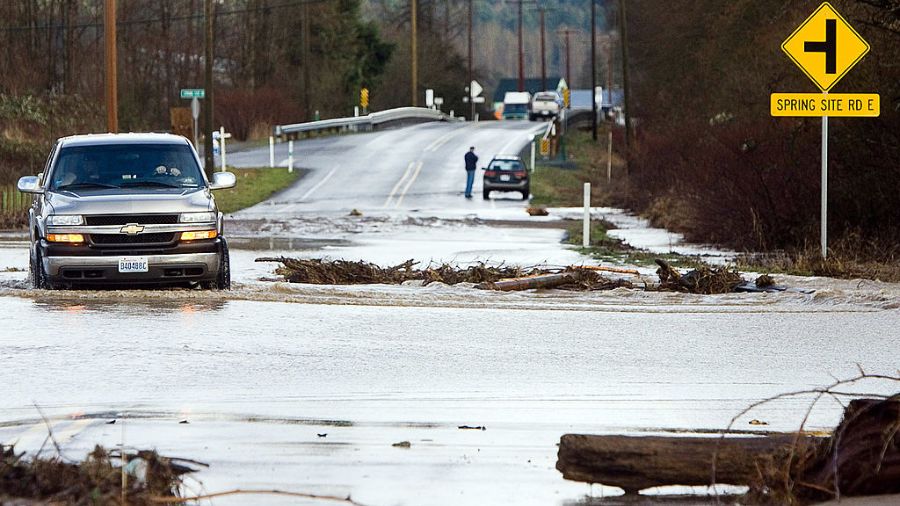
A pickup drives through water flowing over Highway 162 on January 8, 2009 near Orting, Washington. (Photo: Stephen Brashear, Getty Images)
(Photo: Stephen Brashear, Getty Images)
Western Washington’s flood season usually runs from late October through March and mirrors the rainy season. Washington averages about one presidentially declared disaster per year, going back to 1950. About half of those disaster declarations involved major flooding.
Every once in a while, the region gets an extended heavy rain event that results in major river flooding and often a disaster declaration. Some recent big floods included early November 2006, early December 2007, early January 2009, and it was 4 years ago this week that Whatcom County suffered major flooding from a heavy rainfall event.
RELATED STORIES



What does the term ‘100-year flood’ actually mean?
During big floods, you may hear the term — 100-year flood, but what does that term mean? The term 100-year flood often gets misinterpreted, such as, “I just survived a 100-year flood, so I am good for another 99 years.” Sorry, that is not the case.
The term actually means there is a 1% chance of this kind of significant flood each year. As an analogy, imagine a six-sided die. What are the odds of rolling a five? One in six, right? Now you roll it again. What are the odds of getting a five again? The same — one in six. For fun, you can also obtain a 100-sided die and use it to demonstrate the 1 in 100 odds of rolling your selected number.
Those odds are the same for a 1% or 100-year flood each fall and winter season. If you got a 100-year flood this season, next season you have the same 1% chance of getting a 100-year flood once again. Unfortunately, there have been seemingly back-to-back 100-year flood seasons.
The 100-year flood term is a regulatory standard used by the Federal Emergency Management Agency (FEMA) and other federal agencies for local floodplain management and flood insurance. Across the nation, FEMA has created 100-year floodplain maps that local officials and insurance companies use.
Rivers and coastlines evolve over time, and FEMA is constantly catching up on updating these floodplain maps. Local development in floodplains also plays a key role in how rivers change and behave during high water periods.
If you live in or have just moved into a flood-prone or low-lying area, there are steps to take in advance of the next major flood. Some resources include the Washington State Emergency Management Division flood preparedness webpage, FEMA’s flood readiness webpage, and your local county emergency management websites.
As always during flood season, remain vigilant and prepared in case there is an extended heavy rain event resulting in significant flooding, not only for your home or business, but also for your commute if it takes you through river basins. Each season, there is a 1% chance of a 100-year flood on any western Washington river.
Ted Buehner is the KIRO Newsradio meteorologist. Follow him on X and Bluesky. Read more of his stories here.