
Wash. House passes bill to address ‘stealthing’ in sexual encounters
Feb 8, 2024, 4:59 AM
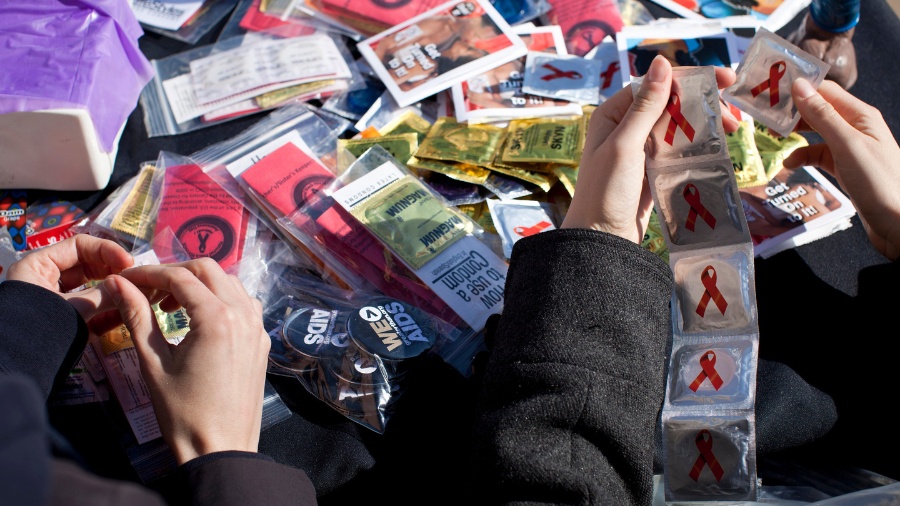
Volunteers separate condoms to give away during a free HIV testing event in Washington, D.C., in February 2012. (Photo: Brendan Smialowski, Getty Images)
(Photo: Brendan Smialowski, Getty Images)
In a decisive move, the House has passed HB 1958, an act aimed at addressing the alarming issue of nonconsensual removal or tampering with sexually protective devices during sexual intercourse. (A PDF of the substitute bill can be viewed here.)
The bill, which passed 64-33, marks a significant step in combating the practice known as “stealthing.”
Titled “An Act Relating to Nonconsensual Removal of or Tampering with a Sexually Protective Device,” the bill introduces measures to create a civil cause of action for individuals who have experienced the nonconsensual removal or tampering of sexually protective devices or have been misled into believing that such devices were used.
Stealthing refers to the deliberate removal or destruction of a condom or other sexually protective device during sexual intercourse without the knowledge or consent of one partner.
This practice can lead to unintended pregnancies and the transmission of sexually transmitted infections.
Stealthing and the law
While stealthing is not explicitly prohibited under current state laws, it may qualify as various offenses depending on the circumstances, such as intentional transmission of HIV or battery.
In response to this gap in legislation, states like California and Maine have recently enacted laws authorizing civil remedies for nonconsensual removal or tampering with condoms. California was the first state to pass a stealthing law in 2021. Maine’s went on the books in 2023.
In its coverage of the California law, The Associated Press in 2021 noted “(stealthing) is rarely prosecuted given the difficulty in proving that a perpetrator acted intentionally instead of accidentally.”
HB 1958 aims to provide recourse for individuals who have been victims of stealthing by allowing them to bring civil actions against perpetrators.
“This bill will allow survivors of sexual assault to be compensated for the real harm that is done to them by stealthing or the nonconsensual removal of a sexually protective device,” Rep. Liz Berry, D-Seattle, said.
The bill outlines specific instances where such actions can be pursued, including cases where the protective device is removed without consent or tampered with in a manner likely to render it ineffective.
Disagreement about devices in the stealthing bill
However, there was disagreement on the House floor regarding how many devices should be included in the bill.
It covers condoms but does not cover devices that are inserted into a woman’s vagina such as diaphragms and internal uterine devices (IUDs). Some argued birth control pills should be included as well.
“What we have to consider, is if a woman says that they have those protective devices, and she’s lying, they could get pregnant, and that man would be financially responsible for that child. That’s not fair,” Rep. Michelle Caldier, R-Gig Harbor, said.
Berry says the bill has been vetted well by experts.
“Broadening this definition to beyond a physical barrier device will open up unintended consequences, especially that can be weaponized against the victims that we are trying to protect in this bill,” Berry said.
An amendment to include other devices failed on a voice vote.
Caldier says she would have voted for the bill if other devices were included, but because they are not, she voted no.
“We cannot say that we want to protect women when we don’t want to protect men. I’m sorry, but I am all for protecting women. But we also have to protect men too,” Caldier said.
Rep. Cyndy Jacobsen, R-Puyallup, called the bill too ambiguous and unenforceable.
“What this may create unintentionally is a morass of he said, she said, and things that we can’t prove in court,” Jacobsen said.
The bill allows for the use of pseudonyms by plaintiffs in legal proceedings to protect their privacy.
It also stipulates that prevailing plaintiffs may be entitled to compensatory and punitive damages, statutory damages of $5,000 per violation, injunctive relief, and reimbursement of legal fees.
The bill now moves to the Senate for further consideration and potential enactment into law.
Matt Markovich often covers the state legislature and public policy for KIRO Newsradio. You can read more of Matt’s stories here. Follow him on X, formerly known as Twitter, or email him here.
Follow @https://twitter.com/mattmarkovich