
Good night and good luck: Why do radio and TV broadcasters speak in that funny voice?
Sep 2, 2015, 5:42 PM | Updated: Oct 11, 2024, 10:06 am
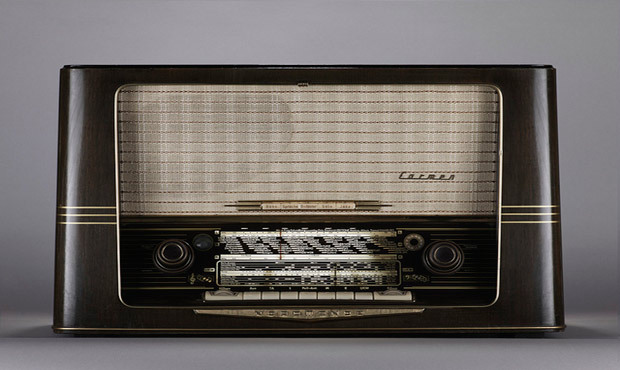
Photo by Dimitri Kloster, CC Images
The other day, while listening to network news, I pondered something I hadn’t pondered much in my 13-year radio broadcasting career: why do most radio and TV newscasters speak like that? You know what I’m talking about. That unnatural, ultra enunciated, super dramatic “news voice.”
As a reporter I did it. I was trained to speak that way. But what’s the history behind it?
Related: Mighty Mo was once a local favorite
Feliks Banel, curator of the Northwest Hall of Radio History at Washington State University, said the “broadcast voice” is as old as radio broadcasting itself, dating back to the 1920s.
“It was a very formal industry,” he said. “So you had people actually dressed in tuxedos standing before microphones, when no one’s there, and doing this formal diction and talking about things in very clear accents. It was radio. There was nothing you could see. Most people had no idea what the people on the radio looked like.
“And so, in order to distinguish themselves, people would exaggerate their voices. By the time you get to the ’30s and ’40s, you have guys like Walter Winchell, who are talking in this very bizarre staccato. Or people like H.V. Kaltenborn, who was this other commentator with a very recognizable voice. So people did things to distinguish themselves,” Banel said.
But while they worked to develop a unique delivery, they were also trying to sound the same, devoid of any regional accent.
“In the 1930s and 1940s, the United States felt bigger because people weren’t connected the way we are now,” Banel explained. “To hear people speaking from all over the world, that was weird.
“In 1932, to hear Franklin Roosevelt campaigning for the presidency with his bizarre accent, ‘The only thing we have to fear…'” Feliks imitates Roosevelt’s booming east coast accent. “There were regional accents and that was kind of strange. So as the radio networks knit together this sort of standardized speech developed.”
Then news radio really took off.
“Radio journalism started to get really serious during World War II,” Banel said. “And there’s this guy named Edward R. Murrow, who was born in North Carolina, but grew up in Washington state, went to school in Pullman. He had gone to school and studied speech. He was all about diction, speaking clearly, and not being opinionated.”
“So there’s this notion of making your voice sound very neutral so you’re not injecting opinion into what you’re saying. And that means speaking in a way that is very clear and very different from how you might speak to your friends or in an office. So it becomes this sort of broadcast speak developed during World War II and perfected, most of all, by Edward R. Murrow,” he said.
Banel believes Murrow’s clear, enunciated, authoritative style has been copied ever since, even by Walter Cronkite, who, in turn, was copied by many people over the years.
Now, you can’t talk radio history without calling up Seattle radio legend Pat O’Day, who was given his first radio job in 1956. His dad, a preacher, had a show, so Pat dreamed of working in radio since he was a kid.
Pat was only in broadcasting school, in Tacoma, for six months when he was plucked up by a station in Astoria, Oregon. But he said he’d already developed his own style.
“So when I was about 10 or 11 years old, I went in the bathroom because the bathtub offers sort of an echo chamber. And I would do play-by-play sports and commercials into the bathtub so I could hear myself talking,” O’Day recalled, laughing. “That’s where I developed a lot of my early training.”
When I think of another local with a very distinct style, I think of KIRO TV’s Jesse Jones and his famous, signature sign-off. But Jesse said it came about by accident.
“I didn’t try to do this. The ‘Jesse Jones’ thing just happened. I wanted to let people know who I was. All the great reporters in this town used to just sign off like ‘I’m Bob Smith. From KIRO,'” Jones imitates in a quiet, slow, monotone voice. “And I’m like, wait? You just did a good story and you’re just, ‘Bob Smith from KIRO.'”
“So, I’m on my first live shot, I’m really nervous, the lights came on, it got to the moment, and it came out,” he said.
What came out was a quick, sharp “Jesse Jones.” It was distinctive and it stuck.
“And my photographer looked at me and was just like, ‘What. In the heck. Was that?’ I came back, I did it again. And then I started getting love mail and hate mail and then I knew people were watching. So I just kept doing it,” he said.
Styles have changed in the nearly 100 years since radio was born, but Banel thinks it remains important to have a serious, cadenced news person on the desk of a nightly news program.
“You don’t want Brian Williams slow jamming the news or whatever,” Banel said.
But you certainly don’t want to go all Ron Burgundy either.