Never Forget: Why Some Young Jews Are Getting Holocaust Tattoos
Oct 29, 2012, 3:37 PM | Updated: Oct 11, 2024, 11:23 am
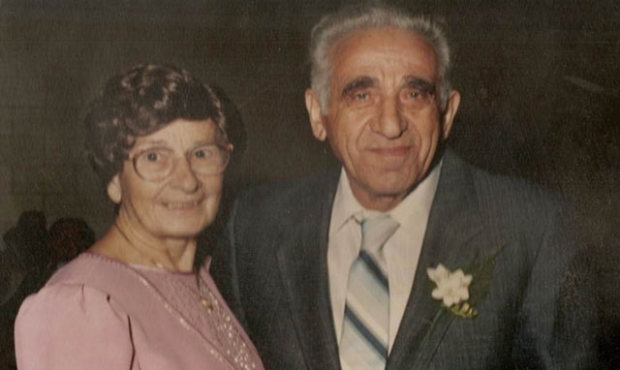
Sheldon Balberman's mom & dad.
Both of my grandparents, on my dad’s side, were Holocaust survivors. My Grandma Margaret was born in Hungary, she met my grandpa in Romania, after the war, and they raised my dad in Israel. But, despite speaking a handful of languages, English wasn’t one of them. So the small amount I know about her story comes through my dad. I know that Grandma Margaret spent three transitional weeks in Auschwitz, which is where her mother and youngest sister were killed, and that my grandpa survived the war, but his first wife and young child did not.
My dad says Grandma Margaret talked about the Holocaust regularly, until the day she died, which was four years ago, and I know that she suffered from terrible nightmares. If she could have somehow forgotten this terrible tragedy, she could have lived her life in peace. Which is why I was so shocked by the story I’m about to tell you.
A recently published New York Times article says that nearly 70 years after the Nazis forcefully tattooed numbers onto the forearms of Jews taken to Auschwitz, some of their descendents are now choosing to get their relative’s numbers tattooed on their forearms.
Seattle’s Sheldon Balberman is the son of two Holocaust survivors, and a volunteer at the Washington State Holocaust Education Resource Center. That’s where we met to discuss this article.
“My parents would never condone this,” Sheldon says.
His mother is from Strykow, Poland, a city that was home to 2,700 Jews before the war, and zero after. His mother was sent to Auschwitz, the only place where Jews were tattooed.
“She went from the Warsaw ghetto to the concentration camp at Mydonic. She was transferred with 626 others who all received their tattoos on June 26th, the same day as my mother.”
Like my grandmother, Sheldon’s mother suffered for decades after the war.
“I can remember, as a boy, waking up and the screams coming from the next room and not really understanding what that was all about.”
I asked Sheldon if his mother ever tried to cover the number on her arm.
“Never. I wouldn’t say that she was proud of it, but she never hid it and she always, always talked about things. Even going back into the 1970’s she was talking to local newspapers and telling her story, which was unheard of back then.”
Story telling is one of the main reason’s that these grandkids, sons, daughters, nieces and nephews say they’re getting this tattoo now. A 21-year-old quoted in the article says that his peers think of the Holocaust as ancient history, and he wants to keep his grandparents story alive and feel a connection to him. Sheldon totally gets that.
“If this is something that enables kids to connect with this past history, if this is something that keeps the memory fresh, then I can look past my initial horror and my initial shock. I’m a volunteer educator. I go out and I speak to kids in the schools and I try and find ways to reach them. My nephew, who’s a graduate student up in Toronto, he’s 21 years old, and his feeling was it might help kids to connect with this past history, and if it does, it’s a good thing.”
Sheldon sent this article to family and friends, asking them what they thought.
“I have a gentile friend in California whose response was ‘My daughter covered her entire arm with meaningless tattoos. At least this has meaning.’ So for him, this was totally clear, why people might want to do this.”
Most of the people quoted in the article live in Israel. This young woman was interviewed by the New York Times:
“It’s the most important thing I did in my life. My name is Eli Sagir. I’m 21 years old. I did this tattoo when I was 17. I ask my grandfather first. He said, ‘Why you want to do this awful number on your hand?’ When my grandfather saw this tattoo first, he started to cry and he kissed my hand. It was very emotional. I told him I want to keep him in me. People ask about it a lot. Every day, minimum of 10 times. My generation doesn’t take the Holocaust seriously enough. So I said to them, ‘It’s to keep my grandfather and the Holocaust survivor alive.'”
My grandma wasn’t at Auschwitz long enough to get a tattoo but if she did have one, I would not replicate it. But, I must say, my perspective on this story has completely changed since I initially read the article. At first I was horrified and shocked, since these tattoos were meant to dehumanize the Jewish people. But after hearing these stories, I now support people who want to get them.
To find out more about where Sheldon volunteers, the visit the Washington State Holocaust Education Resource Center in Seattle website.