Harger: Rob McKenna says the Democrats Christine Gregoire served with wouldn’t recognize what Olympia has become
May 24, 2026, 5:00 AM | Updated: May 26, 2026, 2:06 pm
Rob McKenna was sitting right next to Christine Gregoire when she did it.
Earlier this month at the Association of Washington Business Spring Summit in Vancouver, the former Democratic governor looked at a room full of business leaders and told them her own party has a spending problem. Not a revenue problem. A spending problem. She drew applause. We covered her remarks last week.
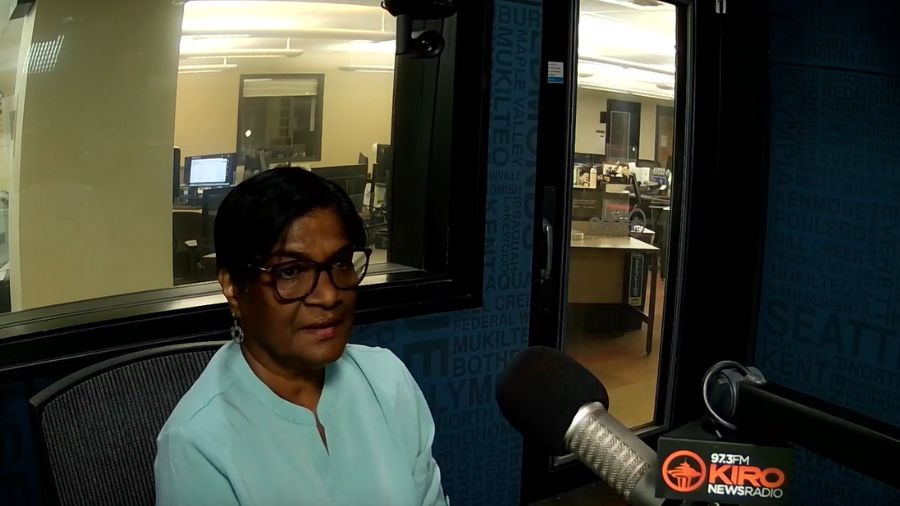
McKenna, the former Republican attorney general, joined Manda Factor and me this week on “Seattle’s Morning News.” He didn’t just witness the moment. He had a few things to add.
McKenna: The state budget is up 150%, and nobody can tell you what we got for it
“The state budget is up 150% since Chris and I left office in 2013, and I doubt very many taxpayers feel like they’re getting 150% more from their state government than they used to,” McKenna told us.
He cited declining school test scores despite some of the highest teacher salaries in the country, and a roughly 40% jump in state employee pay over the same period.
“We’re not seeing better results. We’re seeing worse results in some cases,” McKenna said.
The operating budget stood at roughly $33 billion when Gregoire and McKenna left office in 2013. It sits at about $80 billion today.
Gregoire warned them: The wealthy are leaving, and when they leave, everything goes with them
Gregoire’s message to the AWB crowd was blunt. “I would suggest to you, we don’t really have an income problem, we have a spending problem,” she said. “And we’re answering it by stacking one more tax, one more rule, one more regulation, and the one thing that the business community doesn’t need is that lack of predictability.”
She pointed to the new 9.9% tax on millionaire earners and the estate tax bumped from 20% to 35%, and warned that the consequences are already in motion.
“They will not pay, they’re leaving,” Gregoire said. “When they leave, they stop paying capital gains. When they leave, they stop giving significantly to philanthropy, which would otherwise be necessary by government. So, do you understand? Do you see the consequences of what you’re doing? And the answer is no.”
McKenna: The Democrats Gregoire served with wouldn’t recognize what Olympia has become
I asked McKenna whether Gregoire’s message would have sounded out of place to Washington Democrats 20 years ago. He said no.
“It was consistent with the majority of those Democrats, I think,” McKenna said. “But that majority has shifted now to a majority that believes that taxes should be increased for their own sake and that there’s just no end to government spending.”
He pointed to former Governors Gary Locke and Gregoire as examples of Democrats who were liberal on social issues but fiscally cautious. Gregoire steered the state through the Great Recession. She helped preserve the competitive advantages that attracted companies like Amazon and Boeing, along with thousands of smaller businesses that flourished alongside them.
McKenna warned that those advantages are fragile. Washington has the third-highest per capita GDP in the country and the seventh-highest average personal income. Those numbers weren’t inevitable. They were earned. And they can be lost.
“There are people on the progressive left who complain about a tax system they believe is broken, but these are the same people who voted to give us the highest gas taxes in the country,” McKenna said.
RELATED STORIES



The progressive rebuttal, and why we’re looking at the same dress in different colors
Andrew Villeneuve of the Northwest Progressive Institute published a rebuttal targeting Gregoire’s remarks, The Seattle Times editorial page, and my commentaries on the state budget.
It reminded me of that dress photo from 2015. Was it blue and black? White and gold? Two people staring at the same image, absolutely certain they were seeing different things. Villeneuve and I are looking at the same state budget, the same Olympia, and walking away with takes that don’t seem to be about the same place.
His central argument: Washington’s budget is actually shrinking when you measure state and local spending per $1,000 of personal income. By that metric, spending was $189.98 in 2005 and $170.25 in 2023. The Office of Financial Management publishes the number. It’s real.
But the premise is that government spending should automatically rise in lockstep with private-sector growth, and anything less counts as a cut. If Amazon and Microsoft have a banner year, Olympia is entitled to a proportionally bigger share. If the budget doesn’t keep pace, the state has been forced into “austerity.”
I’d be curious whether he’d apply that logic in reverse. If state GDP dropped 20%, would he support cutting the budget by 20%? Would a smaller economy mean Olympia should spend proportionally less? I suspect the answer is no, and that tells you something about how the metric is being used.
Telling a Washingtonian whose property tax, gas bill, and grocery bill have all climbed that the $80 billion budget is really a smaller version of the old $33 billion one is a hard sell at the kitchen table.
Where Villeneuve and I agree: Washington’s tax code is broken and worth fixing. Where we part ways is the diagnosis. He sees a state starved of resources. McKenna, Gregoire, and many Washingtonians see a state collecting more than ever and still asking for more.
Same dress. Different colors.
Gregoire endorsed Ferguson. She campaigned for him. And now she’s publicly breaking with his direction
Gregoire’s break with her party’s current leadership matters precisely because she’s not a conservative critic. She endorsed Gov. Bob Ferguson. She campaigned for him. And now she’s standing in front of a business audience telling them his administration and the Legislature are misreading the moment.
A $33 billion budget became an $80 billion budget. Test scores went down. The number of full-time employees of Washington State grew by 25% in the past 10 years. The wealthy are being shown the door. And the people running Olympia are asking for more.
At some point, the numbers have to matter more than the labels.
Charlie Harger is the host of “Seattle’s Morning News” on KIRO Newsradio. You can read more of his stories and commentaries here. Follow Charlie on X and email him here.