Harger: Two blue cities decided dealers don’t belong in recovery housing. Seattle hasn’t
Sep 9, 2026, 5:46 AM
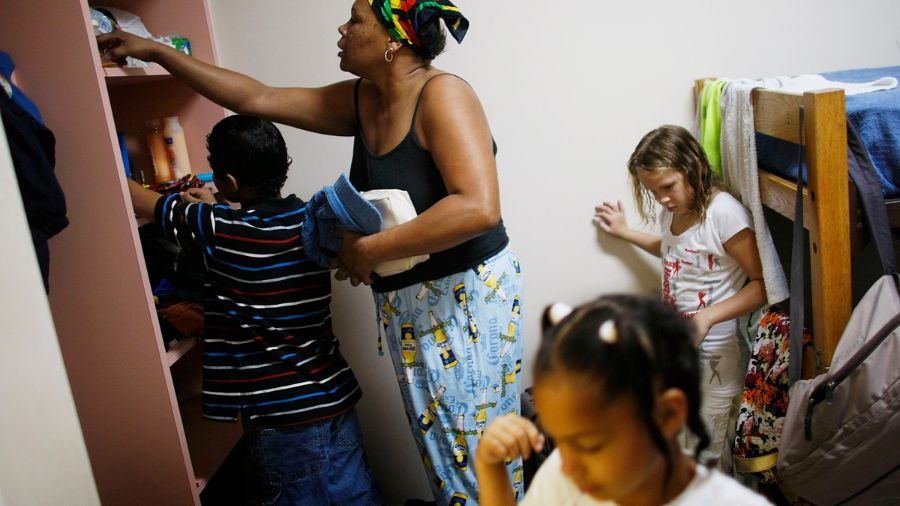
A woman helps her children prepare for school as they try to overcome homelessness while they live in a supportive housing unit. (Photo: Joe Raedle, Getty Images)
(Photo: Joe Raedle, Getty Images)
Yes, I get frustrated writing about addiction and the streets in this region. But the frustration comes from somewhere simple: these are human beings who deserve to get better, and too often we prolong their suffering and call it kindness. So today, instead of just venting, I want to point at something that’s actually working.
It starts with a story I keep hearing from people I interview who’ve lived in permanent supportive housing around here. They finally got inside. A room, a door that locks, the thing that’s supposed to be the foundation for putting a life back together. And down the hall lives the dealer. Drugs move through the building around the clock, and staff looks the other way.
Look at what that does to anyone in the building who might want out. The drugs are 40 feet away, 24 hours a day. The guy selling them has a stake in the relapse. It’s hard to find a way out. The help is real, but you have to ask for it first, and until you do, the staff look away, keep you comfortable, and hope you get around to it. In these buildings, recovery was never really on the table.
Two cities a lot like ours have started changing it, and neither one had to sell out its values to do it. Portland and San Francisco, about as deep blue as it gets, running some of the most permissive drug policies in the country, both looked at the dealer in the hallway and decided that’s a line worth holding.
Portland charged 100 fentanyl dealers; now it’s going after the ones in public housing
Three years ago, Portland’s open-air drug markets were so notorious they’d become the city’s national brand.
The U.S. Attorney’s Office got tired of watching the same cycle Seattle knows by heart, dealers arrested in the morning and back on the corner by dinner. So in 2023, the Portland Project put an FBI agent, a federal prosecutor, and Portland cops on the same blocks week after week, and charged the dealers federally, where nobody walks out the same afternoon. More than 100 have been charged since, with sentences of five years and up.
Two weeks ago, Portland announced the expansion: the same treatment now hits dealers working inside public housing and outside treatment clinics.
“We cannot and will not tolerate dealers on our streets, outside of our clinics or inside our public housing,” Bradford said. “We need to give people who are in recovery a safe place to continue that recovery.”
A safe place to continue that recovery.
San Francisco passed a drug-free housing law, written by a supervisor in recovery
San Francisco, nobody’s idea of a conservative town, built its own version. And in July, its Board of Supervisors went where the problem actually lives. A new ordinance requires new city-funded supportive housing to be drug-free, with eviction or relocation on the table for on-site use. The guy who wrote it, Supervisor Matt Dorsey, is in recovery himself, and he built in a protection so nobody gets tossed for a single relapse. Same diagnosis as Portland, different tool: the building where you’re rebuilding your life can’t double as the marketplace.
Neither city solved fentanyl. But both proved the useful thing: you can push the dealing out of the specific places where vulnerable people are trying to claw their way out of it, as long as you keep the pressure on and the dealers face real time.
Seattle keeps trying at 12th and Jackson. The corner does not care.
Federal prosecutors, Seattle police, and King County prosecutors have all done real casework against the networks feeding 12th and Jackson. But walk down there and see what it bought. In June, the city announced a crackdown: more police, $1.1 million for outreach, a promise it would “no longer tolerate” the open-air market. A week later I went back and found the corner pretty much unchanged, dozens still smoking out in the open. A mile south, on North Beacon Hill, neighbors watch dealers work the tree line at Dr. Jose Rizal Park while patrol results stay limited at best. Someone sent me a video last week of officers riding ATVs across the expanse of Rizal. The dealing just waits them out.
Seattle even had a tool for this. The SODA law, those “stay out of drug area” orders, got used once in 2024, then more than 100 times in 2025, according to Seattle Municipal Court records. This year it’s collapsed to a single order, after the new city attorney, who campaigned on ending SODA, took office. Erika Evans isn’t offering her neighborhoods much right now. One can hope she watches these results roll in from Portland and San Francisco, two cities nobody’s going to accuse of a red-state crackdown, and finds a little room to move. The door’s wide open.
RELATED STORIES


None of this requires a miracle
The city and county can copy San Francisco and write it into the contracts: new supportive housing has to be drug-free. A future U.S. Attorney for western Washington can announce the same street-level partnership Portland runs, because the publicity is half the deterrent. Start with the buildings and the clinic doorsteps.
And none of this touches the addict. Every bit of it lands on the person profiting off him.
Right now we put people in supportive housing, keep the drugs 40 feet away, and call it help while they keep using in a warm room. We give them the foil, the needles, the pipes, and the paraphernalia. We’re warehousing them comfortably enough to stay sick. Make the drugs a hassle, get the dealer out of the hallway, and some of these people get their heads clear enough to do the one thing this whole system sits around waiting for: ask for help.
Portland and San Francisco decided their side of the deal was to make the hallway safe.
Because these are people worth saving. If loving your neighbor means anything, it means wanting the sick one to get well, guiding him toward recovery, and keeping the predator who profits off his sickness out of his building. He deserves the chance to get healthy, to work, to be somebody’s neighbor back. We owe him a hallway that points toward the door, not the dealer.
Seattle’s turn. We can do this.
Charlie Harger is the host of “Seattle’s Morning News” on KIRO Newsradio. You can read more of his stories and commentaries here. Follow Charlie on X and email him here.
Follow @https://twitter.com/kirocharlie