Harger: Kelley Blue Book wants your teen in a Camry. A KIRO listener in Seattle started in a $50 Plymouth. What was your first car?
Oct 22, 2026, 4:00 PM
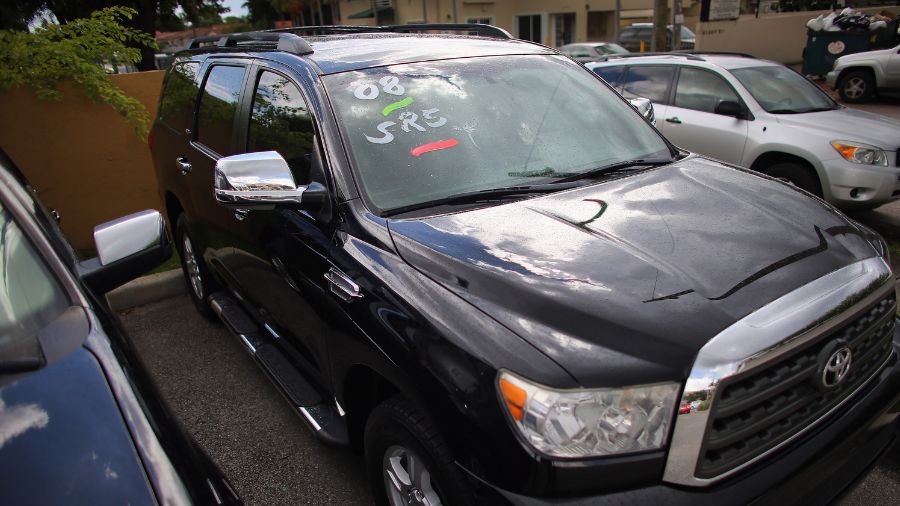
A 2008 Toyota sits on the Affordable Motors sales lot. (Photo: Joe Raedle, Getty Images)
(Photo: Joe Raedle, Getty Images)
Rhiannon in Green Lake learned to drive with both feet.
She texted into the show that her first car was a Plymouth Voyager minivan, the fourth and final hand-me-down in her family. A bungee cord held one door on. The radio only worked when she hit a pothole. The fuel pump was shot, so if she took her foot all the way off the gas, the engine died. She learned to work the brake with one foot and keep the other on the gas.
If you’re shopping for a teenager’s first car this fall, you can do better than that.
Sean Tucker, managing editor at Kelley Blue Book (KBB), joined Manda Factor and me on “Seattle’s Morning News” to walk through KBB’s list of the best cars for teens, from new models down to used cars under $10,000. Manda and I had more than a professional interest. Her daughter is 15 and a half. My son is 14. Both of them have their eyes on the car keys.
While you read, think back to your first car. We want the story, the good, the bad, and the Bungee cords. Share it in the comments below.
What Kelley Blue Book says to avoid in a teen’s first car
Tucker started with what not to buy. Subcompacts are out.
“They just don’t do well enough in crashes,” Tucker said.
So are the biggest pickups and SUVs, which carry a lot of weight for a new driver to control, and anything with a lot of horsepower. The sweet spot is a compact or midsize car, or a small SUV.
The safety features every teen driver’s car needs
Kelley Blue Book leans on crash-test scores from the Insurance Institute for Highway Safety, which Tucker called “a harder grader” than the government’s tests.
At a minimum, he wants antilock brakes, traction control, and stability control. Those have been standard on new cars since around 2012, so they’re easy to find on an affordable used car.
Tucker said automatic emergency braking and blind-spot monitoring make a bigger difference for a teenager than for an experienced driver. Those of us who’ve been driving for decades have spent years learning to judge the cars moving around us. New drivers are doing it for the first time.
“What the brain is learning when it’s learning to drive is just how to perceive space at high speed, and it’s a task they haven’t really had to do before,” Tucker said.
Anything the car can do to help with that, he said, can make a big difference.
RELATED STORIES
Best cars for teens, from new to used under $10,000
For new cars, Tucker’s favorites are the Honda HR-V, the Mazda 3, and the Honda Civic. In the used categories under $20,000 and under $15,000, the Honda CR-V and Toyota RAV4 keep showing up. The only difference is how many birthdays they’ve had.
Kelley Blue Book found six used cars under $10,000 that met all its criteria:
- 2013 Toyota Camry
- 2014 Mazda3
- 2013 Toyota Corolla
- 2009 Toyota RAV4
- 2010 Honda Element
- 2011 Toyota Avalon
Tucker warned they’re fairly rare on dealer lots right now. If you find a good one, don’t sit on it.
Not every family can afford to put a teenager in a car, new or used. Plenty of kids save up and buy their own, share the family car, or ride the bus until it makes sense. For families who are shopping, the same rules apply at any price: stay in the middle of the size range, look for the safety features, and check the crash-test scores.
Call your insurance agent before you buy
Adding a teenager to your car insurance can raise the bill by 150% or more. That number changed Kelley Blue Book’s own advice. Once you think you know what you’re buying, call your insurance company for a quote before you sign anything.
The one exception, according to Kelley Blue Book, is Hawaii, where adding a teen barely moves the premium. I’m not saying move to Maui. I’m just saying.
Is an old beater good enough for a teen driver?
Every parent has heard the argument that an old beater teaches a kid to drive. Tucker isn’t buying it.
“It’s not just a matter of how good a driver your child is; it’s how good a driver everybody else in the world is as well,” he said.
Teens need a car that can survive a crash they couldn’t avoid.
Hand-me-downs can be a different story. Tucker said cars from 10 or 12 years ago are starting to come with automatic emergency braking and lane departure warning, so the car already sitting in your garage might have what you’re looking for.
‘Seattle’s Morning News’ listeners share their first cars
Tucker’s first car was a new Toyota Corolla in the early 1990s. He’d saved up for a used one, and his dad offered to match whatever he had. The first one I bought with my money was an ‘83 Corolla, because my dad did not match.
Manda’s was a neon green Volkswagen Rabbit handed down from her grandmother, the color of a green M&M. She still misses it. My colleague Chris Sullivan paid $500 at a school auction for a 1969 Chevy Impala, a huge rear-wheel-drive boat he admits was too much car for a 16-year-old. He’s not sure it had seatbelts.
Then the text line lit up.
The bargain hunters: Barb in Anacortes bought a ‘52 Plymouth Cranbrook in 1966 for $50, drove it to her lifeguard job all summer, and paid someone $25 to tow it away in September. Tiss in Lakewood paid $700 for a 1988 Honda Civic she named “White Thunder” because it was slow. It had 90 horsepower, and the front windows didn’t roll down.
The ones Kelley Blue Book would worry about: Bill the School Bus Driver said he was one year older than his first car, a 1953 DeSoto Firedome. In the winter of 1970, he crammed eight Cleveland High School soccer players into it and drove them to Memorial Field at Seattle Center. A listener in the 206 had a 1949 Buick with a straight-eight engine that would hit 100 mph, eventually.
“It would take several minutes to get up to that speed,” he wrote.
The questionable parenting: Tammy in the 360 drove a 1967 Oldsmobile Cutlass, and her dad told her she didn’t need to change the oil. Another 206 listener had a poo-brown 1977 Toyota Corolla station wagon with a stick shift. When she broke her foot senior year, her mom let her drive the family’s cherry 1957 Chevy Bel Air instead.
“That was not smart,” she wrote.
Joan in Bellingham hoped for a two-door 1964 Impala and got a four-door 1965. When she landed her first teaching job, her mom sent her the bill.
The lemons: Greg in Vegas had a ‘72 Ford Pinto from a used car dealer his Navy base had blacklisted for putting sawdust in transmissions. Lynn in Mount Vernon had a Datsun B210 hatchback whose air conditioning overheated the car if she dared to use it. Rockfish drove an orange 1974 Chevy Vega with two black racing stripes, a gray hood, a tan fender, and one blue and one yellow headlight rim.
The ones that stuck: Helen’s first car was a copper Volkswagen Rabbit convertible with a white top, which matched her red hair. For the last few years she’s driven a copper Honda Element, a model that happens to be on Kelley Blue Book’s under-$10,000 list.
A listener in the 206 got a 1969 Ford F100 from his grandpa in 1988 and still has it, manual brakes and manual steering included. And Mando’s first car was a ‘72 Beetle. His son just turned 18, and the two of them are restoring a ‘74 Beetle together. It runs and drives perfectly. All it needs now is paint.
RELATED STORIES
Seattle listeners’ advice for buying a car for your teen
Trucker Joe in Graham went a step further than Kelley Blue Book. If your teen is responsible, he said get a used Ford Maverick. If not, a 10-year-old Toyota Camry or Honda Accord, and nothing heavy, not even a RAV4.
Brian in Bellevue kept it simple: a Toyota Corolla if you trust your kid, a Nissan Leaf if you don’t.
“They call it the Nissan Leash for a reason,” he wrote.
The full list of Kelley Blue Book’s best cars for teens is available here. And don’t forget to tell us about your first car in the comments below.
Charlie Harger is the host of “Seattle’s Morning News” on KIRO Newsradio. You can read more of his stories and commentaries here. Follow Charlie on X and email him here.
Follow @https://twitter.com/kirocharlie