Past Port of Seattle labor spat overhangs imminent West Coast dockworker contract talks
May 9, 2022, 2:10 PM | Updated: 6:53 pm

Port of Seattle (Flickr Creative Commons)
(Flickr Creative Commons)

This week, negotiations among 22,000 West Coast dockworkers, represented by the International Longshore and Warehouse Union (ILWU), and the Pacific Maritime Association (PMA) will begin ahead of a July 1 contract expiration date.
An old contract informs current negotiations
Historically, automation of the West Coast’s ports and its impact on the workers who tie up ocean vessels, operate cranes, unload cargo, and operate yard tractors has been a centerpiece of negotiations.
In 2008, the ILWU and PMA reached an agreement wherein the ports were granted the right to automate some operations — four terminals covered under the agreement have since incorporated elements of automation — in exchange for exclusive work privileges to equipment used to handle cargo and load and unload ships.
The contract designated certain exemptions, specifically worksites not operated by the ILWU.
At the time of the agreement, the Port of Seattle’s Terminal 5 was one such facility. However, the terminal was vacated in 2014 and lost its exemption status.
In 2018, Terminal 5 was leased by SSA Terminals from the Northwest Seaport Alliance, a partnership between the Ports of Seattle and Tacoma. Per the terms of the agreement, the employer hired ILWU mechanics to operate Terminal 5’s semi-autonomous cranes, despite a preference for hiring mechanics through the International Association of Machinists (IAM).
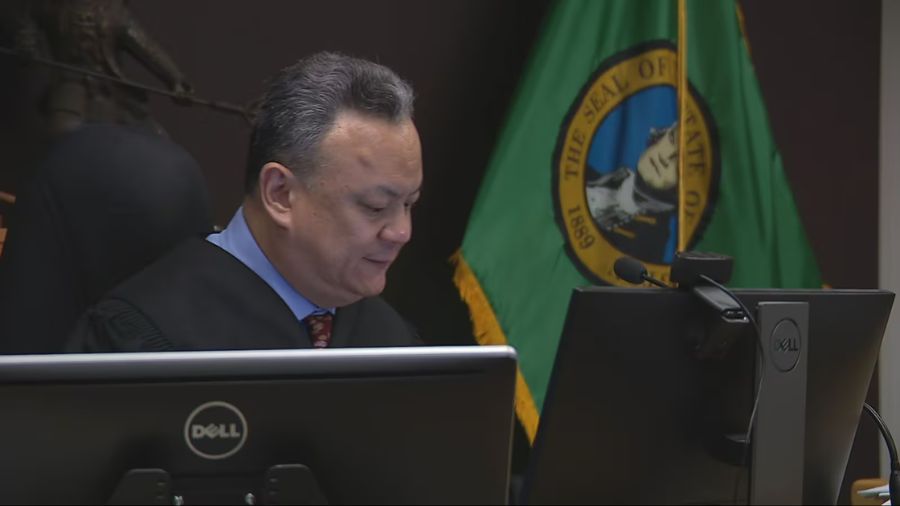
In response, the IAM filed an unfair labor practices complaint through the National Labor Relations Board to acquire the work, a complaint that, in March of this year, ultimately went in the machinists’ favor, with NLRB judge Michael Rosas finding of “ILWU’s failure to establish a union-wide level of skills and training; and IAM mechanics had more experience handling Terminal 5’s cranes,” according to the NLRB board ruling.
The ILWU has referenced the NLRB ruling in favor of the machinists union as a flashpoint as negotiations commence this week and last into the summer.
“The situation at T5 with SSA is about them not fulfilling their side of the contractual agreement when it comes to the assignment of work to ILWU,” Cam Williams, ILWU Coast Committeeman, wrote to MyNorthwest, referencing an interview with the Journal of Commerce.
“By SSA not holding up their end of the agreement and the PMA not reinforcing it, it is our view [as well as an independent arbitrator’s] that the section of the contract related to automation is being violated, which raises a question of its current viability.”
That sentiment was echoed in an ILWU open letter, with the caveat it explicitly calls out media interest in showcasing conflict, affirming the union’s interest in good-faith negotiations.
“While the pandemic has underscored the significance of our ports to our economy and our day-to-day lives, it has also shined a light on the shadows of how our ports operate – exposing the fact that while the land on which they sit may be owned by the taxpaying public, a vast majority of our port terminals are leased out to the same foreign-owned billion-dollar shipping companies that gouged American businesses by charging them ten times the usual shipping rates and have contributed toward the rise in inflation,” wrote Willie Adams, International President of ILWU.
“Some of these shipping companies are also attempting to automate the U.S. terminals they lease – using robots instead of American workers to operate the heavy equipment that moves cargo.”
“Soon the ILWU will be sitting down with these foreign-owned companies to negotiate its contract. While there has been much speculation in the media as to what these talks will mean to our economy with some headlines expressing an apparent hope of conflict to capture their audience’s attention, I can tell you that the men and women of the ILWU are looking forward to the opportunity to meet with the employers and seek a contract that honors, respects, and protects good American jobs and U.S. importers and exporters.”
Push to expand automation leaves behind the Port of Seattle
The Port of Seattle has fallen behind other West Coast ports, with no current automated or semi-automated terminals.
The TraPac terminal in the Port of Los Angeles semiautomated in 2016. The Long Beach Container Terminal fully automated its terminal in 2017. In 2019, the Maersk Terminal began the transition of automating its machinery and equipment in the Port of Long Beach. Recently, Total Terminals, Inc. announced that it would be fully automating its terminal at the Port of Long Beach.
“Although ports have adopted automation more slowly than comparable sectors, notably mining and warehousing, the pace is now starting to accelerate,” a 2018 report on the state of port automation, conducted by McKinsey, concludes.
“Successful automated ports show that careful planning and management can surmount these difficulties [of high upfront capital costs associated with automation]: operating expenses could [f]all by 25 to 55 percent and productivity could rise by 10 to 35 percent,” the report continues.
“And in the long run, these investments will lead the way toward a new paradigm–call it Port 4.0–the shift from asset operator to service orchestrator, part of a larger transition to Industry.”
In April, the PMA released the results of a commissioned study — led by Dr. Michael Nacht, a Professor of Public Policy at the University of California, Berkeley and former Assistant U.S. Secretary of Defense — that highlights greater opportunities for employment at automated ports with higher volume capacity.
“Automation is offering early proof of a win-win strategy: work gains for ILWU members and productivity and efficiency gains that will drive up growth, drive down cargo-handling costs,” write the co-authors.
“Failing to adapt threatens to drive cargo to other ports, with a cascading loss of jobs on the docks and throughout the regional economy.”
The ILWU views the study as “posturing” for the PMA to push for subsequent automation of West Coast ports through upcoming contract talks with the longshoremen union.
“It’s obvious that the PMA is issuing its report as posturing as we go into negotiations … The bottom line is that automation has killed jobs at the ports,” Frank Ponce De Leon, ILWU Coast Committeeman, wrote to MyNorthwest.
“With regard to claims of higher efficiency, we’ve seen more container volume, not more speed at the automated ports. This shift is due to shipping alliances diverting more cargo to automated terminals, leaving unused capacity at other terminals during a time when the ports have been congested and need every terminal to be as productive as possible.”
Follow @http://www.twitter.com/daltonjday