New ratings reveal huge price gaps: Where to save the most on groceries in western WA
Dec 8, 2025, 3:55 PM | Updated: 5:53 pm
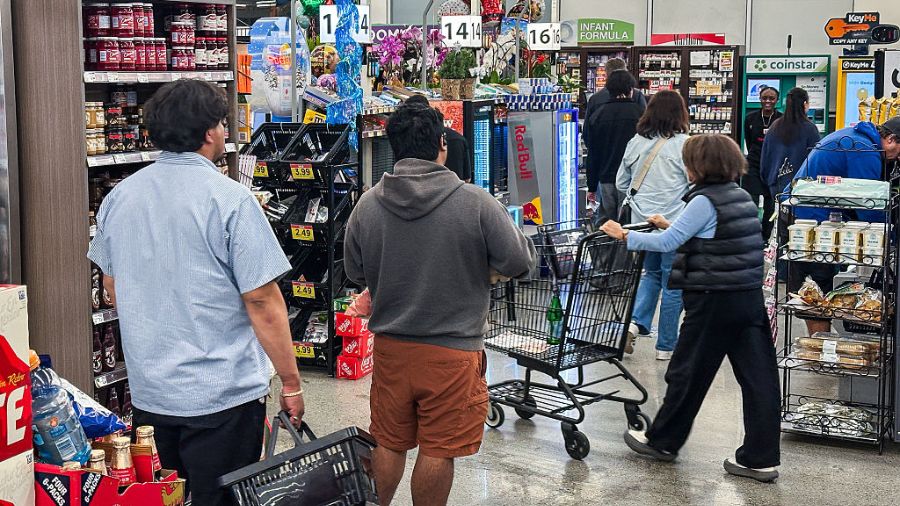
People shop in a grocery store on November 26, 2025. (Photo: Apu Gomes, Getty Images)
(Photo: Apu Gomes, Getty Images)
Grocery shopping in the Puget Sound area just got easier.
A comprehensive new survey from Consumers’ Checkbook compared prices and quality at nearly 20 grocery chains, revealing that where you shop can make a difference of hundreds of dollars per month.
Where does your store rank?
With inflation pushing grocery bills higher each month, the difference between shopping at WinCo versus QFC could mean an extra $300 or more in your pocket annually on a typical family’s grocery budget.
Western Washington shoppers enjoy an unusual advantage: an abundance of grocery store options, from budget-focused chains to premium markets. But with so many choices, how do you know which store offers the best value for your needs?
Consumers’ Checkbook, a nonprofit consumer organization, surveyed supermarket prices and quality across the region to answer that question. Executive Director Kevin Brasler shared the findings with “Seattle’s Morning News” on KIRO Newsradio, and the results show dramatic differences between stores.
“We found really big price differences from store to store,” Brasler said. “I’ve been doing this for 30 years, and I’m always surprised at these big price differences because the margins for grocery stores are really small.”
How the survey measured grocery prices
Checkbook’s researchers shopped stores using a market basket of 150 common items, including national brand products, fresh produce, meat, and dairy.
“It’s made up of common national brands and non-perishables. We also shop them for fresh produce prices, fresh meat prices, and dairy prices,” Brasler explained.
The pricing methodology mirrors the categories used in the Consumer Price Index, weighted to reflect typical shopping patterns. The organization also surveyed thousands of local shoppers about their experiences, collecting ratings on produce quality, meat quality, customer service, checkout speed, and overall satisfaction.
The lowest prices: Where budget shoppers win big
“WinCo had the lowest prices. It beat everyone, and its prices are nearly 30% lower than what you’d find at Albertsons, Safeway, or QFC,” Brasler said. “So there are big savings to be had just based on which grocery store you frequent.”
Breaking down the numbers further, WinCo’s produce prices came in 37% lower than average, while meat prices were 22% below typical rates. Overall, WinCo shoppers pay 24% less than average.
Other strong performers for price-conscious shoppers included Grocery Outlet at 21% below average.
Brasler described it as “kind of like this weird cobbling together of overstocks, you never know what you’re going to get there.”
Amazon Fresh came in at 19% below average, and Walmart matched that discount.
Perhaps most surprising: Fred Meyer and QFC are owned by the same parent company, Kroger, yet shoppers rate them differently and pay different prices. Fred Meyer came in 16% below average while QFC was 3% above average, despite sharing corporate ownership.
What about Costco membership savings?
The warehouse club dilemma has sparked countless debates among Seattle-area shoppers: Does that $60 annual membership pay for itself, or are you better off hitting WinCo or Walmart without the commitment?
Brasler explained that the math is more complicated than it appears.
“Costco’s prices were very, very low” on a per-unit basis, he confirmed. “Prices at Costco were even lower than WinCo’s, but not low enough where you’d really save money if you don’t go often enough, because you have to pay its annual fee.”
He added another consideration: “If you’re buying stuff at Costco and it goes bad before you can eat through it, then you’re also not saving a lot of money.”
Premium pricing: What you pay at high-end grocery stores
At the opposite end of the spectrum, Metropolitan Market charged prices 29% above average. Town & Country Market and Haggen also commanded premium pricing, coming in 19% and 16% above average, respectively.
The survey results may challenge some long-held assumptions about grocery shopping. Whole Foods, often perceived as the most expensive option, actually came in cheaper than Metropolitan Market, Town & Country, and even Haggen, with prices just 5% above average. And Grocery Outlet, despite its bargain reputation, earned just 19% for produce quality, lower than WinCo’s 44%.
Traditional chains like Albertsons, Safeway, and QFC fell in the middle, with prices ranging from 3% to 5% above average. These stores cost significantly more than discount options while not delivering substantially better quality ratings.
The quality trade-off shoppers face
Brasler delivered both good news and bad news about shopping options in the region.
“The good news is there’s lots of low-cost options in the Puget Sound area. It makes us unique, really. In a lot of other markets, there aren’t many low-cost options,” he said. “The bad news is, if you want to save money, you’re going to have to forsake quality, because the highest-rated stores are places like PCC, Metropolitan Market, these local chains that do really well for quality but unfortunately charge far higher prices than those low-cost options.”
The survey confirmed this pattern. PCC Community Markets and Town & Country Market earned the highest overall quality ratings at 94% to 95%, with particularly strong marks for produce. Metropolitan Market, Thriftway, and Central Co-op rounded out the top tier.
Big chains disappointing on quality ratings
Brasler had particularly harsh words for conventional supermarket chains.
“These big conventional chains perform dreadfully for quality. None of them got very good ratings for quality. Neither did Target,” he said.
His advice for shoppers at these stores? “If you’re used to shopping at QFC or Safeway or Albertsons, you should consider changing your business to some other store, because you’re not going to give up much in terms of quality of produce and these other things people really care about to go to one of these lower-priced stores.”
He pointed out that while budget options like Walmart and Amazon Fresh didn’t rate particularly well for quality either, “neither did the other big conventional stores. And the other big conventional stores are a lot more expensive.”
Customer service: Where shoppers feel valued
Beyond price and quality, the survey measured customer experience across western Washington grocery stores. Trader Joe’s dominated the customer service category with a 97% rating for staff helpfulness and pleasantness. Thriftway, Town & Country, and PCC also excelled in this area.
Checkout speed varied dramatically. Amazon Fresh led with 86% satisfaction, while traditional stores struggled. WinCo scored just 29% for checkout speed, reflecting its no-frills approach to keeping prices low.
RELATED STORIES


Complete grocery store ratings available
Consumers’ Checkbook has made the complete supermarket ratings available to KIRO Newsradio listeners here. The link provides detailed comparisons of prices, quality ratings, and customer service scores across all surveyed stores in the Puget Sound area.
Charlie Harger is the host of “Seattle’s Morning News” on KIRO Newsradio. You can read more of his stories and commentaries here. Follow Charlie on X and email him here.
Follow @https://twitter.com/kirocharlie