Harger: North Beacon Hill park is worse after city sweep as fentanyl is smoked openly
Apr 2, 2026, 8:02 AM | Updated: 5:25 pm


Kevin has lived on Beacon Hill for more than 20 years. He emailed me after a recent commentary and asked me to come see what had happened to his neighborhood. What he didn’t know is that I’d already been there three times before he reached out. It was bad then. But Kevin was right. It’s gotten so much worse, so quickly. Last week was my fourth visit in five months.
It keeps getting worse.
Four North Beacon Hill parks completely unusable: Dr. Jose Rizal, Lewis, Sturgus, and Daejeon
At the north end of Beacon Hill, four interconnected parks sit adjacent to Pacific Medical Center, the stunning Art Deco building that once served as Amazon’s first headquarters. Dr. Jose Rizal Park. Lewis Park. Sturgus Park. Daejeon Park.
The picnic shelter at Rizal, where families once came to barbecue and take in one of the most breathtaking views in the city, had to be torn down since my last visit. It was beyond saving. The pagoda at Daejeon Park, a gift from the city of Daejeon, South Korea, is heading in the same direction. Someone is living in it now.
“That was a gift from Korea to the city,” Kevin told me. He said it the way you say something that still stuns you even after you’ve had time to process it.
But the city is building all-gender restrooms nearby, so progress.
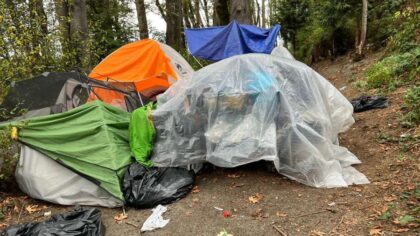
Last week, in the middle of a Wednesday afternoon, I walked past groups of men smoking fentanyl in an open city park. Not hidden. Not at the edge of the tree line. Right on the path. I walked through the smoke. Foil everywhere. Human waste on walking paths. Dozens of tents, maybe more. A woman screaming in what sounded like full psychosis. An open campfire. Dozens of men glaring at anyone who didn’t belong. The people who live in the homes here, most definitely, don’t belong.
People with houses on the north side of Lewis Park have had their porches defecated on. When they’ve asked people to clear their driveways, they’ve been threatened.
“We know where you live,” one resident was told.
Kevin described a neighborhood where some people don’t want to leave their homes. Where families stopped going to the parks months ago. Where the fire department has been called dozens of times because people are literally lighting fires in the middle of the night.
“You can walk along here at night and see fires,” Kevin told me. “You can even smell one right now.”
He was right. I could.
RELATED STORIES

Seattle’s North Beacon Hill fentanyl crisis: this is a drug problem masquerading as a homeless problem
Kevin put it plainly. Call it what it is. This is an open-air drug scene.
He’s been saying this for a long time. He told me about a conversation he had 15 years ago with someone from the Union Gospel Mission.
“He said our homeless problem is really a drug problem masquerading as a homeless problem,” Kevin recalled. “And I don’t think what we see here is just people who can’t afford a place to live. They need treatment.”
Kevin knows something about that. He went through treatment himself when he was young. He has friends who did too. He’s not speaking from a place of judgment. He’s speaking from a place of experience.
“If you watch them day in and day out, you see them hunched over,” he said. “They don’t want to live like this.”
Open drug sales in North Beacon Hill parks, in the middle of a Wednesday afternoon
Kevin watches the cars pull up. People walk into the park, stay a few minutes, and walk back out. Drug sales in the open, in the middle of a Wednesday afternoon, with no apparent concern about who’s watching. When you concentrate addiction in one place, tolerate it, and remove all consequences for using in public, you don’t stabilize anything. You make it worse. Dealers operate with no fear. Supply stays cheap and constant. The scene becomes a magnet, pulling in more users, more dealers, more chaos. People choose tents in these parks over shelters because the parks allow them to keep using.
“By the time you build enough housing for all the people who need it, we’re looking 30 to 40 years down the road,” he said. “They need to come up with some program to get people into detox, get them on their feet, and get them living their lives again.”
The city swept Lewis Park in November. It is now worse than before they touched it
When I asked whether he ever sees anyone from the city, county, or state coming through to offer treatment or detox, he didn’t hesitate.
“I’ve never seen it,” Kevin said. “I’ve never even heard about it.”
The city does show up occasionally. They’ll hand out supplies. They’ll clean up a mess. When I first visited in November, signs were posted on the east side of Lewis Park that the camp would be swept and cleared out. And the city did sweep it. Workers came through, tents came down, and the park was cleaned up.
It is now worse than it was before they touched it.
Seattle’s harm reduction model at Lewis Park: treatment is available, but only if you ask
To be fair, treatment and detox are technically available. But only if the person in full-blown fentanyl addiction asks for them first. That’s the harm reduction model as practiced here: don’t push, don’t pressure, don’t do anything that might hurt the feelings of someone who is actively dying. Wait for them to raise their hand. Under that framework, nobody comes through Lewis Park and says, “We can get you into detox today.” Nobody makes the offer. The city waits to be asked by people who, by definition, are not in a condition to ask. And so nobody does. And the supplies keep getting handed out. And the tents come back bigger each time.
Cities that have actually broken up open drug scenes, in Europe and elsewhere, did it through enforcement, relocation, and access to mandatory treatment. They made it harder to stay sick in public. We are doing the opposite.
Nobody is listening.
North Beacon Hill residents emailed the city, the mayor, and their council member. They got nothing back
Kevin has emailed his council member four times. No response. He’s contacted the mayor’s office. No response. Others in his neighborhood group have done the same.
“It’s just crickets,” he told me. “We don’t hear anything, we don’t see anybody show up to do anything. We’re kind of at a loss. We feel helpless and hopeless. It’s like we just have to live with this chaos.”
Twenty years in a neighborhood. Watching it deteriorate in real time. Doing everything you’re supposed to do: writing letters, attending meetings, emailing elected officials. Getting nothing back. Kevin eventually emailed a radio host because he’d run out of other options.
That’s where we are.
We get what we tolerate. North Beacon Hill is paying the price
The people paying the price for our collective tolerance are Kevin and his neighbors. The families who can’t use those parks. The kids who can’t play in them. And the people dying in them. All of them are casualties of a policy that decided managing the problem was good enough.
A picnic shelter torn down. A Korean pagoda on its way out. Four parks that belong to everyone, usable by no one.
I asked Kevin what he’d say to people who live in neighborhoods where this hasn’t happened yet. People sitting on the sidelines who haven’t given it much thought.
He thought for a second.
“The scariest thing you can hear somebody say in Seattle is, ‘We’re going to build a park by you,'” Kevin answered. “Because this is what it turns into.”
Charlie Harger is the host of “Seattle’s Morning News” on KIRO Newsradio. You can read more of his stories and commentaries here. Follow Charlie on X and email him here.
Follow @https://twitter.com/kirocharlie